Circle City Repipe replaces cast iron drain, waste and vent stacks inside Indianapolis houses, doubles and small buildings, and in nearby communities across Marion and the surrounding counties. Cast iron stack replacement takes out the vertical drain pipe and the branch drains that feed it, from the roof vent down to the base of the stack, and replaces them, usually in PVC, under a plumbing permit where one applies. The work is carried out by licensed and insured contractors. It stops at the foundation: the building sewer outside the foundation, running under the yard to the street, is not part of this service.
The stack is the backbone of the drain system. Every toilet, tub and sink drains into it, and its top runs up through the roof as a vent. In a prewar house it is often cast iron with hub-and-spigot joints packed with oakum and lead, and after the better part of a century some of those stacks are cracking or rusting through. When that happens, and especially when the walls are opening anyway for a supply repipe, replacing the stack once is cheaper than patching it repeatedly.
Supply repiping and drain replacement are different jobs
A house has two water systems in the same walls, and they work in opposite ways. The supply system carries clean drinking water in under pressure, in pipe usually half an inch to an inch across, and because it is pressurized it can run in any direction. The drain, waste and vent system carries used water out by gravity, in pipe three or four inches across for the stack, so every horizontal drain has to slope downhill toward it. The vent part lets air into the system so draining water does not siphon the water out of the fixture traps, which is what keeps sewer gas out of the house.
That difference sets everything else. A whole-house repipe replaces the supply and is tested by holding it under pressure. A stack replacement replaces the drain and vent and is tested by filling the new drain with water or putting it under an air test. A repipe does not touch the drains, and this service does not replace the supply. The complete guide to repiping explains the supply side in depth. In older houses the two often fail around the same time, and they share the same chases and walls, which is why the work is often planned together.
What happens on the first visit
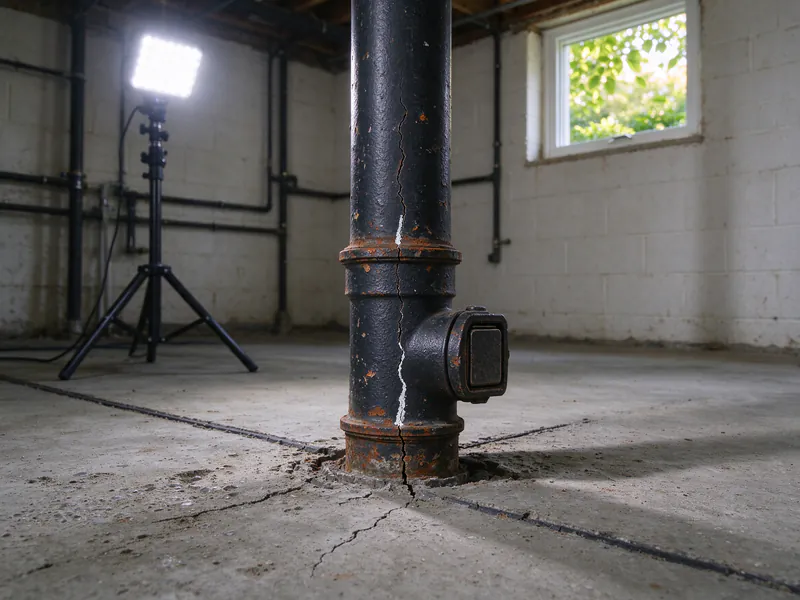
The visit starts at the base of the stack, usually in the basement where it turns into the building drain, and follows it up as far as it can be seen. The base and the first horizontal runs take the most wear, so they get the closest look. Rust weeping, a crack running along the length of the pipe, wet or crusty hub joints and a stain on the ceiling under a bathroom all point to a failing stack. So can sewer odor near the pipe. Slow drains at several fixtures can mean scale has narrowed the inside, but they can also be a clog or a venting problem, so they are a clue rather than proof.
Then the stack is mapped floor by floor: where it passes through each floor, which fixtures tie into it, where the cleanouts are and where it leaves through the roof. Each floor’s finish matters. Plaster, tile walls and built-in cabinets around the stack all add work. The visit also looks at the supply pipe beside it. If the house still has galvanized supply that is scaling shut, planning both jobs together saves a second round of openings, and the galvanized pipe replacement page explains that side.
Why cast iron drains fail
Cast iron corrodes from the inside. Water and waste sit along the bottom of horizontal runs, so the bottom of the pipe thins first, and a pipe can rot through along its underside while the top looks sound. Vertical sections tend to crack lengthwise. Scale builds up inside and narrows the bore. The old hub joints, packed with oakum and sealed with poured lead, can loosen as the house moves and the pipe ages, and they start to weep. Later houses used no-hub cast iron joined with couplings, which fail in different places but age in the same way.
Indianapolis has plenty of houses from the cast iron era. Census figures show about 16% of the city’s homes were built in 1939 or earlier and about a third before 1960, and older neighborhoods with historic districts, such as Irvington, Fountain Square and the Old Northside, have many houses from that era. That is context, not a diagnosis. A stack of that age may be failing or may have decades left, and only looking at it settles which.
Repair, partial or full stack
A single cracked section or leaking hub can often be repaired: the bad piece is cut out and replaced with a short length of PVC or cast iron joined with shielded couplings. That fits a leak with sound pipe around it. Where the rot is concentrated low, replacing the stack from its base up through the first floor, with the branch drains there, removes the worst of it without opening the upper floors. Where there are cracks or leaks on several floors, or the walls are already open for a repipe, the full stack from roof to base is usually the better job. The scope should name where the new pipe stops and what cast iron stays.
How a stack is replaced
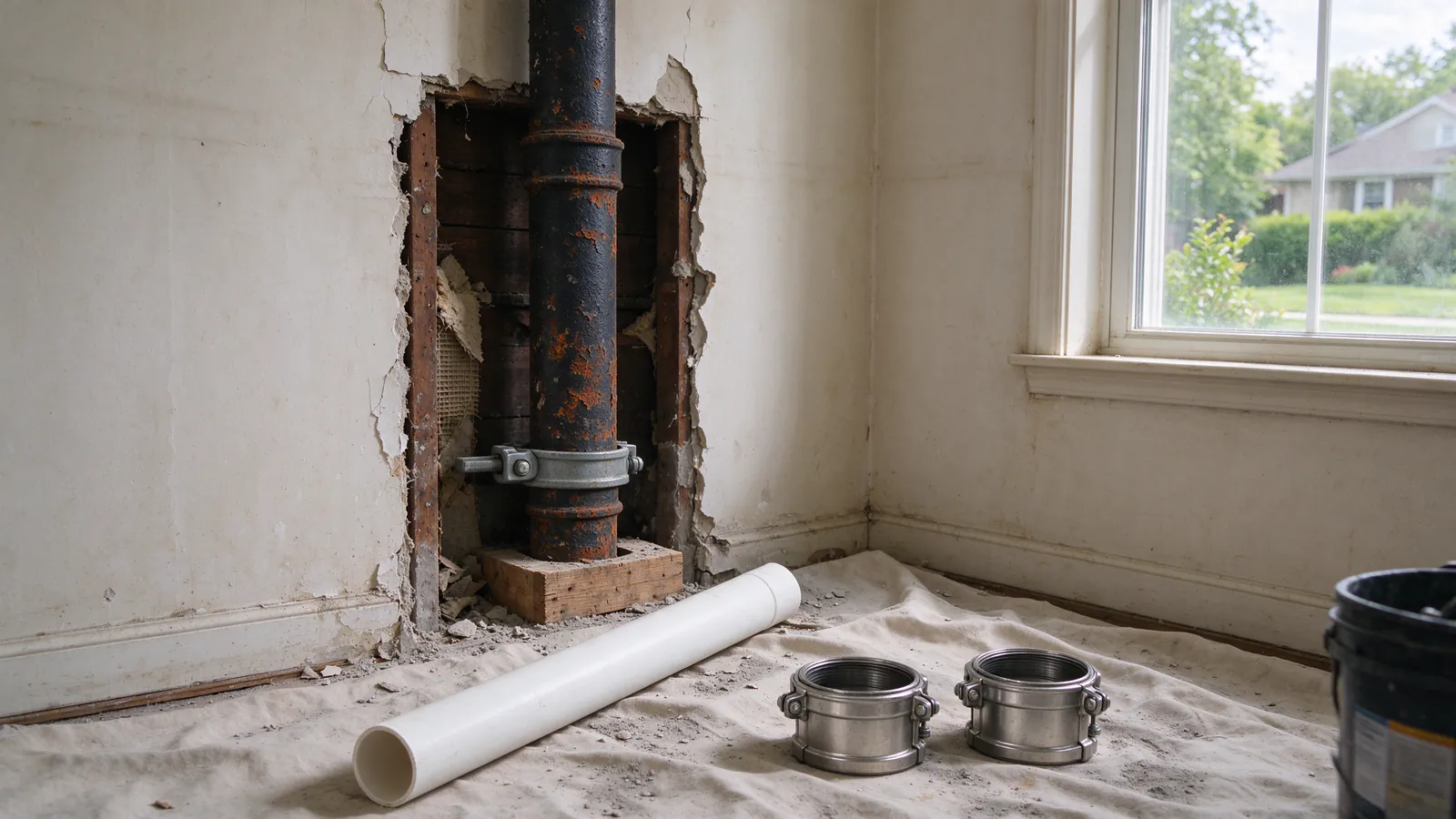
Cast iron is heavy, so the first step is support. The pipe above and below each planned cut is clamped with riser clamps and supported at each floor, so nothing drops when it is cut free. The old stack is then cut out in sections and removed, and the old lead joints are handled and disposed of with the rest of the pipe. The new stack goes in from the bottom up, with fittings where each branch drain ties in, and branch drains to the toilets, tubs, sinks and laundry are reconnected. Toilets are pulled and reset, and where the stack is replaced through the roof, the vent gets new flashing.
PVC is the usual replacement because it is light, does not corrode and costs less. Its drawback is noise: water falling through a PVC stack is louder than through cast iron. Wrapping the new stack with insulation helps, and where quiet matters more than cost, no-hub cast iron can be used instead. Neither is right for every house.
While the stack is open, the fixtures that drain into it cannot be used. The work is sequenced so they are out of service for as short a stretch as possible, and a fixture on a separate drain stays usable. Before any wall closes, the new drain is tested and inspected.
Rust weeping from the drain stack?
Get the stack mapped, the scope written down and the openings agreed before anything is cut.
Old-house conditions
Opening walls in an older house brings its own rules. In a home built before 1978, painted plaster and trim may contain lead paint, and EPA’s Renovation, Repair and Painting rule sets lead-safe work practices for contractors who disturb those surfaces. Plaster dust is contained around each opening. These are part of how the work is planned and priced, not surprises found halfway through.
Doing it alongside a repipe
When the supply and the drain are both due, doing them together means one set of openings, one schedule and one round of patching. The drain usually goes in first, because it is larger and has to keep its slope, and the new supply lines, in PEX or copper, are routed around it. Whether both pieces go on one permit or two is confirmed per job. The guide to how invasive repiping is shows what the openings usually look like, and the partial repiping page covers supply work limited to one area. In apartment and small commercial buildings, commercial repiping covers how stacks and risers are phased while the building stays occupied.
Where this service stops
This service covers the drain, waste and vent stack inside the house and the branch drains that feed it, down to where the stack meets the building drain at its base. Drain line buried under a basement floor or slab is assessed separately if it is suspect. The building sewer that runs outside the foundation to the street is a separate job for a sewer contractor and is not offered here. The buried water service line is separate too, and water line replacement covers it. If tree roots, a sagging lateral or a backup at the floor drain point to the sewer, that is the place to start.
Permit and inspection
Inside the City of Indianapolis, the Department of Business and Neighborhood Services requires a plumbing permit for construction on a plumbing system, with exemptions for replacing fixtures, traps, valves and up to 20 percent of the piping in kind. Replacing a stack in a different material, through several floors, goes beyond a small in-kind repair, so a permit is expected; the permit office confirms the requirement for each job. Where a permit applies to an existing home, the City’s fee starts at $153. The City also requires a rough inspection after the new pipe is installed and before it is covered or fixtures are set. The Indianapolis repiping permit guide explains which office covers which address.
What changes the price
Stack replacement has no published local price range, so each job is priced from the house. The drivers are the number of floors the stack passes through, the finishes at each floor such as plaster, tile and cabinets, whether the base ties in at a basement or a slab, how many branch drains are reconnected, the roof vent flashing, the support and clamping of the cast iron that stays, the restoration scope and the permit. The guide to buying a house with old pipes covers how buyers weigh an old stack alongside old supply pipe.