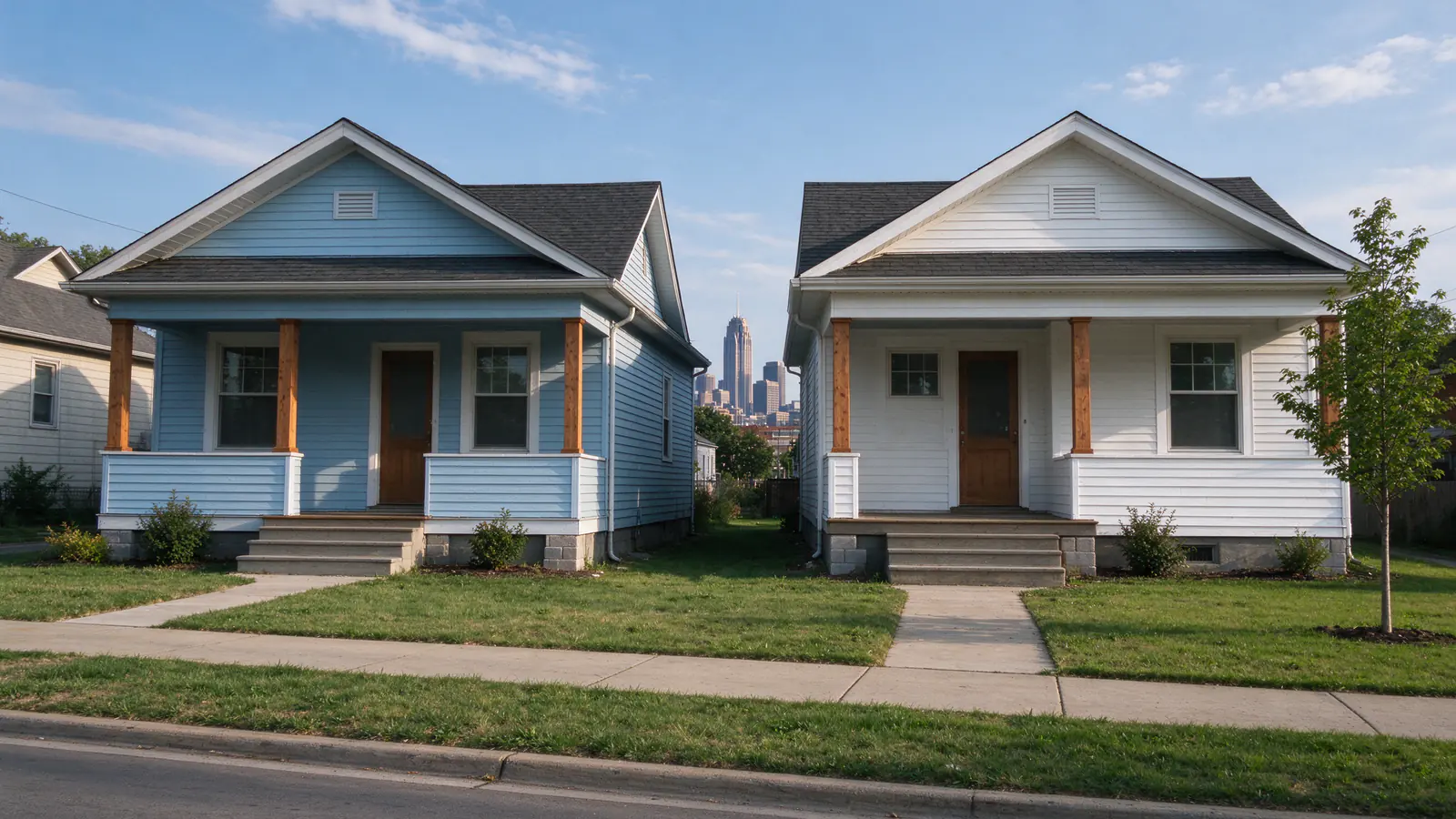
Fountain Square owners tend to ask one question before any other: is the weak water pressure a south side problem, or a problem with this house? Circle City Repipe works through that question in Fountain Square, Fletcher Place and Bates-Hendricks, then replaces whatever the answer points to, from a single partial repipe to galvanized pipe replacement through the whole house. Every job is handled by licensed and insured contractors and permitted by the City of Indianapolis, on a Citizens Energy Group water supply.
The neighborhood or the house?
Hard water is a citywide condition, not a Fountain Square one. Citizens Energy Group reports an average of 19 grains per gallon, ranging up to 27 depending on which treatment plant serves an address. Over decades that mineral load narrows the inside of galvanized steel, and the narrowing is worst in the small branches to individual fixtures. So the neighborhood supplies the water chemistry, and the house supplies the pipe that reacts to it.
Renovated houses add a second possibility. A remodel can replace every visible line and still leave a short length of old or half-inch pipe between the meter and the first branch, and every fixture downstream is limited by that one section. A stuck or partly closed main shutoff does the same thing. The first visit separates these causes by reading static pressure at the meter and flow at the fixtures upstairs and down, hot and cold. A normal reading at the meter with poor flow inside means the problem is in the house. A worn gate valve at the meter gets replaced with the job; the main shutoff valve replacement page explains why. The low water pressure page covers the rest of the diagnosis.
Two Census areas, both mostly prewar
The American Community Survey splits this part of the south side across two Census areas, and both are old. In the smaller area just south of downtown, 51.3% of homes predate 1940, the median build year is 1938 and about three in four homes are single-unit. In the larger area that takes in Fountain Square, 30.1% were built before 1940, another 23.6% between 1940 and 1959, and the median is 1957, with nearly 83% single-unit.
Those numbers describe the stock, not a given house. Galvanized steel was the usual supply pipe in those decades, and Citizens Energy Group links the years before 1950 to lead service lines and lead in household plumbing. Many have been worked on piecemeal since. Whether a house needs a full repipe or only the galvanized that remains is a judgment the repipe vs repair guide sets out, and it depends on what the survey finds rather than on the street.
Pressure still weak after a Fountain Square remodel?
Get the line from the meter traced and measured before more fixtures are replaced.
Cottages, crawlspaces and short runs
Where a house is one story over a crawlspace, a repipe is mostly a below-floor job. The new main runs from the shutoff under the joists, branches feed the kitchen, bath, laundry and water heater, and each fixture gets a short riser into the wall behind it. That keeps openings small and few. Pipe in a crawlspace is supported off the soil, kept clear of the foundation vents and insulated where it runs near an outside wall.
Not every house here fits that pattern. Where a house has a second floor, a finished bath upstairs or a partial basement under one end, the route for the upstairs riser becomes the main decision, and a closet or chase stacked under the bath is usually the first place to look. The written scope names each opening before any wall is cut, and the guide to how long repiping takes shows how a small house is kept on water through most of each day.
Cold is the reason for that care. NOAA’s climate normals for Indianapolis show about 29 days a year when the temperature never rises above freezing, and those are the stretches when a crawlspace with open vents can drop below 32 degrees. A repipe is the time to route lines away from the coldest corners rather than simply replacing them where the old ones ran. A PEX repipe tolerates a freeze better than rigid pipe, but placement still matters more than material.
Historic districts and the commercial streets
Fletcher Place and the Fountain Square Historic Commercial district are both on the Indianapolis Historic Preservation Commission’s boundary map. Under the City’s Building Standards, a permit exemption does not cancel a possible certificate of appropriateness requirement in those areas. Inside the walls a repipe rarely touches anything the Commission reviews; outside, a yard trench for the service line, a new meter pit or a wall penetration on the street side are the items to clear early.
The commercial streets around the fountain at Virginia Avenue, Prospect Street and Shelby Street hold buildings with shops below and homes above. Those are permitted by the Department of Business and Neighborhood Services as commercial plumbing, at $182 for up to 10 fixtures plus $23 for each additional 5, and usually involve shared risers and separate shutoffs for each unit. The commercial repiping page covers how that work is staged.
Service line work and what it leaves inside
When Citizens Energy Group’s lead program reaches a street, it replaces lead or galvanized parts of the line between the main and the house. If that house has its meter in the basement, the new service ends at a meter pit outside instead. The meter pit and service line guide explains that change. Street and service work can loosen scale in old interior pipe, so brown water after work nearby is worth reading about before assuming the worst: brown water from the faucet.
Permit and price on the south side
A single-family repipe here is permitted by the City at $153 for the first 1,000 square feet plus $23 for each further 500, and an inspector sees the rough-in while every opening is still open. The price band is the same as anywhere in the Indianapolis area, $4,000 to $15,000 or more for a whole house, and a compact one-story house generally lands lower in it. The Indianapolis repipe cost guide and the cost estimator show how size, stories and baths move the figure.
Nearby
Beech Grove, to the southeast, is on the same Citizens water but issues its own permits. Irvington and the Old Northside share the City permit office and their own historic districts. All areas are on the service areas page.