Circle City Repipe repairs water supply pipe in Indianapolis houses and in nearby communities across Marion and the surrounding counties, on copper, galvanized steel, PEX and CPVC. Water pipe repair is the pipe work itself: cutting out the part that failed, joining new pipe to sound pipe with fittings that suit both, and testing it before the wall or ceiling closes. The work is carried out by licensed and insured contractors.
Most repairs start with a leak someone has already found, a dripping line in the basement or a joint weeping in an open wall. If all you have is a stain and no idea where it comes from, water leak repair covers finding it first. If a line has split and is spraying, the burst pipe repair page starts with the shutoff. This page is about what happens to the pipe, and what the repair tells you about the rest of the system.
What happens on the first visit
The first question is what the pipe is, because every material repairs differently. A magnet sticks to galvanized steel and not to copper. A light scratch shows copper’s color or the dull grey of steel or lead. Plastic pipe is read by its markings: PEX is printed with its type and standard, and CPVC is a cream or tan rigid pipe with solvent-welded joints. An older house can carry more than one, with galvanized near the original fixtures and copper where a past owner fixed something. The pipe identification guide covers the checks.
The second question is why it failed. Is the leak in the wall of the pipe or at a joint? A joint that leaks in sound pipe points to how it was made. A hole in the pipe wall points to the pipe. Looking at a few feet on either side, how the pipe is supported, and whether the line bangs when a valve closes fast, tells which. Static pressure at a hose bibb shows whether high pressure is part of the story, because it stresses every joint in the house.
The third is access. A basement line on open joists is a different job from a riser buried in plaster between floors. The price is set from those three answers, and the opening, if there is one, is agreed before anyone cuts.
Joint leaks and pipe-wall leaks
A leak at a joint and a leak through the pipe wall look alike from below, but they mean different things. Joints fail from how they were made. A solder joint where the solder never flowed all the way around, a cut that was not reamed and left a burr to disturb the flow, a crimp ring set off square, the wrong fitting for the tubing, or a run with too few hangers that moves every time a valve shuts. Those failures happen regardless of the pipe’s age, and fixing the one joint usually fixes the problem.
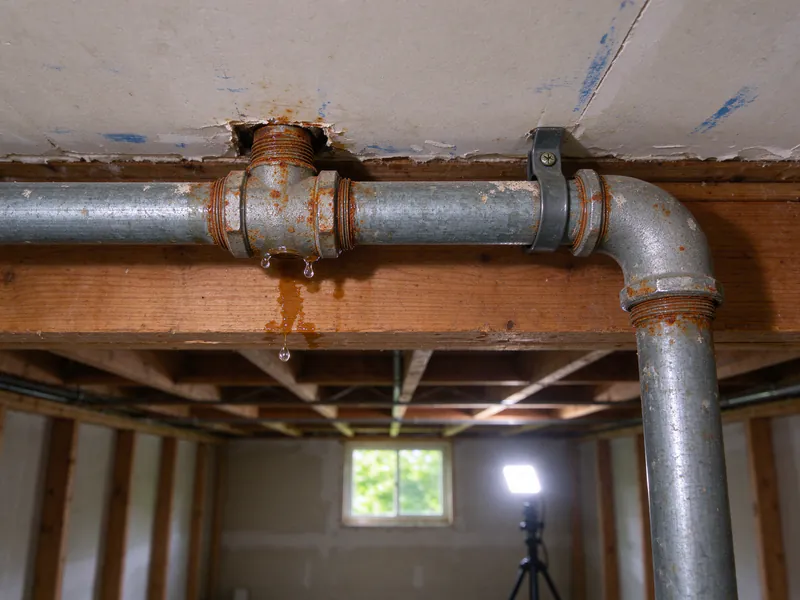
A leak through the pipe wall is different. Copper pinholes start inside the pipe as pitting or erosion and work outward; galvanized steel rusts from the inside until a thread or a thin spot gives way. In both cases the hole is a symptom of the whole length of pipe carrying the same water at the same age. The pipe around one hole may still have years in it, or it may be thin everywhere, and only cutting it open and looking says which. The copper pipe repair page covers copper’s failure modes in detail.
How each material is repaired
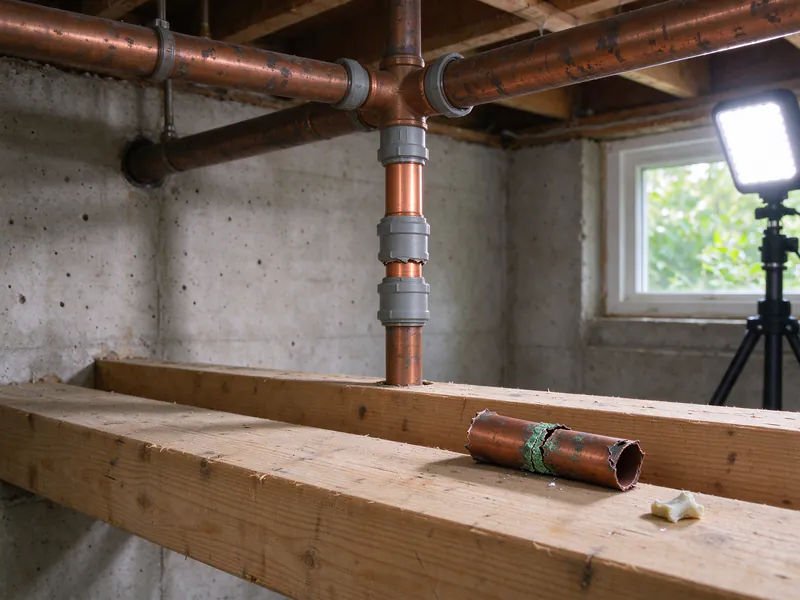
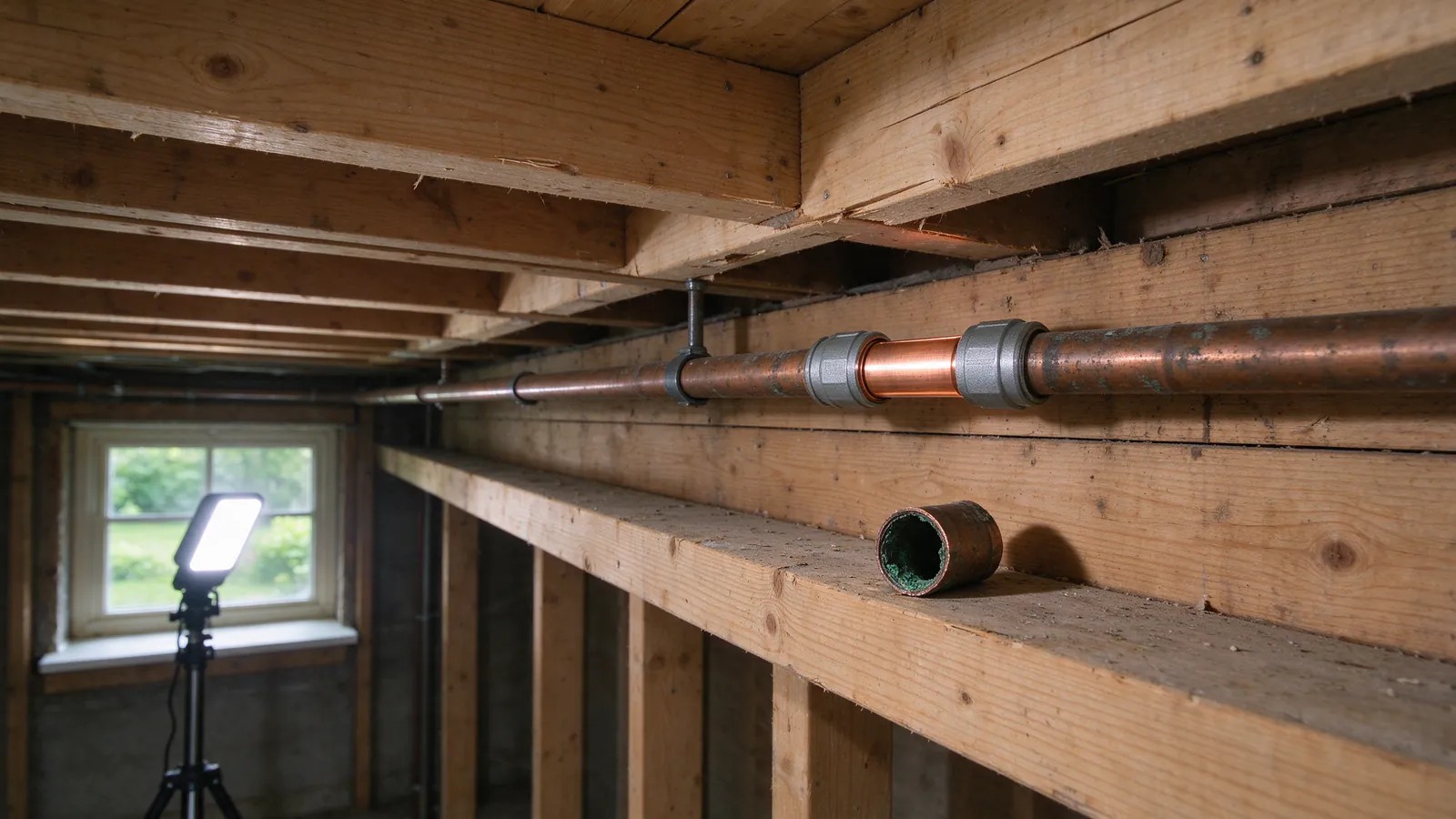
Copper is cut back past the damage and rejoined with a new section, using lead-free solder or press fittings. Press fittings need no flame, which matters next to old framing or in a finished ceiling. Copper is also checked for its wall thickness: thin Type M tube and heavier Type L behave differently once pitting starts, which the Type L vs Type K copper guide explains.
Galvanized steel is the hardest to repair in the middle. Its threads are the thinnest part, and turning an old fitting can snap the pipe beyond it. Repairs usually replace the run from one fitting to the next and join it to copper or PEX with a dielectric or listed transition fitting, because copper screwed straight to steel corrodes at the joint. Galvanized that is scaled inside restricts flow too, and the galvanized pipe replacement page covers when it is time to stop repairing it.
PEX is repaired with a coupling and new crimp, clamp or expansion fittings matched to the tubing type. PEX itself rarely leaks through its wall, so a PEX leak is usually a fitting, a kink, a nail, or tubing left in sunlight before it was installed.
CPVC grows brittle with age and heat, and it tends to crack near fittings when it is bent or stressed. Repairs cut back to pipe that has not cracked and use new solvent-welded fittings; where the old pipe shatters when it is cut, the repair has to go further than planned, and that is said before it starts.
One leak, or the first of several?
Find out what failed and why before deciding. The repair is priced on the pipe, the access and the opening.
Access, sections and restoration
A repair is only as small as its access allows. In a basement or crawlspace the pipe is exposed and the job is mostly the pipe. Behind finished drywall or plaster the repair needs an opening, and the size of it depends on how much pipe has to come out to reach sound material. An opening below a bathroom from the ceiling is usually cheaper to close than tile removed from above. Plaster takes more work to patch than drywall, and the patch on this page means closing the opening, ready for finishing. Paint, texture and tile matching are named separately.
Some repairs turn into section replacements once the wall is open. Pipe that looks fine from the outside can be thin or scaled inside, and joining new copper to old copper that is pitting a few inches away only moves the next leak. When a run from one valve to the next is worn throughout, replacing that run is often less work than three spot repairs.
Repair or repipe
A repair is right when the cause is local, one joint, one damaged spot or one nail through a line, and the pipe around it is sound. A repipe starts to make sense when leaks appear in different places on the same kind of pipe, when galvanized is scaled throughout, or when several fixtures are weak at once. The repair or repipe guide goes through the signs, and a partial repipe replaces one zone where only part of the house is failing.
The shutoff matters here too. If the main valve did not hold when the water was turned off for the repair, the main shutoff valve replacement is a small job worth doing while the water is already off.
Permits
Inside the City of Indianapolis, the Department of Business and Neighborhood Services exempts replacement of piping in kind from a plumbing permit, up to 20 percent of all piping in the structure. A typical spot repair falls well inside that. Changing material on a large run, moving a line or replacing enough pipe to pass the limit can need a permit, and the excluded cities and surrounding towns are confirmed per address.
What pipe repair costs
A typical Indianapolis-area range for an accessible spot repair is about $150 to $650. When a wall or ceiling has to be opened and patched to reach the pipe, the range is about $300 to $1,200. The material, the access, the opening and how much pipe turns out to be sound set where a job falls. A leak that still has to be found is priced as water leak repair, and the Indianapolis repipe cost guide compares repairs with partial and whole-house work.