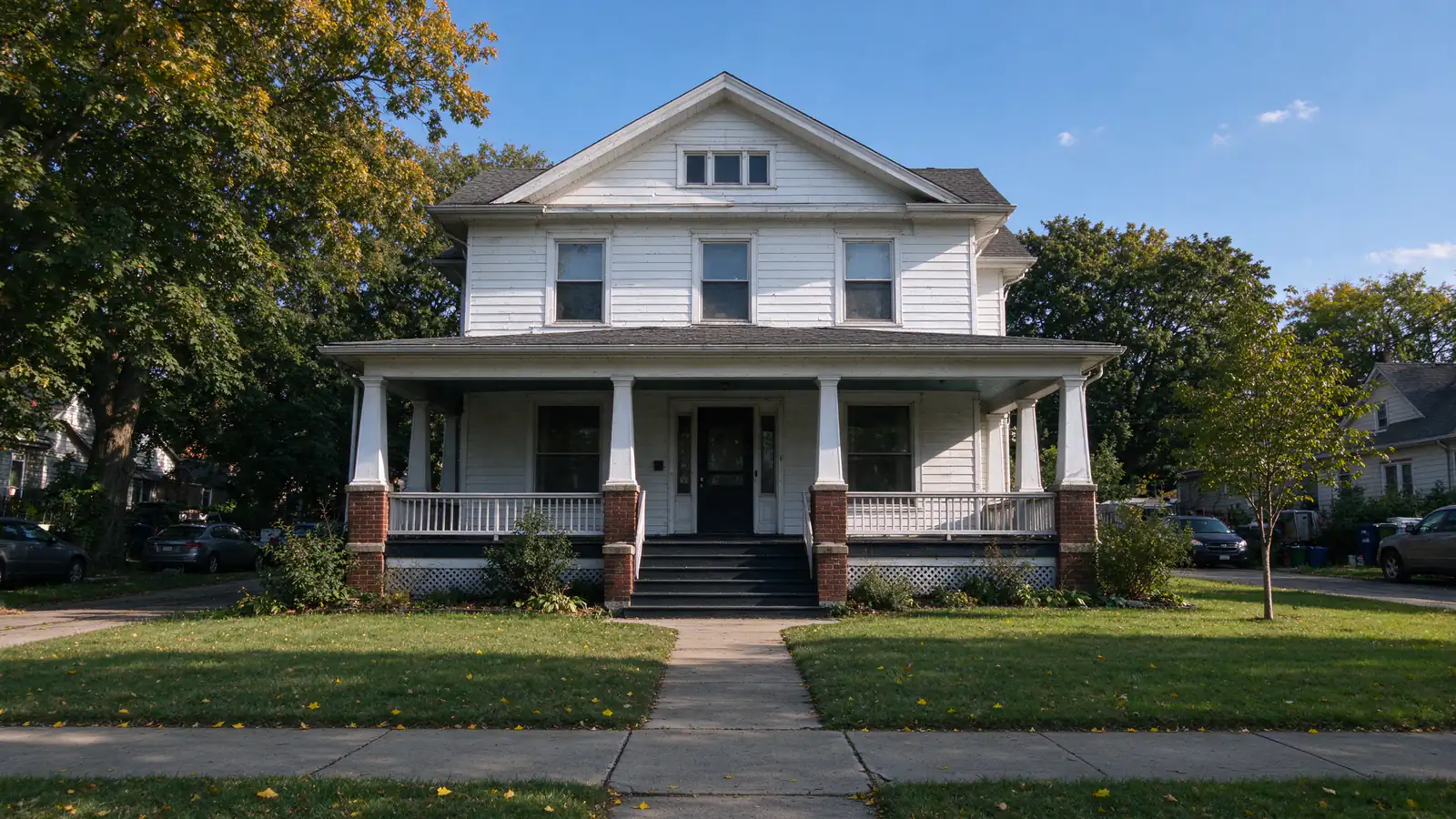
Most of the houses on Irvington’s east side streets were standing long before plastic supply pipe existed. Circle City Repipe replaces water supply piping in Irvington and the surrounding east side of Indianapolis: whole-house and partial repipes in PEX or copper, galvanized pipe replacement, pipe and leak repair, and the service line work that often comes up at the same time. The work is carried out by licensed and insured contractors under a City of Indianapolis plumbing permit.
The decision an Irvington owner faces usually has three parts at once: what the old pipe inside the house is doing, what Citizens Energy Group plans for the buried line outside it, and whether anything about the job touches the outside of a house in a historic district. This page takes those in order.
What the housing record says about Irvington
In the Census area that takes in Irvington and the surrounding east side, 23.7% of homes were built in 1939 or earlier and another 33.4% between 1940 and 1959, according to the Census Bureau’s American Community Survey. The median home there was built in 1957, against 1973 for Indianapolis as a whole. About 71% of homes are single-unit houses. The Census area is larger than the historic district itself, so these shares describe the wider east side rather than the district alone.
Age is context, not a diagnosis. A house built in the 1920s was most likely plumbed in threaded galvanized steel, and Citizens Energy Group notes that lead in service lines and plumbing was common in homes and buildings built before 1950. Many of those houses have been partly redone since, so a single basement can hold galvanized near the original fixtures, copper where a leak was fixed and newer plastic under a remodeled bath. The guide to whether galvanized pipes are safe explains what that mix means for flow and water quality. What a given Irvington house has is found by looking at it, starting at the meter and the main shutoff.
Historic district review and the work outside the walls
Irvington is one of the historic districts administered by the Indianapolis Historic Preservation Commission, on the City’s own preservation boundary map. The City’s Building Standards say that a permit exemption does not remove a possible obligation to obtain a certificate of appropriateness from the Commission in those areas. For a repipe, that matters less for the pipe inside the walls than for the parts of a job that reach the outside of the house.
Those parts are mostly about water service. Replacing the service line means a trench or a bore across the front yard. Citizens requires the meter to move to an outside pit when the service to a house with an inside meter is replaced. A repipe can also add a new wall penetration or relocate a hose bibb on a street-facing wall. Each of these is worth confirming with the Commission before it goes into the schedule, because a review step is easier to plan around than to discover after the trench is open. Interior pipe replacement is confirmed per project rather than assumed either way.
Citizens, the service line and the meter pit
Irvington is served by Citizens Water. The owner owns the full length of the water service line, and Citizens repairs leaks in the portion between the main and the right-of-way line. When the line is replaced in full, Citizens requires SDR9 polyethylene with tracing wire; PEX and PVC are not allowed for it. For a house under 2,000 square feet without irrigation the minimum domestic service is three-quarter inch, and one inch for a larger house or one with irrigation. Every service needs its own tap.
Where the line is lead or galvanized, Citizens’ Lead Service Line Replacement Program replaces it from the main to the home at no direct cost when a prioritized project area is scheduled and the owner signs a Right of Entry agreement. Outside a scheduled area, a qualifying owner can start a replacement: Citizens pays for the right-of-way portion and the owner pays for the private side and the move of the meter to an outside pit, through Citizens’ contractor or a plumber registered and bonded with Citizens. Owners can look up their own address on Citizens’ service line map. The Citizens lead service line program guide and the lead service line replacement page cover how that work and an interior repipe can be sequenced.
Planning around Citizens' line work in Irvington?
Have the inside pipe traced from the meter so the interior scope is ready when the street work is.
How an Irvington repipe usually runs
Where a house has a full basement, that is where the work starts: a new main from the shutoff along the joists, branches to the kitchen, laundry and water heater, and the old main cut out where it can be reached. Where a house sits over a crawlspace, the same runs go below the floor, supported off the soil and kept away from the vents. The harder part in a two-story house is the climb to an upstairs bath. Interior walls in older houses are often plaster on lath, so the routes worth looking for are a closet stacked under the bath, a kitchen chase or the cavity beside the old drain stack. The guide to how invasive repiping is shows what those openings typically involve.
That drain stack deserves a look while the walls are open. In prewar houses it is often cast iron, and if it is cracked or rusting through, replacing it alongside the supply pipe avoids opening the same walls twice. Cast iron stack replacement is scoped and priced as a separate job.
Cold matters in an older frame house. Indianapolis averages more than 100 nights a year at or below freezing, by NOAA’s climate normals, and old supply pipe sometimes runs in or against an outside wall. A repipe is the chance to move those lines to interior walls and heated chases, and to insulate any run that has to stay near the outside. The new pipe does not remove the freeze risk on its own; where it runs does.
Permit, inspection and price
Irvington is inside the Consolidated City of Indianapolis, so the Department of Business and Neighborhood Services issues the plumbing permit. In-kind pipe replacement is exempt only up to 20 percent of the piping in the structure, so a repipe needs a permit. The fee for an existing home is $153 for up to 1,000 square feet plus $23 for each additional 500, and a failed inspection adds $175. The rough-in is inspected before any wall is patched. The Indianapolis repiping permit guide covers who can pull it.
Price follows the house more than the neighborhood. Two stories, plaster, more than one bath and a copper choice all push toward the upper part of the typical Indianapolis-area range of $4,000 to $15,000 or more for a whole-house repipe. The Indianapolis repipe cost guide breaks down what sits inside that number, and the cost estimator gives a planning range without a phone call.
Nearby
Fountain Square also has a large prewar housing stock and the same Citizens service rules. Beech Grove and Lawrence are excluded cities with their own permit offices, so the paperwork differs even where the houses look alike. The service areas page covers the rest of the east side and the wider metro.