Circle City Repipe repairs and reroutes leaking water lines under concrete floors in Indianapolis and in nearby communities across Marion and the surrounding counties. Slab leak repair is a two-part decision: find exactly where the buried line is leaking, then choose between opening the concrete at that spot or abandoning the line and running a new one where it can be reached. The work is carried out by licensed and insured contractors, and the choice between the two is put in writing before any floor is cut.
Not every Indianapolis house has supply lines under a slab. Many have basements or crawlspaces with every pipe exposed overhead. Where a house does sit on a slab, or where part of it does, such as a later addition, an enclosed porch or a converted garage, the lines feeding that area may run under or through the concrete. Those are the lines this page is about. If the leak turns out to be in a wall, a ceiling or the yard, it is a water leak repair or a water line job instead. Water coming up through the floor fast enough to spread is an emergency: close the main and see emergency pipe repair.
What happens on the first visit
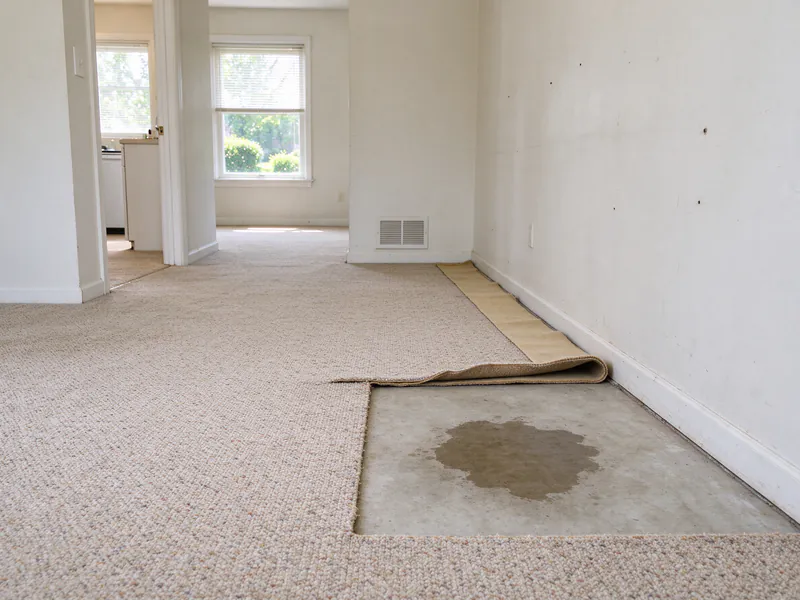
The first visit confirms that the leak is under the slab before anyone talks about concrete. It starts at the meter with every fixture off, then moves to a pressure gauge on a hose connection, then isolates the hot side at the water heater so each side can be tested alone. A drop on one side only tells which line is leaking. Signs from the house help too: a warm patch on the floor points to the hot line, damp carpet along a wall points to water rising at an edge, and a water heater that keeps running points to hot water leaving the system.
Locating follows. Acoustic equipment listens for the leak through the concrete, which works well on copper. Thermal imaging shows the warm bloom of a hot-line leak. Tracer gas finds quiet leaks and plastic lines. The water leak detection page explains each method. The spot is marked on the floor, and the rest of the visit is about what sits above it and where a new line could run instead: the attic, interior walls, closets, a soffit, or the ceiling of a basement under an adjoining part of the house.
Why lines under a slab fail
Supply lines buried in or under concrete live in a hard place. When the slab was poured, the lines were laid in fill and sometimes pressed against gravel, a rebar chair or the edge of a footing. Every time hot water runs, the line expands a little and moves against whatever touches it; when it cools, it moves back. Over years, that rubbing can wear through the wall of a copper line at one spot. Cold lines move less, which is one reason a hot line can be the first to go.
Other causes have nothing to do with the slab. Copper can fail from water chemistry, poor joints made when the house was built, or a kink or dent from the pour. Fittings under the floor are weak points because no one can see them. Ground movement and freeze-thaw near an exterior edge can stress a line where it leaves the concrete. A leak’s cause is a working conclusion from the evidence, not something visible from above. It matters, because a line that failed from wear may fail again a few feet away, while a line damaged once at a single fitting may be sound everywhere else.
Spot repair through the slab
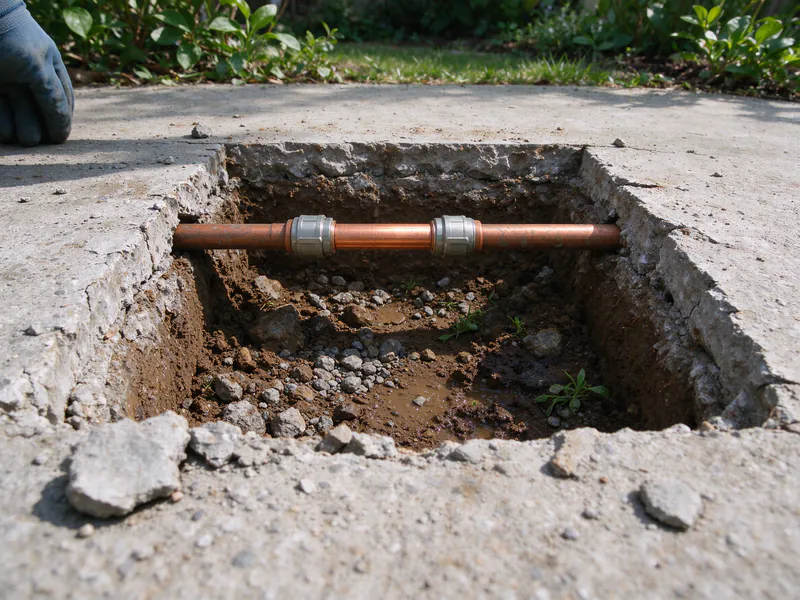
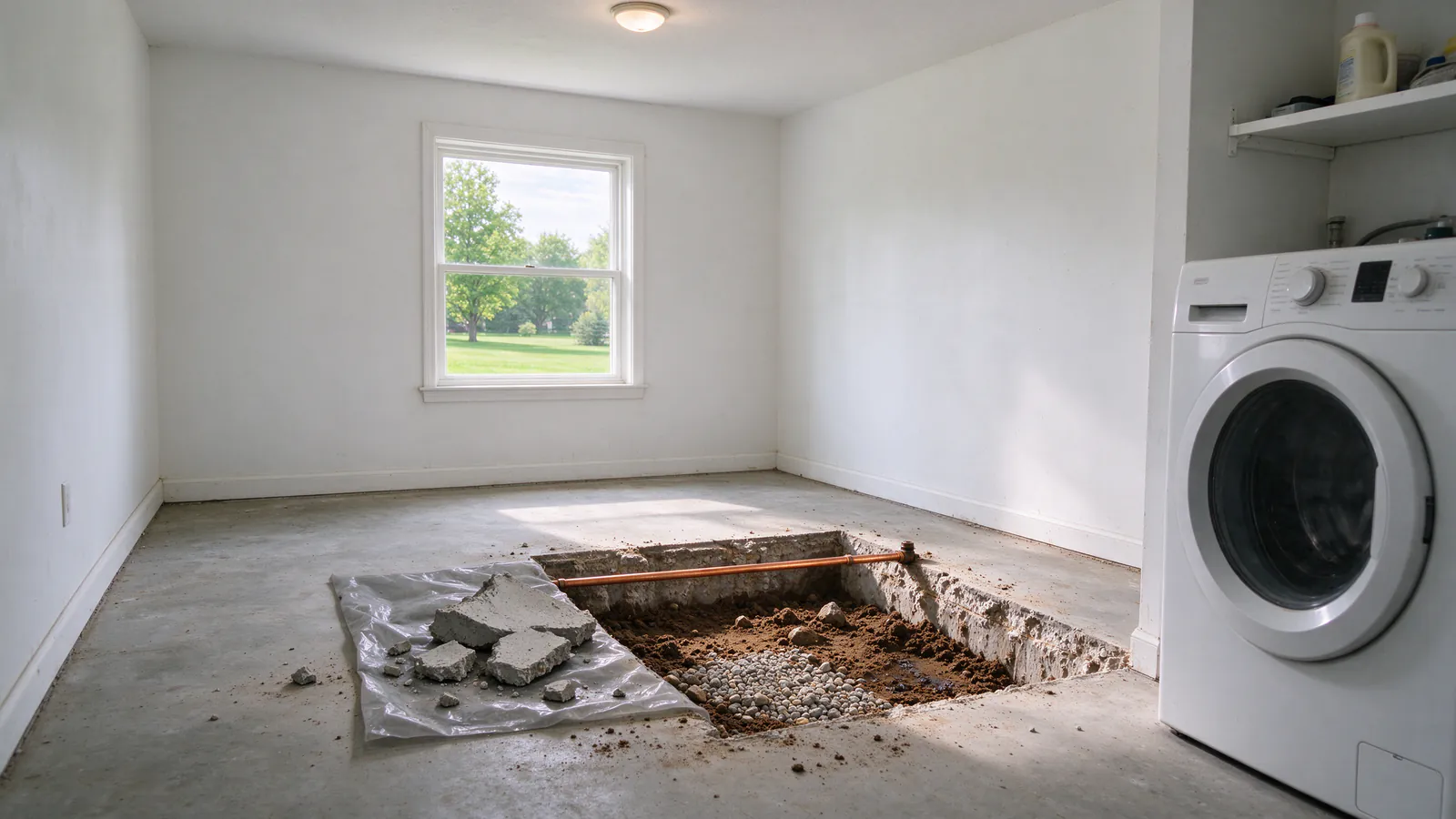
A spot repair opens the concrete at the marked spot, fixes the line and closes the floor again. The floor covering comes up first, whether tile, wood, vinyl or carpet. Then a square opening is cut and broken out, the fill is dug down to the pipe, and the damaged section is cut out and replaced with new pipe and fittings. The repair is pressure tested while it is still exposed, then wrapped or sleeved where it passes through the concrete, backfilled and capped with new concrete. Flooring is a separate restoration step. On copper, the repair itself is the same work described on the copper pipe repair page, done at the bottom of a hole.
The appeal is that it changes only a short length of pipe. The limitation is the same thing. The rest of the buried line is the same age, the same material and in the same conditions as the part that failed. Where the line has no history, the floor above is easy to open and the cause was clearly local, that tradeoff is often reasonable. Where the floor is finished in tile or wood, or the line has leaked before, it often is not.
Rerouting instead of breaking the slab
A reroute leaves the leaking line where it is and takes it out of service. The line is cut and capped where it enters and leaves the slab, and a new line, usually PEX, runs from the nearest exposed point to the fixtures it fed, through the attic, interior walls or ceilings. No concrete is broken. The openings are in drywall or plaster along the new route, and they are planned before work starts rather than found during it. The guide to how invasive repiping is shows what those openings usually look like.
Routing is the skill in a reroute. PEX suits it because it bends around framing and needs few fittings in hidden places; the PEX repiping page covers the material. Attics are the usual path in a single-story slab house, and they need care in central Indiana. Indianapolis averages more than 100 nights a year at or below freezing, by NOAA’s 1991-2020 climate normals, so lines in an attic belong down under the insulation on the warm side, kept away from eaves and gable vents. A new line does not remove freeze exposure; where it runs does.
A reroute can be one line or all of them. Rerouting only the leaking hot line is a smaller job; rerouting both hot and cold, or every line under the slab, is a partial repipe that takes the whole buried system out of service. If the house is also showing leaks or weak flow elsewhere, a whole-house repipe may be the better comparison.
Warm floor or a meter that won't stop?
Get the leak confirmed and located first. Spot repair and reroute are then priced side by side for your house.
Permits, testing and what to expect after
Inside the City of Indianapolis, the Department of Business and Neighborhood Services exempts in-kind pipe replacement only up to 20 percent of the piping in a structure, and requires a rough-in inspection before concealed plumbing is covered. Whether a particular slab repair or reroute needs a permit depends on how much piping it changes, so it is confirmed for each address before work starts; the repiping permit guide explains the rules. Carmel lists under-slab plumbing as its own inspection, made before backfill, so in Carmel the timing of the concrete patch follows the inspection.
Either way, the new or repaired section is pressure tested before anything is closed, then the line is flushed and the meter is checked again with the house shut down to confirm the leak is gone. A slab that has had water under it for months may stay damp for a while after the leak stops; that is drying, not a new leak, and a meter that stays still is the test that matters.
Water damage, the foundation and insurance
Stopping the water is the plumbing job; drying and restoring wet materials is a separate scope. Carpet pad, baseboards and drywall at the edge of the slab may need to be dried or replaced, and flooring removed for a spot repair is restored afterward. A list of who handles each piece belongs in the written scope.
A slab leak that ran a long time can soften or wash out the fill beneath the concrete. If there are new cracks, sloping floors or doors that have started to bind, have a foundation professional look at the structure; that assessment is not part of plumbing work. Insurance is decided by the policy and the adjuster, and the parts of a slab leak are often treated differently. The homeowners insurance and repiping guide covers the questions to ask.
What moves the price of slab leak repair
Slab leak repair is priced by the route, not the leak. For a spot repair, the drivers are the depth of the line, the slab thickness, what flooring sits over the spot and how far the fill has washed out. For a reroute, they are the length of the new line, whether the attic or walls give a clear path, plaster or drywall at the openings, and whether one line or several are being replaced. Locating, the permit where one is needed and floor or wall restoration sit on top of either. The repipe vs repair guide explains when a repeat leak tips the comparison.