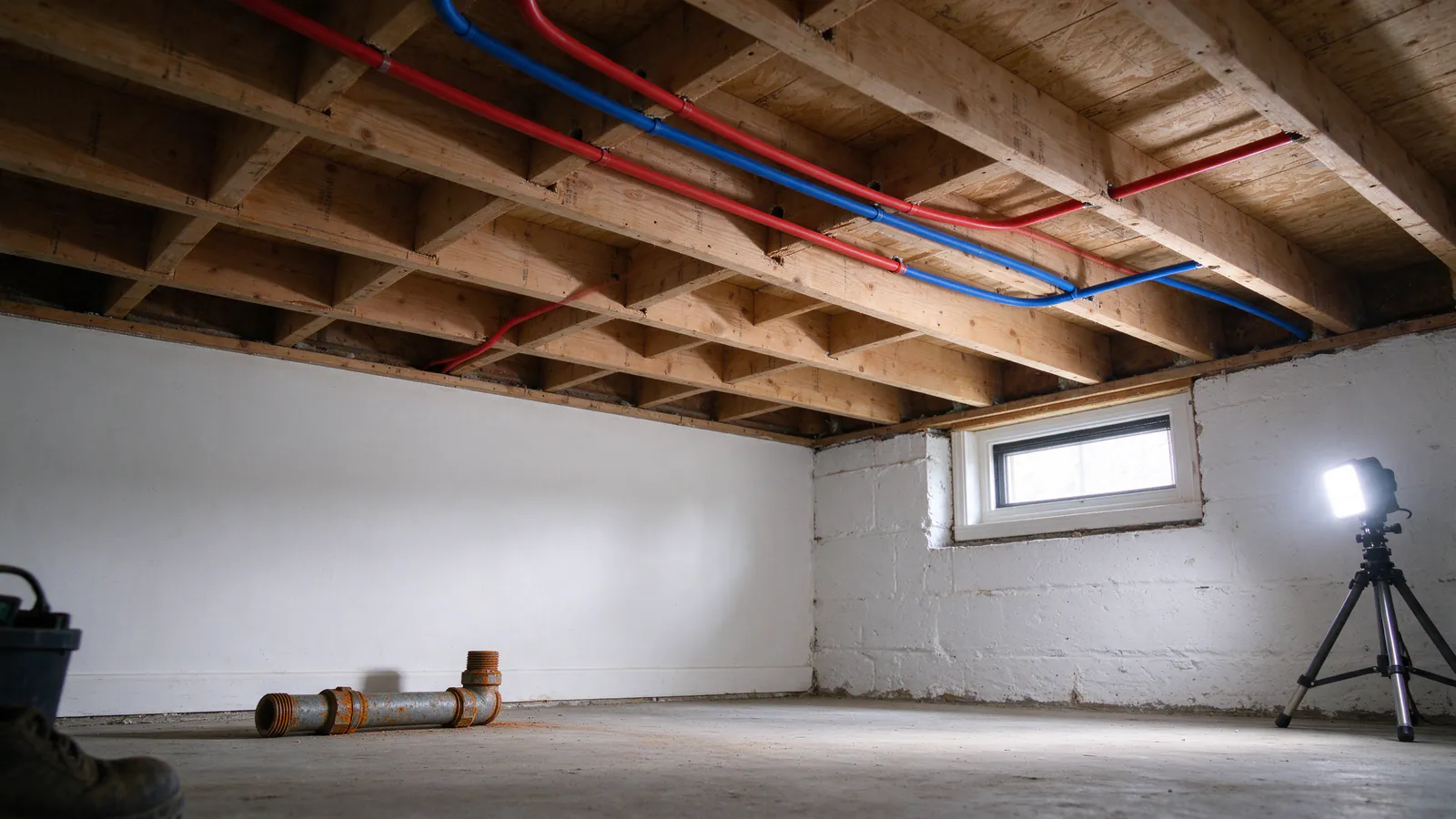
Repiping means replacing the pipes that carry drinking water around a house: the hot and cold supply lines from the main shutoff to every faucet, toilet, shower and appliance. In Indianapolis it usually means taking out galvanized steel or aging copper and putting in PEX or new copper under a plumbing permit, then testing it before the walls close.
Circle City Repipe offers and manages whole-house and partial repipes, pipe repair and service line work across Indianapolis and nearby communities, carried out by licensed and insured contractors. This guide covers the whole subject, from how the system works to what living with a new one is like. For prices, the Indianapolis repipe cost guide has the ranges.
What repiping does and doesn’t include
A house has two separate water systems that are easy to confuse. The supply system brings clean water in under pressure and delivers it to fixtures. The drain, waste and vent system carries used water out by gravity, through larger pipes and a main stack, to the sewer. Repiping, in the trade sense, means the supply side. Replacing a cast iron drain stack is a different job with different pipe, different code sections and a different permit line, even when both happen while the same walls are open. The cast iron stack replacement page covers the drain side.
The other boundary is the service line. That is the buried pipe from the water main in the street to the house. In Citizens Energy Group territory the owner owns the full length of that line, it is replaced under a Citizens permit by a plumber bonded with Citizens, and a full replacement has to be SDR9 polyethylene. A repipe starts where the service line ends, at the main shutoff inside the house. Water line replacement and lead service line replacement are the service-line jobs.
How a house’s supply system works
The supply system is a pressurized network for drinking water, which the trade calls domestic or potable water distribution. Water arrives through the service line, passes the meter and the main shutoff valve, and enters the house as a single cold main. From there it splits. One branch feeds the water heater, and a hot main leaves the heater beside the cold one. Both run through the house to the fixtures, which draw from them when a valve opens.
Because the system is under pressure, it works in any direction. That is why supply pipe can run up walls, across ceilings and through attics, while drains must slope downhill. It is also why a supply leak sprays or drips continuously rather than only when a fixture is used. The pressure that arrives at the house is set by the utility’s system and the service line; the pipe inside the house can only lose some of it to friction and restriction. That distinction explains why a repipe fixes some low-pressure complaints and not others.
Inside the house, the pieces are the mains, the branches that serve each fixture group, the shutoff valves, the water heater connections and the fixture supply lines. A pressure-reducing valve, an expansion tank at the water heater, water hammer arrestors and a recirculation pump may also be part of the system. A repipe can replace some or all of them, and a good scope says which.
Trunk-and-branch vs home-run manifold
There are two basic ways to lay out the pipe. In a trunk-and-branch layout, a larger main runs through the house and smaller branch piping tees off it to each fixture or group of fixtures, the way older houses were built. In a home-run manifold layout, used with PEX, each fixture gets its own line from a central manifold near the water heater, with a shutoff for each line on the manifold panel.
Trunk-and-branch uses less pipe and fewer long runs. A manifold uses more tubing but no concealed fittings between the manifold and the fixture, and it lets one fixture be shut off without touching the rest. Hybrid layouts with small remote manifolds sit in between. The manifold vs trunk-and-branch guide goes into the tradeoffs, including hot-water wait times.
What Indianapolis houses were piped with
Indianapolis was built in layers, and its plumbing follows them. In the city, about 15.7% of homes were built in 1939 or earlier, 17.6% between 1940 and 1959 and 25.9% between 1960 and 1979, according to the Census Bureau’s American Community Survey. In the Census areas covering older neighborhoods on the near east, north and near south sides, the share built before 1960 runs well over half.
Each era has its usual pipe, though any one house can differ:
- Lead. Used for service lines and some early interior plumbing. Citizens Energy Group notes that lead in service lines and plumbing was common in homes and buildings built before 1950, and estimates that about 75,000 homes and businesses built before then in the Indianapolis area may have lead service lines or lead plumbing.
- Galvanized steel. Threaded steel pipe coated in zinc, the standard supply pipe from the early twentieth century into the postwar years.
- Copper. Common from the postwar years on. Citizens notes that some homes built before 1986 may have lead solder in the joints of their copper pipe.
- Polybutylene. A gray flexible plastic used in some houses from the late 1970s into the 1990s. No public source measures how many Indianapolis houses have it.
- CPVC. A rigid cream or tan plastic used for hot and cold water in some houses and repairs.
- PEX. Flexible cross-linked polyethylene tubing, now the most common choice for new work and repipes.
Most older houses have been partly redone, so a single basement can show galvanized near the original fixtures, copper where a past owner fixed a leak and PEX under a remodeled bath. The guide to whether galvanized pipes are safe covers what that mix means.
Why those materials made sense when they went in
Every material that is now being replaced was a reasonable choice in its day. Lead was soft enough to bend around obstacles and resisted the corrosion that ate early iron pipe. Galvanized steel was strong, cheap and easy to thread with hand tools, and its zinc coating protected the steel for years. Copper was lighter, joined with solder instead of threads, resisted scale better than steel and lasted far longer in most water. Polybutylene and CPVC were cheap, quick to install and immune to the rust that ended galvanized pipe. PEX added flexibility, fewer fittings and tolerance of the occasional freeze.
The point is not that earlier plumbers chose badly. It is that each material has a service life and a set of conditions it handles poorly, and many Indianapolis houses are now past the first or living with the second.
Where each material reaches its limits
Lead’s problem is health, not durability: it can leach into drinking water, which is why federal law has restricted lead in plumbing since 1986 and why utilities are now replacing lead service lines. Galvanized steel’s problem is time. The zinc wears away, the steel rusts from the inside, and the rust builds into scale that narrows the pipe. Copper is durable but not immortal; it can pinhole, and old joints may hold lead solder. Polybutylene has a history of failures widely associated with its fittings and with the pipe breaking down in contact with disinfectants in the water. CPVC can become brittle with age and heat. PEX dislikes sunlight, needs proper support and listed fittings, and is not suitable for some exposed outdoor uses.
None of this means one material is right for every house. Copper does not last forever, and PEX is not immune to failure. Each has conditions where it is the better fit.
Identifying the pipe you have
Start where the water comes in, at the meter or main shutoff, and work outward. A few simple checks sort most pipe:
- Galvanized steel is gray, with threaded joints and fittings that look like collars. A magnet sticks to it.
- Lead is dull gray, soft, and shows bright silver when scratched lightly with a key. A magnet does not stick. It usually appears as the service line coming through the foundation, sometimes with a bulbous wiped joint.
- Copper is penny-colored or brown-green with age, with soldered or pressed joints. A magnet does not stick.
- CPVC is rigid cream or tan plastic with glued joints, usually printed with “CPVC” along its length.
- Polybutylene is flexible plastic, usually gray, joined with metal crimp rings, often stamped with a code such as PB2110.
- PEX is flexible tubing in red, blue, white or gray, printed with “PEX” and a standard number.
These checks only cover what can be seen. Pipe inside walls may differ from pipe in the basement, so identification is a starting point, not a verdict. The guide to identifying pipe material has more detail, and Citizens Energy lets owners look up the recorded material of their own service line on its map.
Fittings, brass and lead-free rules
Fittings and valves are part of the supply system too, and many are brass. Older brass and bronze fittings could contain several percent lead, and some brass alloys lose zinc over time in certain water, which leaves the fitting porous and weak. Federal law has required lead-free pipe, fittings and fixtures since 2014, defined as no more than 0.25% lead as a weighted average of the wetted surfaces, and products are certified to NSF/ANSI 372.
In Indiana, a proposed amendment to the state plumbing code would write that federal definition into 675 IAC 16-1.4; as a proposal, it is not yet in force. In practice, a repipe replaces old valves and fittings along with the pipe, so the lead question inside the house moves to whatever stays: the service line, any old pipe left in service under a partial repipe, and fixtures that are not part of the scope.
How supply pipe fails
Each material has its own way of failing, and the symptom rarely proves one cause on its own.
Galvanized steel corrodes from the inside. Rust and mineral deposits build into lumps that narrow the bore, so flow drops long before anything leaks. Leaks then appear at threaded joints, where the wall was cut thinner to make the threads, and the outside of the pipe can look sound while the inside is nearly closed.
Copper usually fails at pinholes or joints. Water chemistry, high flow velocity, flux left inside the pipe, poor joints and stray electrical current have all been tied to pinholes, and there is no single cause. Where copper meets galvanized steel without a dielectric fitting, galvanic corrosion can eat the steel side of the joint. The copper pinhole leaks guide goes through each one.
Plastics fail at fittings and with age. Polybutylene’s failures are associated with its fittings and the material itself; CPVC grows brittle and can crack when disturbed; PEX can fail at a poorly made connection, where sunlight has degraded it, or where it was left unsupported against a sharp edge.
Freezing affects every material. Indianapolis averages more than 100 nights a year at or below freezing and about three nights a year at or below zero, by NOAA’s 1991-2020 climate normals. Pipe in a crawlspace, an outside wall or an unheated attic is most at risk. New pipe does not remove freeze exposure by itself; where it runs does. The burst pipe repair page covers what to do when it happens.
Water chemistry sets the background. Citizens Energy’s Indianapolis water averages about 19 grains per gallon of hardness and is treated with orthophosphate to limit lead and copper leaching. Hard water scales water heaters and fixtures and adds to galvanized scale; it is not, alone, proof that a particular house needs new pipe. The Indianapolis hard water guide covers it.
Signs a house is due for a repipe
Pipe age leads to deterioration, but age alone does not decide anything. These signs, especially together, point toward a system that is wearing out rather than a single failure:
- Leaks in different places, on different runs or floors, within a few years.
- Weak flow at several fixtures, hot and cold, while static pressure at a hose bibb is normal.
- Rusty or brown water at the first draw that clears after running, from more than one fixture.
- Galvanized pipe with rust at the threads, or a mix of galvanized and copper with repairs at the junctions.
- Green or white crust on copper joints, or pinholes that keep returning in the same run.
- An inspection report flagging galvanized, polybutylene or lead.
Low pressure and rusty water both have causes outside the pipe, so each needs checking before it counts toward a repipe. A failing pressure-reducing valve, a stuck main valve or work on the street main can mimic old pipe. The brown water guide and the low water pressure page explain how to tell the difference.
Repair or repipe: when repairs stop making sense
A single leak with a known cause in otherwise sound pipe is a repair. An accessible spot repair typically runs about $150 to $650 in the Indianapolis area, and about $300 to $1,200 when a wall or ceiling has to be opened and patched. That is a sensible fix when the pipe on either side of the leak is solid.
Repeated failures change the math. Each repair costs money, opens a wall and leaves the rest of the old pipe in service. When the third or fourth leak arrives in a different place, or when cutting out a leak shows the pipe next to it is thin or scaled, the repairs are treating symptoms of a system that is wearing out. At that point a partial or whole-house repipe costs more once but stops the cycle. The repipe vs repair guide works through the decision, and the repiping assessment gives a planning answer from a few questions.
Assessing a house before deciding
A useful assessment answers three questions: what the pipe is, what condition it is in, and how it can be reached. It starts at the meter setting and the main shutoff, then follows the main through the basement or crawlspace, noting each material and each repair. Static pressure is read at a hose bibb or laundry tap, and flow is checked at fixtures on every floor, hot and cold, to separate a supply problem from a pipe problem.
Then comes access. Where are the bathrooms relative to the basement? Is there a crawlspace, an unfinished attic or a closet stacked under an upstairs bath? Are the walls plaster or drywall? Is there tile or cabinetry in the way? Those answers decide how many openings a repipe needs and what it costs. In a pre-1950 house, the assessment should also note the service line material, because Citizens’ lead line work and an interior repipe can be planned together.
Scope options: repair, partial repipe or whole house
There are three scopes, and each has a place.
- Repair fixes one leak or one section. It suits a single failure with a known cause.
- Partial repipe replaces a defined part of the system: one bath group, one floor, the hot side only or a single main. It suits a house where one area is clearly worse, or where the budget has to be staged. A partial repipe does not mean all old pipe is gone, and the scope has to say exactly where new meets old and what stays.
- Whole-house repipe replaces all hot and cold distribution pipe from the main shutoff to the fixtures. It suits a house with galvanized throughout, repeated leaks in several runs or weak flow at several fixtures.
Material is the other choice. Indiana’s code allows both PEX and copper inside the house. PEX repiping bends around obstacles, needs fewer fittings and fewer openings, and usually costs less. Copper repiping is rigid, handles heat and sunlight, and suits exposed runs. The PEX vs copper guide and the Type L vs Type K copper guide cover the details. Epoxy lining of existing pipe is sometimes offered as an alternative; the pipe lining vs repiping guide explains how the two differ.
Indiana and Indianapolis rules: code, permits and licensing
The code. Indiana’s plumbing code is 675 IAC 16-1.4, the 2012 Indiana Plumbing Code, built on the 2012 International Plumbing Code with state amendments. Its water supply and distribution chapter governs the materials, sizing, valves and testing of a repipe statewide.
The permit. Inside the Consolidated City of Indianapolis, the Department of Business and Neighborhood Services requires a permit for construction activity related to a plumbing system. Replacing piping in kind is exempt only when it is no more than 20 percent of all piping in the structure, so a whole-house repipe and most partial repipes need a permit. For an existing home the fee is $153 for up to 1,000 square feet plus $23 for each additional 500, and a reinspection costs $175. The City’s Building Standards require a rough-in inspection after the pipe is installed but before it is covered, which sets the order of the job.
The excluded cities. Lawrence, Beech Grove, Speedway and Southport sit inside Marion County but keep their own municipal functions. Lawrence’s Department of Public Works issues its building permits, and Beech Grove takes permit applications at its Clerk-Treasurer’s office. Suburbs such as Carmel, Greenwood and Avon have their own building departments and fees.
Licensing. Plumbing contractors in Indiana are licensed by the state Plumbing Commission under IC 25-28.5, and the City of Indianapolis requires that license to be registered with it. The City’s licensing does not cover the excluded cities, which run their own registration. Under IC 25-28.5-1-32, the state licensing chapter does not apply to the owner occupant of a dwelling of eight or fewer units working on its own plumbing, or to contractors working on water and drainage lines outside the foundation walls. The Indianapolis repiping permit guide covers who can pull the permit.
The service line and historic districts. Service-line work in Citizens territory needs a plumber with an active Citizens bond and a Citizens permit. In historic districts administered by the Indianapolis Historic Preservation Commission, such as Irvington and the Old Northside, exterior work such as a new meter pit or wall penetration may need a certificate of appropriateness, confirmed per project.
Insurance and programs
Homeowners insurance and repiping meet in two places. Homeowners policies are commonly built around sudden, accidental damage rather than wear, so the water damage from a burst and the pipe that failed can be treated differently. Policies differ from one insurer to the next, and an insurer may ask about galvanized or polybutylene pipe when writing or renewing one. The only reliable answer is the policy itself and a written reply from the insurer. The insurance and repiping guide goes further.
For programs, Citizens Energy Group’s Lead Service Line Replacement Program replaces lead and galvanized service lines at no direct cost in prioritized areas once the owner signs a Right of Entry agreement, and shares the cost outside them. It does not pay for interior plumbing, and there is no federal tax credit for water piping. The Citizens lead service line program guide covers eligibility.
Not sure what your pipe is telling you?
A first look traces the pipe from the meter and checks pressure and flow before anyone talks about scope.
How the replacement happens
A whole-house repipe follows a fixed order, because the rough-in has to be inspected before anything is covered.
- Scope in writing. The pipe being replaced, the material and layout, every opening and who closes it, the days the water is off.
- Permit. Pulled before work starts.
- Protection and openings. Floors and furniture covered, openings cut where planned.
- New pipe in. Mains first along the basement or crawlspace, then branches and risers, run alongside the old pipe so the house keeps water.
- Tie-in. Each area switched to the new pipe, the old pipe disconnected, removed where reachable and capped where not.
- Reconnection. Water heater, fixtures, laundry and hose bibbs connected to the new lines.
- Pressure test and inspection. The system held under pressure and checked for leaks; the City’s rough-in inspection before walls close.
- Flush and close. Every fixture flushed hot and cold, aerators cleared, openings patched as agreed, final inspection.
The repiping timeline guide covers how long each stage tends to take, and the guide to how invasive repiping is covers the openings.
What it costs
A typical Indianapolis-area range for a whole-house repipe is $4,000 to $15,000 or more, and larger multi-story, tile-heavy or copper jobs can run higher. Fixture count, stories, access, material, patching and the permit set where a house lands. The Indianapolis repipe cost guide breaks the price down part by part, and the cost estimator gives a planning range without a phone call.
Living with a new system
The first days after a repipe are mostly about flushing. Scale loosened from old galvanized pipe can lodge in aerators and cartridges, so clearing them once or twice is normal. Water may look cloudy for a short time as trapped air works out. Flow at fixtures that were starved should be noticeably better where the old pipe was the restriction; where the limit is the service line or the street, it will not change.
Over the long run, the new system needs little. Know where the main shutoff is and make sure it turns. Keep exposed pipe in crawlspaces and garages insulated before winter. If the house has a pressure-reducing valve, have its output checked occasionally, because high pressure shortens the life of any pipe and fixture. Keep the scope document: it records where the pipe runs, what old pipe was left capped in the walls and where the shutoffs are, which matters for any future remodel or sale. For a house being bought or sold with old pipe still in it, the buying a house with old pipes guide covers what to ask.
Questions to ask before agreeing to a repipe
- Which pipe is being replaced, and which old pipe stays in service?
- What material and layout, and why for this house?
- Where will each opening be, and who closes and finishes it?
- Is a new main shutoff included? Fixture stops? An expansion tank?
- Which days will the water be off, and for roughly how long?
- Who pulls the permit, and when are the inspections?
- How will the new system be tested before the walls close?
A written answer to each of those is what separates a repipe scope from a guess. To start one for your house, call Circle City Repipe or request an estimate.