Circle City Repipe replaces main water shutoff valves in Indianapolis houses, doubles and small buildings, and in nearby communities across the metro. Main water shut off valve replacement is a small job with a large purpose: it is the one valve that stops all the water in the house when a pipe bursts, and in many older homes it is an original gate valve that has not been turned in years. The work is carried out by licensed and insured contractors. Where the valve sits on the utility’s side of the meter, Citizens service-line work goes through a plumber bonded with Citizens.
The main shutoff is usually just inside where the water line comes through the foundation, in a basement, crawlspace or utility closet. In some houses the only shutoff is in an outside meter pit. The difference between those two places decides who may do the work, how the water is turned off for the swap, and what the job costs.
What happens on the first visit
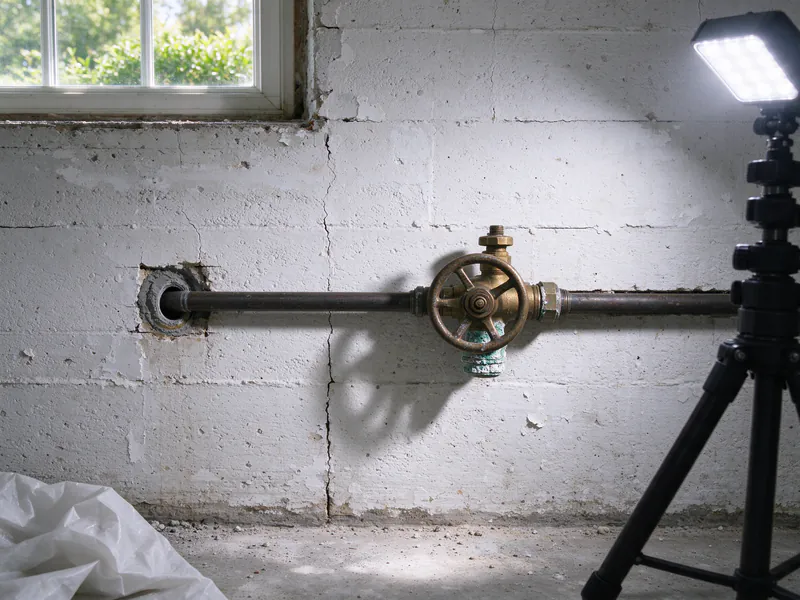
The visit starts by finding the valves and the meter. Is the meter inside, with a valve on each side of it, or outside in a pit? What kind of valve is it: a gate valve with a round wheel, a globe or stop valve, or a ball valve with a lever? What pipe meets it on each side? A magnet and a light scratch separate galvanized steel from copper and lead, as the guide to identifying pipe material explains.
Then the pipe around the valve is checked, because the valve is rarely the only old part. Threaded galvanized nipples on either side of an old valve are often corroded thin, and a valve swap that reuses them can trade one leak for another; corroded pipe beyond the valve is a galvanized pipe replacement question. Static pressure is read at a hose bibb, and flow is checked at a fixture, since a half-closed or scaled gate valve can be the hidden cause of weak flow throughout the house. The low water pressure page explains how to tell a valve restriction from a pipe one. Finally, the visit confirms how the water will be shut off upstream for the swap, and with whom.
Where the valve sits relative to the meter
The meter is the line that matters. On the house side of the meter, the main shutoff is part of the house’s plumbing: the Indiana Plumbing Code governs it, and in Indianapolis the City’s permit rules apply. On the street side, the valve is part of the service line, and the water utility’s rules take over.
In Citizens Energy Group territory the owner owns the full service line and maintains the meter pit, while Citizens maintains the stretch between the main and the right-of-way line for leaks. Any modification or replacement of the service line needs a Citizens permit and a plumber with an active Citizens bond. So a valve in a basement after an inside meter is ordinary plumbing work; a valve in the meter pit before the meter is service-line work, and it needs the Citizens bonded route and a shutoff at the street.
Indiana American Water, which serves areas including Greenwood and Noblesville, draws its line at the outside shut-off or meter pit: the utility owns the line from the main to that valve, and the customer owns it from there to the indoor plumbing. During its lead line replacements it installs an inside shut-off valve where a property has none. In Brownsburg, the town owns the meter pit and meter. Other utilities’ rules at the meter, such as in Lawrence and Speedway, are confirmed per address. The meter pit relocation guide explains how the pit setting works in Citizens territory.
Why old main valves fail
A gate valve closes by lowering a wedge across the pipe as the wheel turns. Left open for decades, its stem and wedge guides collect scale, and the packing around the stem dries out. When the wheel is finally turned, one of three things tends to happen: it will not move, it turns but the wedge stops short and water keeps passing, or the stem breaks or the gate drops off it inside the body. A valve that weeps at the stem after it is turned is a packing failure, and it often gets worse.
Water chemistry plays a part. Citizens’ Indianapolis water averages about 19 grains per gallon of hardness, varying with the plant that serves the address, and hard water leaves mineral scale on valve seats and threads. That is not a reason on its own to replace anything, but it is why an untouched valve can be stuck. The Indianapolis hard water guide covers what scale does and does not do to supply piping.
A globe or stop valve has its own weakness: a rubber washer pressed onto a seat. When the washer wears, the valve lets water by even when closed. Globe valves also bend the water through the body, which restricts flow more than a full-port valve does.
How the valve is replaced
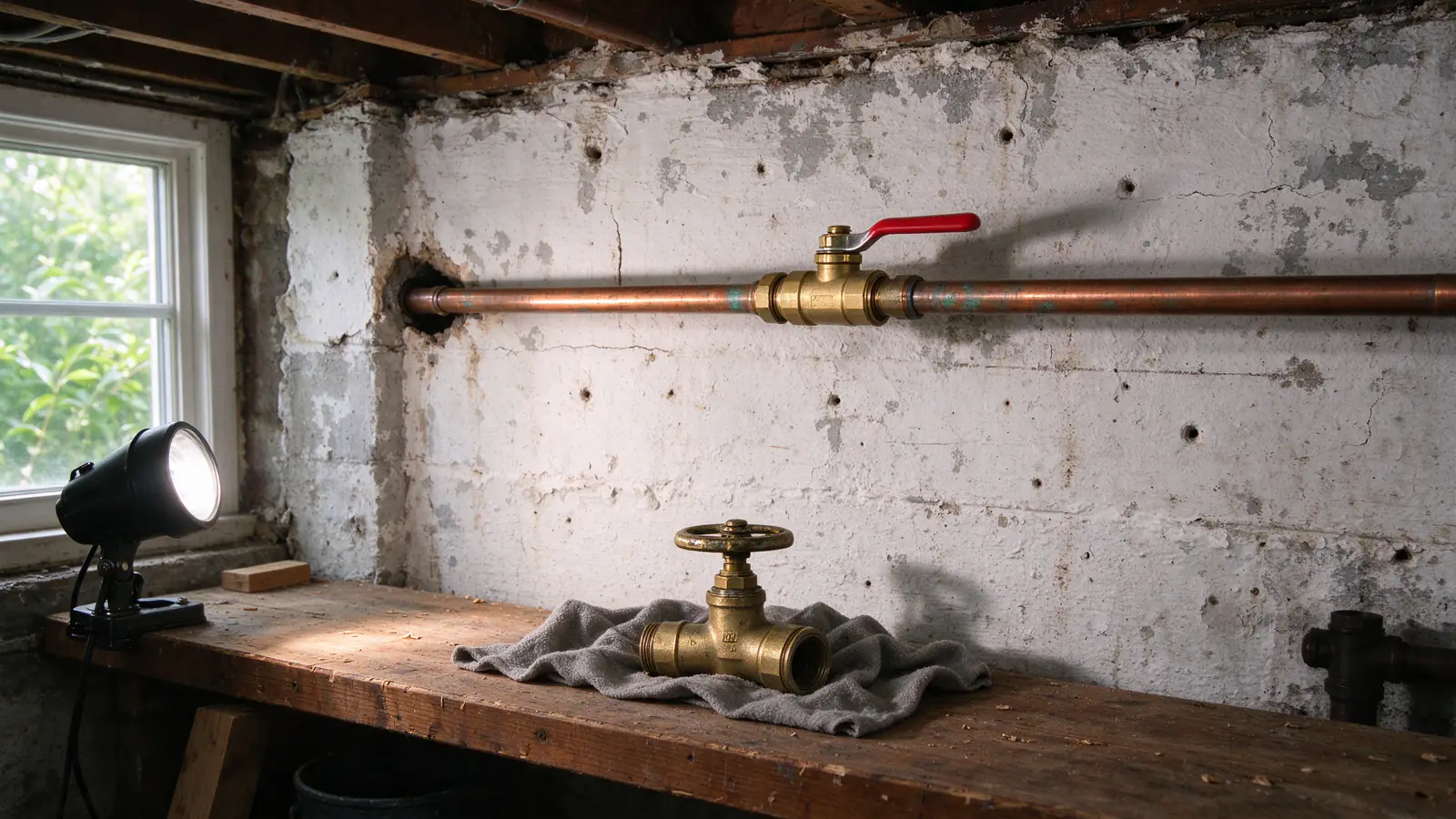
A main valve cannot be replaced with water in the line, so the first step is shutting the water off upstream: at the inside meter valve where one works, or at the curb valve or meter pit through the utility. The house is drained down at the lowest fixture. The old valve comes out with any corroded nipples or fittings around it, much like a short pipe repair, and the new valve goes in with the right transition for the pipe on each side, such as a dielectric fitting where copper meets galvanized steel.
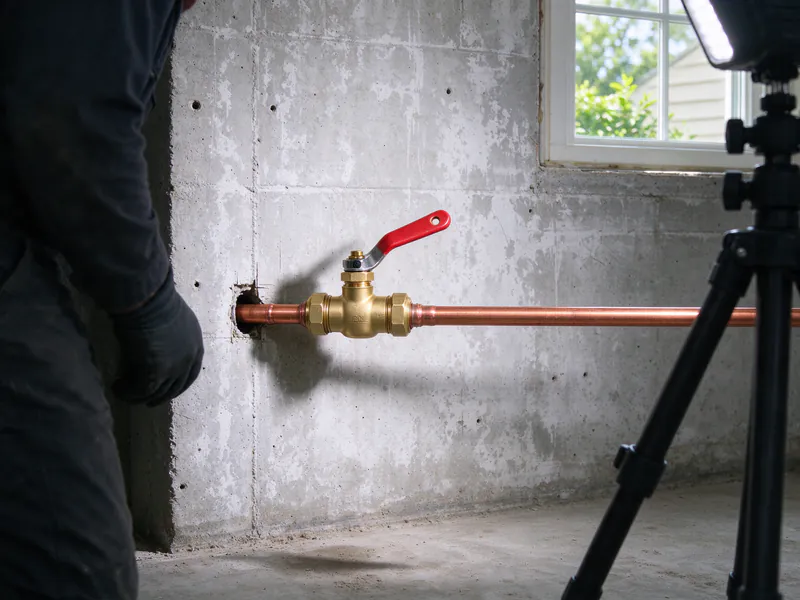
The replacement is normally a quarter-turn, full-port ball valve, sized to the incoming line, with a lever that shows at a glance whether it is open or closed. Full port matters: a reduced-port valve has a smaller bore than the pipe and becomes a small restriction of its own. Valves in contact with drinking water should be listed to NSF/ANSI 61 and 372. Water is then turned back on slowly, air is bled from the fixtures, and every new joint is checked under full pressure.
Inside the City of Indianapolis, the Department of Business and Neighborhood Services lists replacement of valves among the work exempt from a plumbing permit, so a straight valve swap usually needs none. Whether a particular job stays inside that exemption is confirmed before work starts.
Main valve won't close?
Find out whose rules apply at your meter, then get the swap priced in writing before anything is turned off.
When a valve swap becomes a bigger job
Some valve jobs turn out to be the first visible sign of a larger one. If the pipe coming through the wall is lead, the valve sits on a lead service line, and Citizens requires a lead line that is being modified to be replaced in full, from the main to the home. In that case the lead service line replacement page and Citizens’ program come first. If it is galvanized and rusted at the threads, the valve swap may need to include more of the line, or the water line replacement page may be the real scope.
Inside the house, a new main valve is a sensible moment to add what an older system lacks. Where the incoming pressure is high, a pressure-reducing valve and an expansion tank at the water heater may belong next to it. Where the pipe after the valve is scaled galvanized, a whole-house repipe will begin at the new valve anyway.
If the old valve is leaking now, or snapped while someone tried to close it, close a working valve on the meter if there is one indoors and it can be reached safely, ask the utility to shut the water off at the street, and call. Emergency response is available for active leaks; the emergency pipe repair page and the guide to what to do when a pipe bursts cover the first steps.
What moves the price
There is no single published price for this work that fits a given house, and the job can range from a short valve swap to a section of new line. These are the drivers:
- Where the valve is. Inside after the meter, or in an outside pit before it, which brings in the utility’s bonded route and a street shutoff.
- How the water gets shut off. A working inside meter valve, or the curb valve operated by the utility.
- The pipe at the valve. Sound copper, corroded galvanized nipples that need replacing, or a lead or galvanized service line that changes the scope.
- Valve size and type. A 3/4-inch or 1-inch full-port ball valve, sized to the incoming line.
- Access. An open basement wall, a finished wall, a tight crawlspace or a deep pit.
- What goes in with it. A pressure-reducing valve, an expansion tank or a branch shutoff added while the water is already off.
- After-hours timing. An emergency call after hours costs more than a planned one.
A walk-through turns those into a written price, and a valve that will not close is worth replacing before the day it is needed.