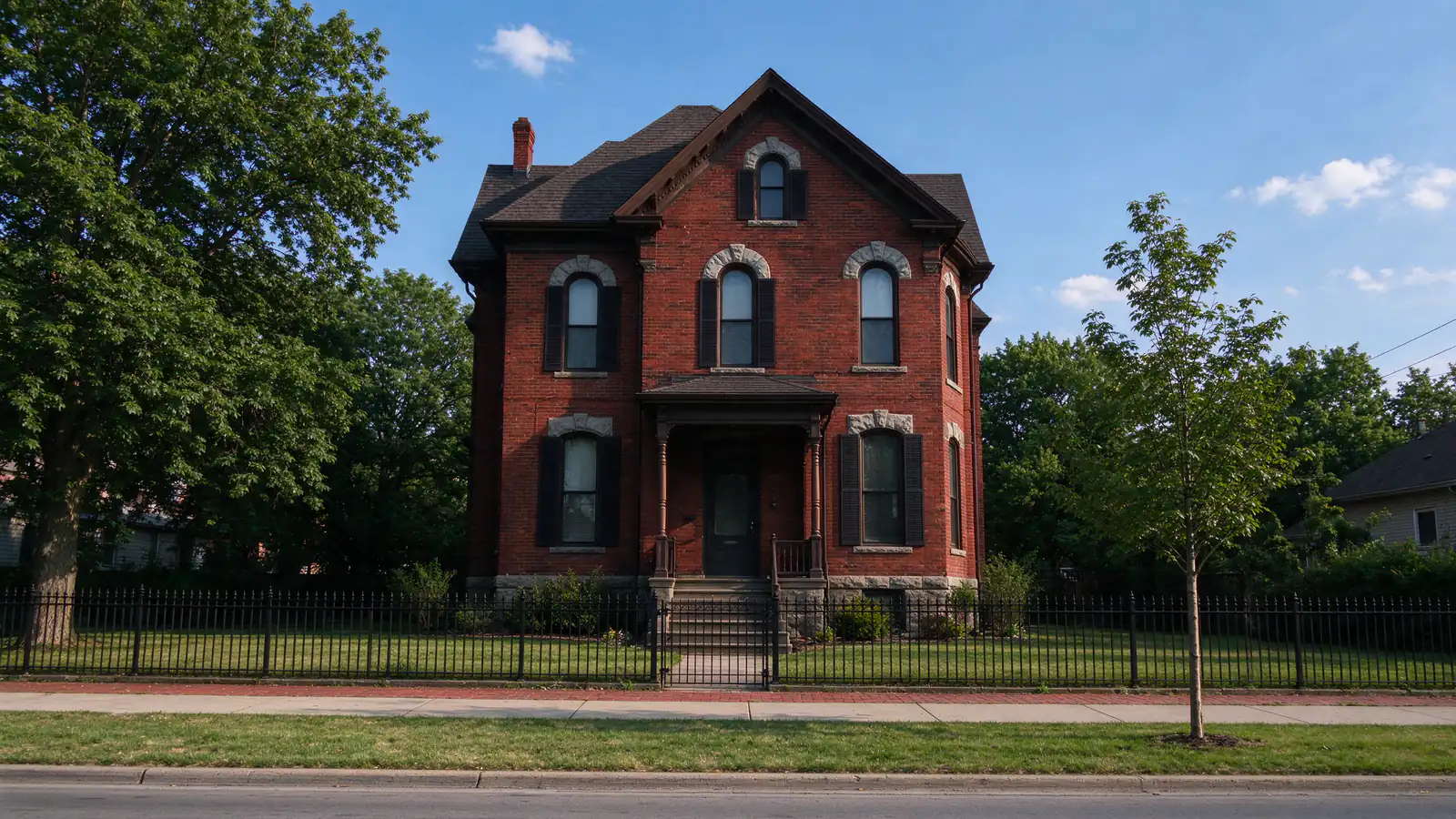
The tallest houses north of downtown put their top-floor baths two full stories or more above the water meter, and that climb shapes how a repipe here is planned. Circle City Repipe handles repiping in the Old Northside, Herron-Morton Place, Chatham-Arch and Lockerbie Square: whole-house repiping in PEX or copper, galvanized pipe replacement, leak and pipe repair, and the drain stack and service line work that tends to come up with an old house. Licensed and insured contractors carry out the work under a City of Indianapolis plumbing permit.
Five districts under one permit office
The area this page covers is a cluster of Indianapolis Historic Preservation Commission districts: the Old Northside, Herron-Morton Place, Lockerbie Square, Chatham-Arch and Massachusetts Avenue, and St. Joseph, all on the City’s preservation boundary map. Lockerbie Square was platted between 1847 and 1850, and Chatham-Arch developed from the 1830s into the 1920s, so the oldest houses here were built before indoor supply plumbing was usual and had it added later.
All of it sits inside the Consolidated City of Indianapolis. Plumbing permits come from the City’s Department of Business and Neighborhood Services, the water comes from Citizens Energy Group, and one Building Standards clause covers every district: being exempt from a permit does not settle whether a certificate of appropriateness is still owed. For a repipe, that clause is about what shows from the street, not the pipe behind the plaster.
What the Census shows north of downtown
The Census area that takes in these neighborhoods holds two very different kinds of housing. According to the American Community Survey, 37.3% of its homes date from before 1940, only 6.5% between 1940 and 1959, and 29.5% since 2000. Nearly 63% are in buildings of five or more units, and about 30% are single-unit houses.
That split makes the area’s median build year of 1969 close to meaningless for an owner. The figure averages Victorian houses with new apartment blocks. A house on Delaware Street or in Lockerbie belongs to the prewar group, the era of threaded galvanized steel and, by Citizens Energy Group’s account, of lead service lines and lead in plumbing before 1950. A newer condominium belongs to the other group entirely. Neither number says what a particular house holds; the survey at the meter does. The guide to identifying pipe material shows what to look for.
Risers, pressure and the climb to the top floor
Height is the local problem. Water loses about 0.43 psi for each foot it rises, so a third-floor bath can start a dozen psi behind the basement before friction is counted. If the original risers are galvanized and have scaled inside, the friction loss stacks on top. That is why the first visit measures static pressure and flow at the meter and again at the highest fixture, hot and cold, before anyone proposes a scope. A strong reading downstairs and a weak one at the top points at the risers; weak readings everywhere point back to the main valve or the service line. The low water pressure page walks through that sorting.
The new layout follows from those numbers. A tall house with several baths often suits a larger trunk up through the building with short branches at each floor, or a manifold in the basement with home runs to each fixture. The manifold vs trunk-and-branch guide compares the two. Routes are chosen around plaster and original woodwork: stacked closets, a back stair, an old dumbwaiter or laundry chute, or the cavity beside the drain stack. If that stack is cast iron and failing, cast iron stack replacement in the same opening saves cutting the wall twice.
Weak shower at the top of an Old Northside house?
Get pressure and flow measured at the meter and the top floor before deciding how much pipe to replace.
The rough-in inspection comes before the plaster
A repipe in Indianapolis needs a plumbing permit, because the in-kind exemption stops at 20 percent of the piping in a structure. The permit is pulled through a plumbing contractor licensed by the State of Indiana and registered with the City. Under the Building Standards, the rough-in is inspected after the pipe is installed and before it is covered, so every opening stays open until the inspector has seen it. In a house with three floors of risers, that inspection sits in the schedule ahead of any patching on any floor.
New lines go in stages, with the house kept on water for most of each day. After inspection the system is pressure tested and flushed, fixtures and the water heater are reconnected, and the openings are closed as agreed in writing, with a list naming every opening and who closes it. For the size and placement of typical openings, read how invasive repiping is.
The service line, the meter and hard water
Under Citizens Energy Group’s terms the buried service line belongs to the property owner from end to end; the utility fixes leaks only on the stretch inside the public right-of-way. For a large house, the line’s size matters as much as its material: a full replacement must be SDR9 polyethylene with tracing wire, at least one inch for a house over 2,000 square feet. If the meter is inside the house today, replacing the service moves it to an outside pit, which in a historic district is one of the exterior items to clear. Citizens’ lead program can replace a lead or galvanized line from the main to the house; the lead service line replacement page and the Citizens program guide explain how that sequencing works with an interior repipe.
Citizens’ water averages 19 grains of hardness per gallon, with the exact figure varying by the plant serving an address. That mineral load is part of why old galvanized narrows, and the Indianapolis hard water guide covers what it means for new pipe.
What a repipe costs north of downtown
The price band does not change by neighborhood. A whole-house repipe runs a typical Indianapolis-area $4,000 to $15,000 or more, and the houses here push toward the upper end for reasons the house itself supplies: height, number of baths, plaster, and a copper choice if that is the preference. The Indianapolis repipe cost guide lays out what sits inside that band, while the repipe cost estimator works from square footage and bath count. Anyone buying in the area can start with the guide to buying a house with old pipes.
Close by
Irvington, on the east side, has the same permit office, the same utility and its own historic district. Fountain Square, south of downtown, has older but mostly smaller houses. The service areas page lists the rest.