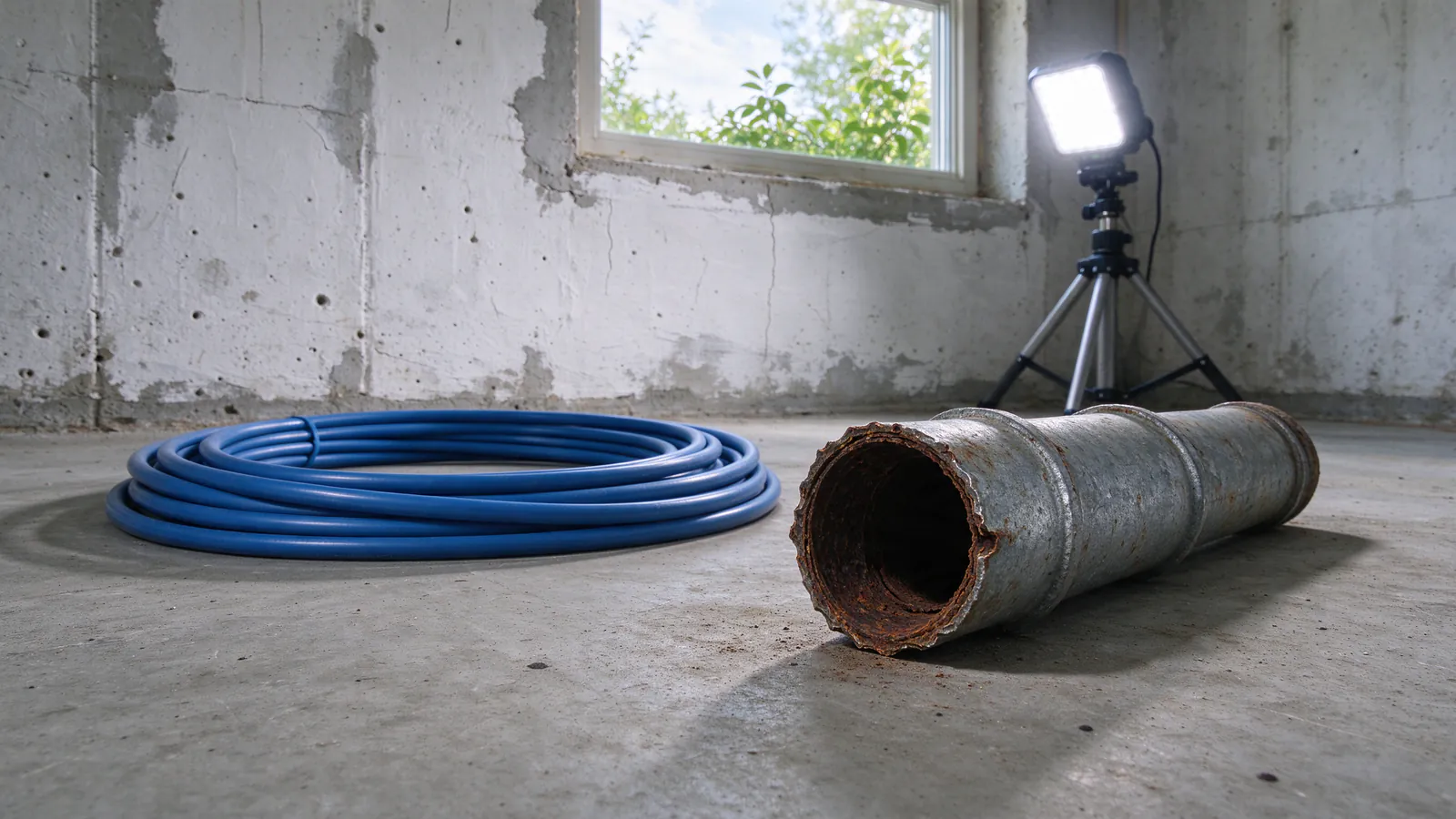
Brown water from a faucet usually comes from one of three places: iron sediment stirred up in the street main, rust and sediment in the water heater, or corroding galvanized pipe in the house. Which faucets, hot or cold, and whether it clears after a minute tell you which. Only the last one points toward repiping.
Circle City Repipe offers and manages galvanized pipe replacement, whole-house repiping and pipe repair across Indianapolis and nearby communities, carried out by licensed and insured contractors. This guide is about finding the source first, because blaming the pipe before ruling out the street and the heater is how people end up paying for the wrong fix.
The three usual sources
The street main
Many older water mains are iron, and iron and mineral sediment settles in the bottom of any main. Anything that changes flow suddenly can stir it up: a main break, a hydrant being opened for firefighting or flushing, valve work, or construction on the street. The result is brown or yellow water in every faucet in the house at once, hot and cold, often at neighbors’ houses too, and it usually clears within hours.
This one is not yours to fix. Run the cold tap at the lowest fixture in the house, such as a basement laundry tub or utility sink, until it runs clear. Avoid running hot water, so the sediment does not get drawn into the water heater. If it does not clear, or comes back repeatedly with no work nearby, call the utility. In most of Marion County that is Citizens Energy Group; Lawrence, Speedway, Carmel and some suburbs have their own water utilities.
The water heater
Sediment and rust build up in the bottom of a tank water heater. Indianapolis water is hard, averaging about 19 grains per gallon in Citizens’ data, so scale adds to it. When that layer is stirred, or the tank lining itself is starting to rust, the hot water comes out discolored. A worn anode rod can play a part.
The tell is simple: at the same faucet, the cold runs clear and the hot comes out brown. Flushing the heater through its drain valve is the usual first step, and if water keeps coming out rusty after a flush, the tank may be failing. The Indianapolis hard water guide covers what scale does to heaters and fixtures.
Galvanized pipe in the house
Galvanized steel rusts from the inside once its zinc coating wears away. The rust builds into scale on the pipe walls and sheds iron into water that has been standing. The pattern is brown or yellow water at the first draw, especially in the morning or after a trip, that clears after the tap runs, from more than one fixture, and keeps happening over weeks. Rust flakes in aerators and a drop in flow often come with it.
That pattern, especially with the house’s age and a magnet that sticks to the exposed pipe, is the one that points to the plumbing itself. The guide to whether galvanized pipes are safe covers what else old galvanized can carry, including lead.
A quick triage at the tap
Check these in order. You do not need tools beyond a white cup or a paper towel.
- One faucet or every faucet? One fixture alone suggests something local: that fixture’s branch, its supply line or its cartridge, which is usually a pipe repair question at most. Every fixture suggests the street, the service line or the main through the house.
- Hot, cold or both? Hot only points to the heater. Cold too points elsewhere.
- Does it clear? Water that clears in a minute or two and comes back after sitting is coming from pipe. Water that stays brown for a long time, house-wide, is more likely the street.
- Neighbors too? If the house next door has it, it is almost certainly the street.
- What happened recently? Main work, a hydrant in use, a shutoff in the house or a hard freeze each have their own story.
Brown water after a shutoff
This is one of the most common times people notice it. When the water comes back on after a shutoff, the flow rushes through pipe that has been still, and it scours loose sediment and rust. If the utility shut the street off, the sediment is usually from the main and clears. If the shutoff was in the house, for a repair or new fixture, the sediment is often from the house’s own pipe, and in a galvanized system it can take longer to clear and leave aerators clogged.
Clear it by running the cold tap at the lowest fixture first, then the others, then cleaning aerators. Brown water that comes back on later days, without another shutoff, is the pipe telling you something.
Brown water after a freeze
After a hard freeze and thaw, two things can cause discolored water. Pipes that froze and thawed may have flow surges that loosen scale, which looks like the shutoff case. More important, a frozen pipe can split, and the first sign of a split can be a drop in pressure or a change in the water before anyone sees a leak. If water turns brown after a freeze, check exposed pipe in the crawlspace, basement and outside walls for wet spots. The burst pipe repair page covers what to do if one has opened.
Brown water that keeps coming back?
A first look checks the service line, the heater and the pipe from the meter outward before anyone talks about replacing anything.
The service line
The buried service line between the main and the house can also shed rust if it is galvanized. In Citizens Energy Group territory the owner owns the full length of that line, and its Lead Service Line Replacement Program replaces lead or galvanized iron components from the main to the home where the line qualifies. A galvanized service line paired with brown water in every fixture is worth checking on Citizens’ service line map. The water line replacement and lead service line replacement pages cover that side.
Is brown water safe to drink?
The iron itself is mainly an appearance and taste problem; the EPA treats iron as a secondary standard, a guideline for color and taste, not a health limit. But brown water from old pipe is a sign of corrosion, and the same corrosion can release lead where lead is present upstream. Until the source is known, it is sensible to drink from water that has run clear, use cold water for cooking, and ask Citizens for a tap sampling kit if the house is old enough to have lead. The guide to identifying pipe material helps with what to look for.
Homes on private wells are outside this guide. Iron in well water comes from the groundwater and is a well and water treatment question, not a repiping one.
When brown water means the pipe needs replacing
Brown water alone is not proof a house needs new pipe. It counts toward that decision when the street and the heater have been ruled out, when it comes from several fixtures over weeks, and when it comes with weak flow, rust at the threads or repeated leaks. Then the choice is between replacing the worst runs and a whole-house repipe. The galvanized pipe replacement page shows how that work is scoped, and the repipe vs repair guide works through the decision.
If you have ruled out the street and the heater and the water keeps coming out brown, call Circle City Repipe or request an estimate.