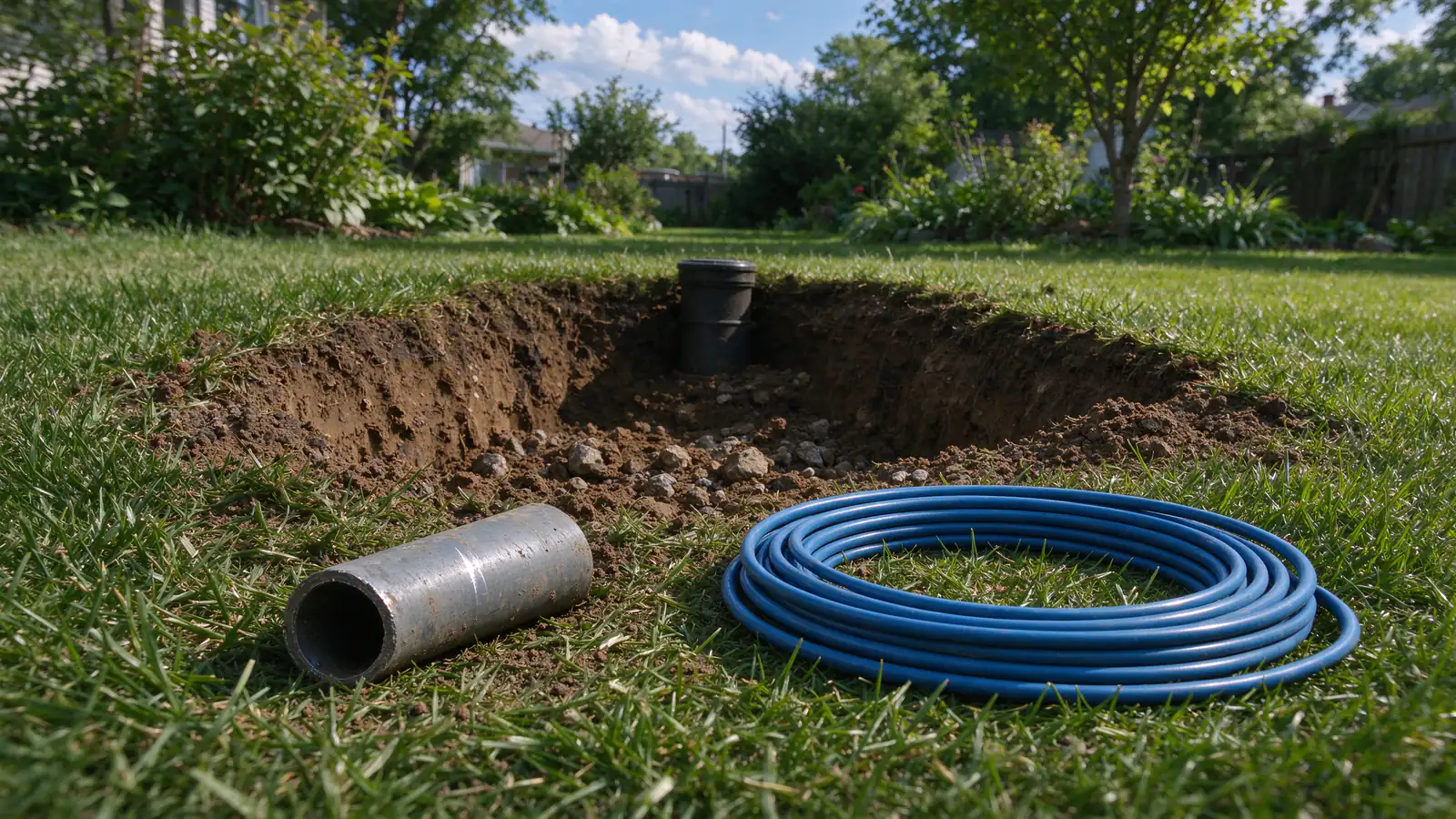
To identify lead pipes, find where the water line enters the house at the meter or main shutoff. Lead is dull gray, soft and non-magnetic: a gentle scratch with a coin shows bright silver, and a magnet will not stick. If the magnet sticks, the pipe is galvanized steel. Copper is penny-colored, and plastic is printed with its type.
Circle City Repipe offers and manages repiping, galvanized pipe replacement and lead service line work across Indianapolis and nearby communities, carried out by licensed and insured contractors. This guide is the full identification walk-through that the complete guide to repiping summarizes, and it goes material by material.
Where to look first
The most important pipe to identify is the service line, the buried pipe from the water main in the street to the house. Inside, it appears where it comes through the basement wall or up through the floor, usually just before the water meter or the main shutoff valve. Where a house has an inside meter, it is usually in the basement or a crawlspace; Citizens’ current standard puts meters in an outside pit near the right-of-way line. If the meter is outside, the pipe coming into the house after it is still the owner’s service line.
Look at the short stretch between where the pipe enters and the first valve or meter. That is the part to test. Then follow the main from the meter through the basement or crawlspace, noting every change of material and every repair.
The scratch and magnet test
Citizens Energy Group and the EPA describe the same simple check. You need a coin or a key and an ordinary refrigerator magnet.
- Find a stretch of the pipe between the wall and the meter or valve. If it is painted or crusted, pick a spot where you can reach bare metal.
- Scratch gently with the edge of the coin. Do not use a knife or file, and do not dig into the pipe, especially near a joint.
- Look at the scratch. Lead shows a bright, shiny silver surface and feels soft. Galvanized stays dull gray. Copper shows a penny color.
- Hold the magnet against the pipe. If it sticks firmly, the pipe is steel, which in a house water line means galvanized. A magnet does not stick to lead or copper.
- Wash your hands afterward if the pipe could be lead.
The EPA’s Protect Your Tap quick check for lead walks through the same steps with pictures. Citizens’ lead and copper FAQs note that the most definitive answer, for the service line and the plumbing inside, comes from a licensed plumber.
Reading each material
Lead
Dull gray, soft, and non-magnetic. Lead service lines are often wider than you would expect for a house line and may bend in a gentle curve rather than running straight. Where lead joins another pipe, there is often a bulbous, rounded joint, called a wiped joint, rather than a threaded or soldered one. Lead was used for service lines and some early interior plumbing; Citizens notes it was common in homes and buildings built before 1950 in the Indianapolis area.
Galvanized steel
Gray, hard, with threaded joints and fittings that look like collars around the pipe. A magnet sticks. Galvanized was a standard supply pipe from the early twentieth century into the postwar years, inside houses and for some service lines. Rust at the threads or orange staining at joints is common on old galvanized. A galvanized service line matters because Citizens’ lead program replaces galvanized iron components between the main and the home where the line qualifies. The guide to whether galvanized pipes are safe explains why.
Copper
Penny-colored when new, turning brown or dull green with age. Joints are soldered (a smooth fillet of metal at the fitting) or pressed (a ridged collar). A magnet does not stick, and a scratch shows bright copper. Rigid copper inside the house is often printed with a colored stripe that tells its wall type; the Type L vs Type K copper guide explains the colors. Soft copper in a coil is common for service lines.
Lead solder on copper
Copper itself is not a lead concern, but the solder joining it can be. Citizens notes that some homes built before 1986 may have lead solder in the joints of copper pipe. Lead solder is silver or gray; so is lead-free solder, so color alone does not settle it. Age of the plumbing is the better guide, and a tap test the better answer.
Plastic pipe
Plastic pipe is easiest to identify by reading what is printed on it.
- PEX is flexible tubing in red, blue, white, gray or black, printed with “PEX” and standards such as ASTM F876 and NSF/ANSI 61. It is joined with crimp, clamp, expansion or press fittings.
- CPVC is rigid, cream or tan, joined with solvent cement, and printed “CPVC”.
- Polybutylene is flexible, usually gray inside the house, often stamped PB2110, with metal crimp rings or plastic fittings. It is the plastic most worth identifying, because of its failure history.
- Polyethylene service line is flexible black or blue pipe entering the house. A newer Citizens service line replacement is SDR9 polyethylene, which is the material Citizens requires.
Checking the records
Citizens Energy Group keeps a service line inventory for its territory, built from visual inspections and historic records, and publishes it as an online map; it also mails annual letters to customers whose line is lead, galvanized or of unknown material. Indiana American Water, which serves Greenwood and Noblesville, publishes a service line map for its areas through its lead information pages. Lawrence and Carmel run their own inventories. If the record for your address says unknown, or does not match what you see at the meter, report what you find. The Citizens lead service line program guide explains what happens next.
The records cover the service line only. No public source records what pipe is inside a particular house.
Not sure what you found at the meter?
A first look identifies the service line and follows the main through the house, noting each material and repair.
What each finding changes
Identifying the pipe matters because each material points to a different set of concerns and a different next step.
- Lead service line: a health question first. Use a lead-removing filter for drinking and cooking water, ask Citizens for a tap sampling kit, and look at the replacement options on the lead service line replacement page.
- Galvanized service line or interior pipe: expect falling flow, rusty first-draw water and leaks at threads over time, and check whether the galvanized is downstream of lead. Galvanized pipe replacement covers the work.
- Copper: generally sound, with pinholes and old solder as the things to watch. The copper pinhole leaks guide covers the first.
- Polybutylene: worth planning to replace, and worth knowing before talking to an insurer. The insurance and repiping guide covers that conversation.
- PEX or CPVC: usually newer work. Note where it joins older pipe, because those junctions are where mixed systems fail.
What you can’t see from the basement
Pipe in the basement may not match pipe in the walls. Many older houses have been repaired piece by piece, so galvanized can run up a wall from a copper main, or a remodeled bath can sit on PEX while the rest is original. Identification from the basement is a starting point, not a full answer. A proper assessment follows the main and checks fixtures on every floor, and the repiping assessment gives a planning answer from what you have found so far.
If you have checked your meter and want someone to confirm what you found, call Circle City Repipe or request an estimate.