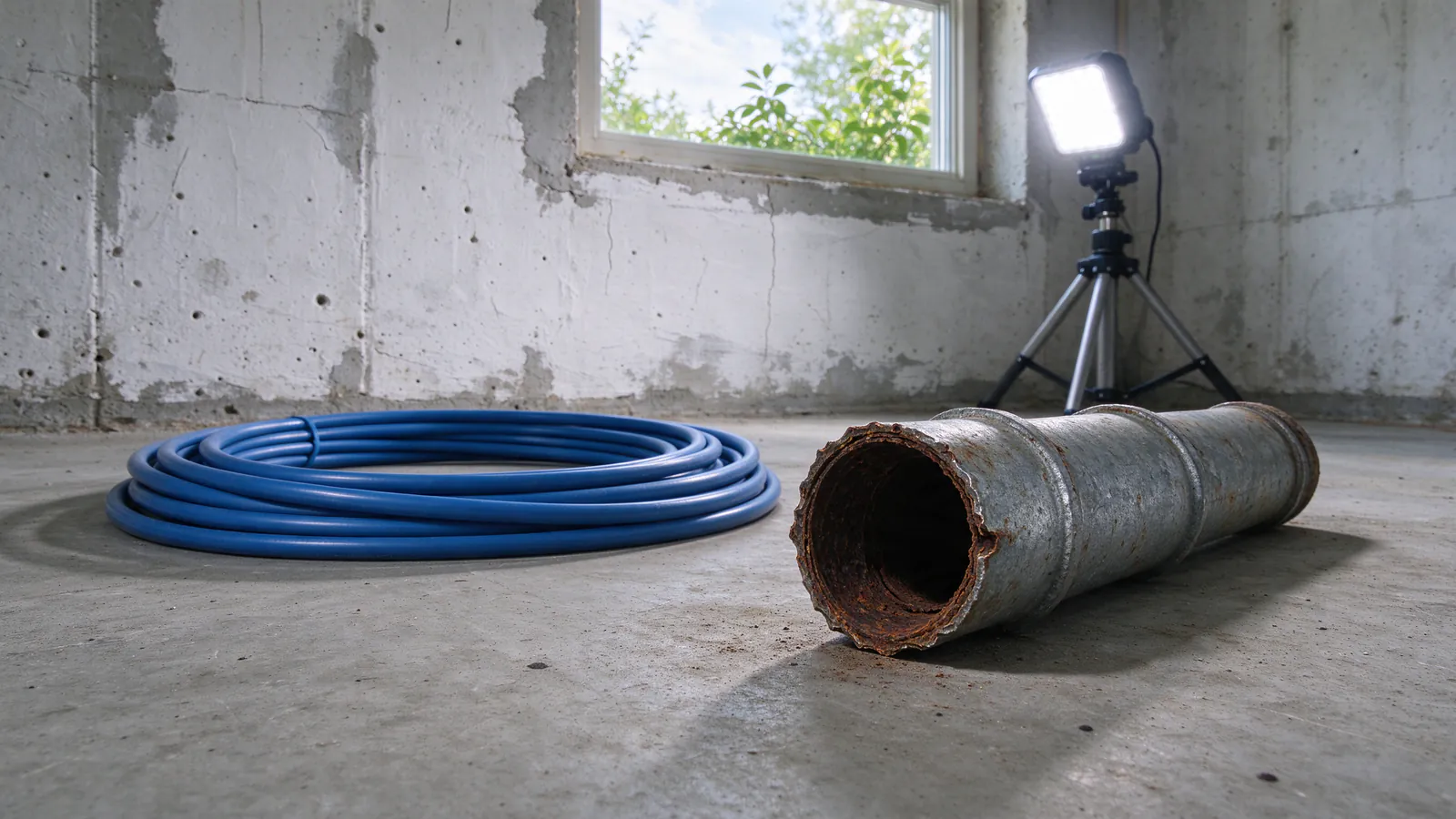
Galvanized pipes are not a lead pipe, and many still deliver water that tests fine. They are not risk-free, though: old galvanized can hold lead, especially downstream of a lead service line, and it rusts from the inside until flow drops and leaks start. They are safe enough to test and plan around, not something to keep forever.
Circle City Repipe offers and manages galvanized pipe replacement and whole-house repiping across Indianapolis and nearby communities, carried out by licensed and insured contractors. This guide stays on the safety question. For how replacement is done, the service page covers it.
What galvanized pipe is and why it was used
Galvanized pipe is steel dipped in molten zinc. The zinc protects the steel from rust for a time, and the pipe is joined with tapered threads cut into its ends. It was strong, cheap and easy to work with hand tools, and it was a standard supply pipe in American houses from the early twentieth century into the postwar years. In Indianapolis, about a third of homes in the city were built before 1960, according to the Census Bureau’s American Community Survey, which is the era when galvanized was most often used. That does not mean any one of those houses still has it; many have been partly or fully redone.
The lead question
There are two ways galvanized pipe can put lead in water.
The first is the zinc itself. The zinc used to galvanize older pipe could contain lead as an impurity, and as the coating corrodes, small amounts can be released.
The second, and usually the larger, is position. Galvanized pipe that sits downstream of a lead service line, or a lead connector at the main, can collect lead particles in the rust and scale lining its walls. Those particles can come loose later, when flow surges or the pipe is disturbed, even after the lead line has been replaced. Federal lead rules recognize this by treating a galvanized service line that is or was downstream of lead as one that needs replacement.
Local utilities follow that logic. Citizens Energy Group’s Lead Service Line Replacement Program replaces lead or galvanized iron components from the water main to the customer’s home, and owner-initiated replacements qualify where the private side is lead or galvanized and the right-of-way side is lead. Indiana American Water, which serves Greenwood and Noblesville, replaces lead service lines and galvanized lines that follow lead piping, at no direct cost while it is upgrading infrastructure in the area. The Town of Brownsburg names galvanized service lines connected to a lead gooseneck as its concern. The Citizens lead service line program guide covers who qualifies and how.
None of those programs pays for galvanized pipe inside the house. Interior galvanized downstream of a lead line is repipe scope, and it is worth planning the two together.
Rust, scale and what iron does to water
As the zinc wears through, the steel corrodes. Rust and minerals from the water build into lumps, called tubercles, on the inside of the pipe. That narrows the bore, so flow drops, especially when two fixtures run at once. It also sheds iron, which is what turns first-draw water brown or yellow.
Iron in drinking water is mainly an appearance, taste and staining problem. The EPA lists it as a secondary standard, at 0.3 milligrams per liter, meaning a guideline for taste and color rather than a health limit. Rusty water is unpleasant and stains laundry and fixtures, but the health concern with galvanized pipe is lead, not iron. Brown water also has causes that have nothing to do with the pipe; the brown water guide explains how to tell them apart.
When galvanized becomes a leak and damage risk
The other safety question is the house itself. Galvanized pipe is thinnest where its threads were cut, so leaks usually start at joints. Once corrosion has eaten through at one fitting, others along the same run are often close behind. A leak behind a wall or above a finished basement ceiling can do more damage than the pipe is worth. A cut section that shows heavy scale and thin walls is a sign the rest of the run is similar.
Mixed systems add a specific risk. Where a past repair joined copper to galvanized without a dielectric fitting, galvanic corrosion eats the steel side of the joint faster than normal. Those junctions are worth finding. The galvanized pipe replacement page shows where they tend to sit.
Living with galvanized pipe?
A first look traces the pipe from the meter, notes every repair and junction, and checks flow at fixtures upstairs and down.
How to find out whether yours is a problem
Start by confirming what you have. A magnet sticks to galvanized steel and not to lead or copper; the guide to identifying pipe material has the full set of checks. Then check the service line: Citizens Energy and Indiana American Water both publish service line maps, and Citizens’ inventory records what it knows about each address.
Then test the water. Citizens offers tap sampling kits by request on its lead and copper page, and returns the results by mail. The EPA’s “Protect Your Tap” guide walks through identifying lead pipe at home. If a test shows lead, or the service line is lead, the county health department or a doctor can advise on blood lead testing.
Finally, look at how the pipe is behaving. Weak flow at several fixtures with normal static pressure, rust at the threads, repeated leaks in different places, or brown water that keeps returning all point to pipe that is near the end of its service. The low water pressure page explains how pressure and flow are separated.
What to do in the meantime
Citizens’ own guidance for reducing lead exposure applies to any house with older plumbing:
- Use a filter rated to remove lead, such as one listed to NSF/ANSI 53, for drinking and cooking water.
- Run the tap for several minutes before drinking if water has sat unused for more than six hours.
- Use cold water, not hot, for drinking, cooking and baby formula. Boiling does not remove lead.
- Clean faucet aerators regularly, since scale and particles collect there.
Those steps reduce exposure. They do not change the pipe.
Deciding between repair and replacement
A single leak in otherwise sound galvanized pipe can be repaired. When the pipe is scaled closed, leaking in more than one place, or sits downstream of a lead service line, repairs keep the problem in service. A partial repipe can replace the worst runs, but it leaves the rest of the galvanized in place and has to say exactly where new meets old. A whole-house repipe removes the question. The repipe vs repair guide works through it, and the buying a house with old pipes guide covers galvanized found at inspection.
If galvanized is what you have and you want a clear answer on what to do next, call Circle City Repipe or request an estimate.