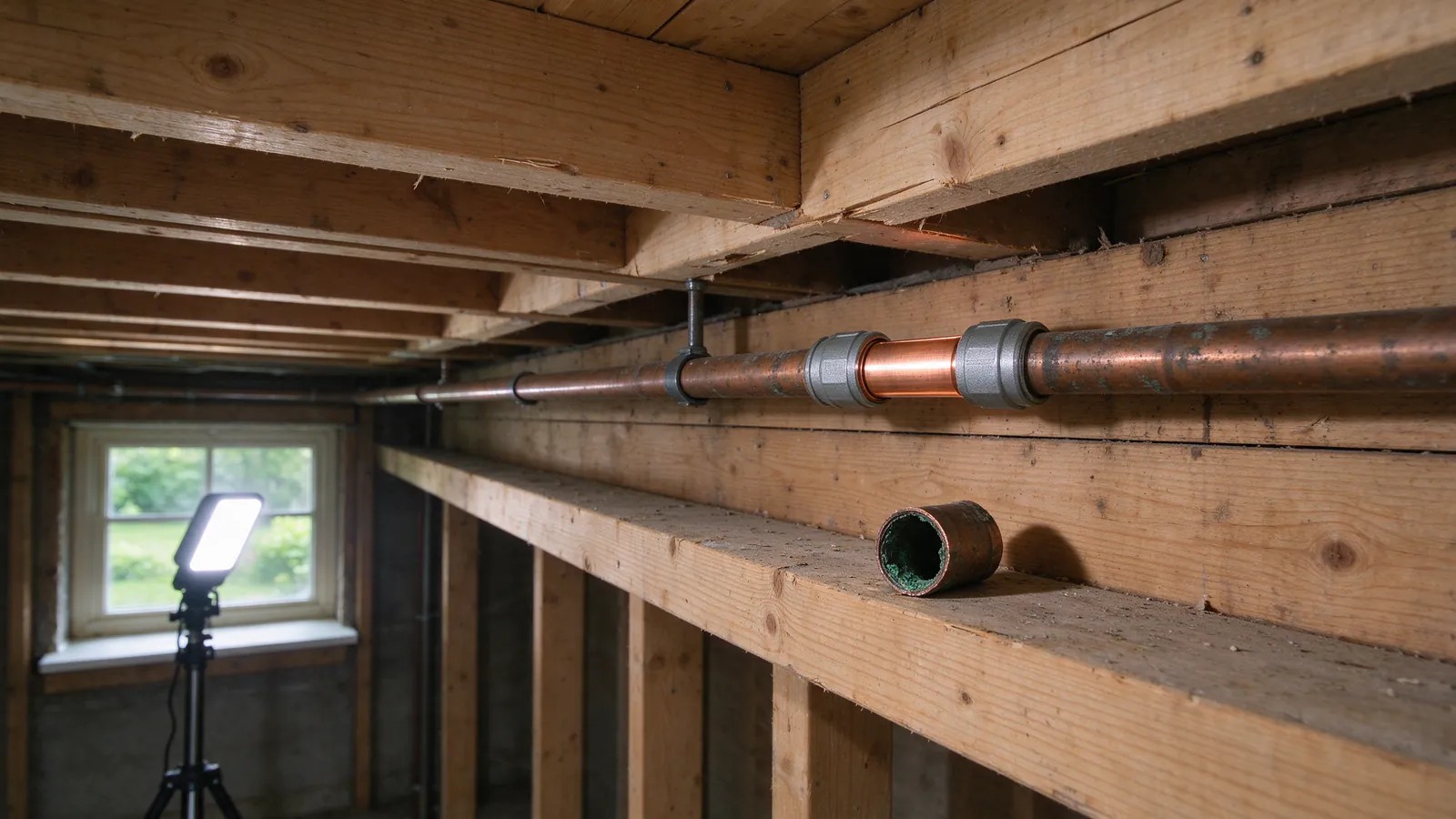
Repair a leak when its cause is local: one freeze, one damaged section, one failed fitting, with solid pipe around it. Repipe when the cause is the pipe itself, such as galvanized corroding along its whole length, copper pinholing in more than one run or polybutylene that has started to fail. The cut-out section and the leak history usually show which one you have.
Circle City Repipe offers pipe repair, partial repipes and whole-house repiping across Indianapolis and nearby communities, carried out by licensed and insured contractors. Because both answers are on the table, the useful work is figuring out which one the house needs. The pipe repair page covers what a repair includes, and whole-house repiping covers the full replacement.
Local cause or system cause
Every leak has a cause, and the cause decides the scope. A local cause damages one place and leaves the rest of the system as it was. A system cause is working on every foot of pipe of the same age and material, and the first leak is simply where it showed up first.
| What happened | Usually local or system | Why |
|---|---|---|
| A line split in an exterior wall after a hard freeze | Local | The cold reached one run; the rest of the house stayed warm |
| A nail or screw through a pipe during a remodel | Local | Mechanical damage at one point |
| A failed fitting, connector or fixture stop | Local, if the pipe is sound | One part wore out; check the pipe on both sides |
| Galvanized leaking at a threaded joint | Usually system | Threads are the thinnest part of galvanized, and every joint is the same age |
| Brown water and weak flow at several fixtures | System | Corrosion and scale inside galvanized pipe throughout the house |
| A second pinhole in copper in a different run | Often system | The same water, alloy and age are acting on the rest of the copper |
| Polybutylene leaking at a fitting | Usually system | The same tubing and fittings run through the whole house |
Visible symptoms do not always prove a single cause. Copper pinholes in particular have several possible causes, from water chemistry to high velocity to stray electrical current, and no one cause applies to every house. The copper pinhole leaks guide goes through them, and the guide to whether galvanized pipes are safe covers how galvanized ages.
What the cut-out pipe tells you
A repair produces evidence. When a leaking section comes out, its inside can be looked at. Galvanized that has lost a third or more of its opening to rust scale, or that crumbles at the threads, is unlikely to be sound a few feet away. Copper with green pitting along the inside wall, rather than one isolated hole, suggests the same process is under way elsewhere. Clean pipe with a single defect suggests the opposite.
Ask for the cut-out piece, or at least a photo of its cut end, every time a repair is made. Over two or three repairs, those pieces are better evidence for the repipe decision than any rule of thumb.
What a repair costs against a repipe
In the Indianapolis area, an accessible spot repair typically runs about $150 to $650, and about $300 to $1,200 when a wall or ceiling has to be opened and patched. A whole-house repipe typically runs $4,000 to $15,000 or more, and larger multi-story, tile-heavy or copper jobs can run higher.
Those numbers make the trade-off concrete. One repair is a small cost against a repipe. But four behind-the-wall repairs at the top of that range would already pass the low end of the whole-house range, and each one leaves the rest of the old pipe in service and opens another wall. A repipe costs more once and plans every opening at the same time. The Indianapolis repipe cost guide explains what moves a repipe price.
Pressure and flow as a second test
Leaks are not the only evidence. On a first visit, static pressure is read at a hose bibb or laundry tap, and flow is checked at fixtures upstairs and down, hot and cold. Good pressure at the main with weak flow at the far fixtures points at restriction inside the pipe, which is a system problem that repairs cannot reach. Weak pressure everywhere, including at the main, may be the service line or the supply, and a repipe alone will not fix it. The low water pressure page explains how the two are told apart.
The middle option: a partial repipe
Between one repair and a whole house sits the partial repipe: one bath group, one floor, the hot side only or a single main. It fits when one area is clearly worse, such as the run to a second-floor bath that has leaked twice, or when the budget has to be staged. It also fits a remodel, when a room’s walls are open anyway.
A partial repipe does not mean the old pipe is gone. The written scope should say exactly where new meets old, what stays in service and what the next stage would cover. Inside Indianapolis, the City exempts in-kind pipe replacement from a permit only up to 20 percent of the piping in the structure, so a partial repipe may need a permit where a repair does not. The Indianapolis repiping permit guide covers that line.
Fix it or replace it?
A first visit traces the pipe from the meter, checks pressure and flow, and gives a written scope for either answer.
When repair is still the right answer
A repair can be the right call even in a house with old pipe:
- The water has to stop now. A repair ends the damage today, and a repipe can be planned without pressure.
- A sale is close. A repair plus a written repipe scope gives a buyer a number instead of a guess. The guide to buying a house with galvanized pipes covers the other side of that conversation.
- A remodel is coming. Repairing now and repiping when the walls open avoids paying twice for openings.
- The pipe really is sound. A single failure with clean pipe on either side is just that.
Epoxy lining is sometimes offered as a third path that avoids both. The pipe lining vs repiping guide explains how it compares and why it depends on the pipe’s condition.
Questions to settle before deciding
- What is the pipe, and is it the same material throughout? The pipe identification guide helps.
- How many leaks has the house had, where, and from what cause?
- What did the cut-out sections look like inside?
- Is flow weak at fixtures that have not leaked?
- What would the next likely repair cost, and where would it open the house?
- If repiping, whole house or a defined part, and where does new meet old?
The repiping assessment turns several of those answers into a planning result. For a written answer about a specific house, call Circle City Repipe to set up a first visit.