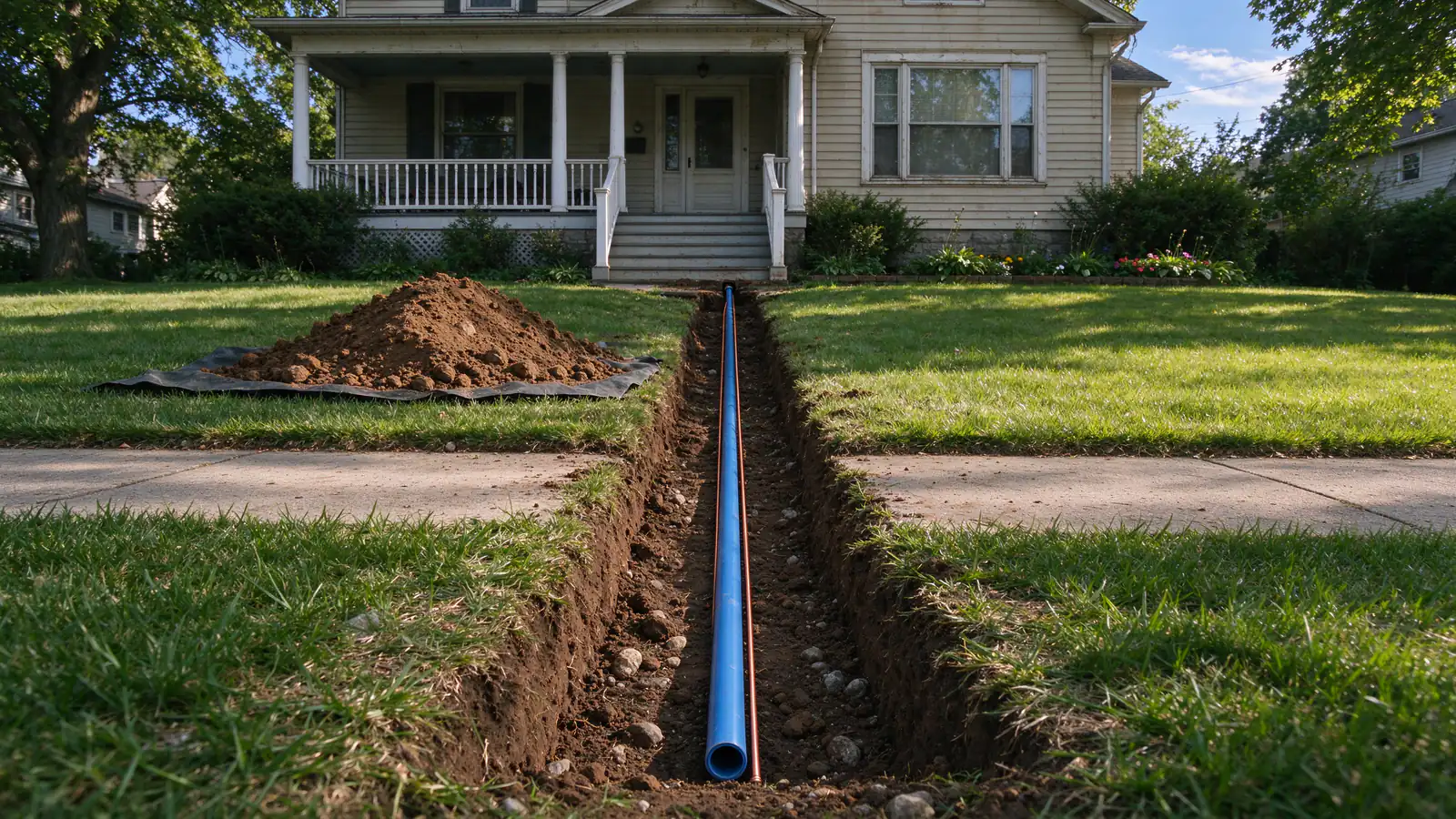
Citizens meter pit relocation is required when the service line to a house with an inside meter is replaced, or when a leak repair needs more than three feet of new pipe. Citizens’ Terms and Conditions then move the meter from the basement to a pit outside, at the owner’s expense, except where Citizens’ lead program is doing the work.
Circle City Repipe replaces water service lines in Indianapolis, including the meter pit setting Citizens requires, through a plumber bonded with Citizens, with the work carried out by licensed and insured contractors. This guide explains the meter move from the owner’s side: what triggers it, what it involves and what it changes. The water line replacement page covers the rest of the service line job.
What triggers the move
Many older Indianapolis houses still have the water meter in the basement, just inside the front wall. Citizens leaves those settings alone until the service line is opened up. Its Terms and Conditions, Rule 7.3, move the meter outside whenever the service pipe to a premises with an inside meter is replaced, and whenever a leak repair is longer than three feet. Citizens’ own answers list the situations where that tends to happen: a service line leak that has to be dug up and needs more than three feet of pipe, a leak that floods the house, and a renovated property that cannot be connected to an undersized or inactive lead line.
Smaller work does not trigger it. Citizens allows point repairs on an existing basement meter setting, so a short leak at a fitting near the meter can be fixed with the meter staying put. The deciding measure is the length of new pipe, which is why the scope of a service line repair should say how much pipe is being replaced.
Lead line replacements always end with an outside meter. In Citizens’ lead program, meters are reinstalled outside, 1 to 3 feet from the right-of-way line. The Citizens lead service line program guide covers when that work costs the owner nothing.
What changes when the meter is outside
Moving the meter changes which side of it the yard pipe sits on. With a basement meter, the buried line under the yard runs before the meter, so a slow leak out there does not register on it and can go unnoticed except as a wet patch or a sound. With the meter in a pit near the right-of-way, nearly the whole private line runs after the meter. A leak anywhere between the pit and the house then turns the meter even when every fixture is off, which makes a hidden leak easier to spot. The water leak detection page explains how a meter test is used.
The ownership does not change. Citizens says the owner owns the full length of the service line wherever the meter is, maintains the meter pit and is responsible for the line from the right-of-way line to the house. What changes is where the owner has to look and dig when something goes wrong.
The shutoff arrangement changes too. The valve the household uses in an emergency should be the main shutoff just inside the foundation wall, not anything in the pit. A new service line is the moment to make sure that inside valve is a working quarter-turn valve; the main water shut off valve replacement page covers that part.
What the work involves
A relocation is really a service line replacement with the meter setting built outside. The work usually runs in this order:
- Permit. A plumber with an active Citizens bond files the service line application. Citizens says a permit for a bonded contractor usually takes a few business days once the application is complete.
- Locates and the pit. Underground utilities are marked, and the pit is dug near the right-of-way, where the meter setting is built.
- The new line. SDR9 polyethylene with tracing wire runs from the pit to the house, by open trench or by boring under a driveway, walk or trees. Citizens prohibits PEX and PVC for this line. It is sized at least 3/4 inch for a home under 2,000 square feet without irrigation, or 1 inch for a larger home or one with irrigation.
- The entry. A new penetration through the foundation wall is sealed, and inside the old meter setting is removed and replaced by a short run to the main shutoff.
- Inspection and meter set. Citizens inspects the work and sets the meter, then the line is flushed and the trench is backfilled.
Homeowners report that Citizens can ask for a plumber to install the meter yoke, the fitting that holds the meter, before it will set a new meter, so that part belongs in the written scope. A double fed by one shared line may also need separate services, because Citizens now requires each domestic service to have its own tap.
Meter still in the basement?
Get the line, the pit and the inside tie-in scoped together, with restoration listed line by line.
What sets the cost
Citizens does not publish a price for a relocation, and the job varies with the lot, so there is no typical number here. The cost depends on:
- Distance. How far the house sits from the right-of-way, which sets the length of new line.
- The route. Lawn, driveway, walk, porch steps or trees between the pit and the foundation, and whether the line is trenched or bored.
- Depth and the entry point. How deep the line runs and how hard the foundation wall is to get through where it enters.
- The inside tie-in. A new main shutoff, and any corroded galvanized pipe just inside the wall that should go at the same time.
- Restoration. Reseeding a trench is a different job from relaying pavers or replacing a section of concrete walk.
- The program. In a Citizens lead project area the owner pays nothing directly; on the owner-initiated lead route, Citizens pays for the right-of-way portion and the owner pays for the private side and the meter move.
A quote is only comparable to another when both list the same items, including who restores what.
Historic districts and other utilities
In the historic districts administered by the Indianapolis Historic Preservation Commission, including Irvington, the Old Northside and the historic commercial district in Fountain Square, whether exterior work such as a new pit or a wall penetration needs a certificate of appropriateness is confirmed per project. The Indianapolis repiping permit guide covers how the City’s permits relate to the commission.
Outside Citizens territory the meter rules are different. Indiana American Water, which serves areas including Greenwood and Noblesville, owns the line from the main to the outside shut-off or meter pit. In Brownsburg the town owns the meter pit and meter. Other utilities’ rules are confirmed per address.
Before you decide
If a leak is small and the line is otherwise sound, a point repair can keep the meter inside. If the line is lead, check first whether Citizens’ program covers the street. If it is galvanized, leaking in more than one place or too small for the house, replacement is likely, and the meter will move with it. In a house that also has old pipe inside, the whole-house repiping page explains how the interior work starts at the new main shutoff. To have the meter setting, the line and the pipe inside looked at in one visit, call Circle City Repipe.