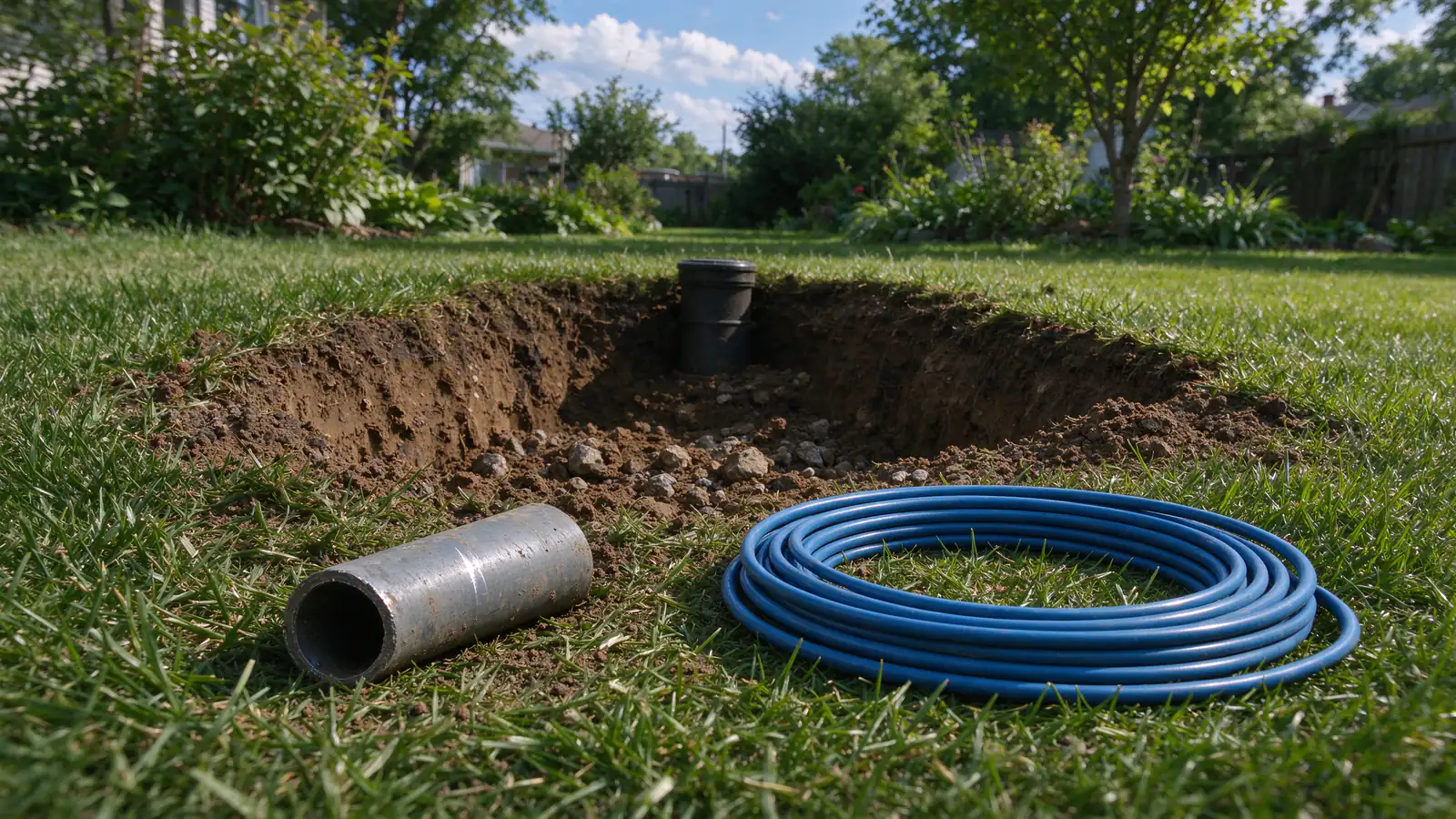
Citizens Energy Group’s lead service line replacement program replaces customer-owned lead lines on both sides of the property line. In prioritized project areas it does the whole line at no direct cost once the owner signs a Right of Entry agreement. Elsewhere, Citizens pays for the street-side portion and the owner pays for the private side and a move of the meter outside.
Circle City Repipe replaces lead service lines on the private side in Indianapolis through a plumber registered and bonded with Citizens, and replaces the supply pipe inside the house, with the work carried out by licensed and insured contractors. This guide explains the program from the owner’s side. The lead service line replacement page covers the work itself.
What the program is
The Indiana Utility Regulatory Commission approved Citizens’ Lead Service Line Replacement Program in 2022. It covers customer-owned lead service lines, meaning the pipe from the water main to the house that Citizens says belongs to the property owner; the water line replacement page explains that ownership split. It replaces lead and galvanized iron components from the main to the home, both in the public right-of-way and on the owner’s property.
Citizens describes several ways a line gets replaced under the program: as part of its capital projects in the street, as an emergency replacement when a lead line fails, proactively in prioritized areas, at the owner’s request, and by cutting off abandoned lead lines that no longer serve anything. Most owners meet it in one of two ways, a project reaching their street or a decision to go first. The scale is large. Citizens estimates that between 55,000 and 75,000 customer-owned service lines in its system contain lead, and it has said that lead in service lines and plumbing was common in homes and buildings built before 1950.
Why you got a letter
Utilities across the country now have to inventory their service lines under federal lead rules, and Citizens mails letters to customers who own, or may own, a line made with lead. Letters sort lines into groups such as non-lead, lead, galvanized requiring replacement and unknown. An “unknown” letter means Citizens has not confirmed the material, not that the line is lead.
Citizens also publishes a service line map at citizensenergygroup.com/service-line-map, where an owner can look up the material on record for their own address. The record and the pipe do not always agree, so it is worth looking at where the line comes through the foundation. Lead is dull gray, soft and shows bright silver when scratched lightly, and a magnet will not stick to it. The guide to identifying pipe material walks through those checks, and the are galvanized pipes safe guide covers why galvanized lines can be listed for replacement too.
A letter is not a bill and not an order to hire anyone. It is notice of what Citizens has on record, and often the first step before a project area is scheduled.
When the program reaches your street
In a prioritized area, Citizens’ own contractor replaces the line from the main to the home “at no cost to the customer provided that an approved Right of Entry Agreement is signed by the property owner,” in Citizens’ words. Because the private side belongs to the owner, Citizens cannot work on it without that signature. Owners who have signed one describe it as permission for crews to come onto the property, dig, and get into the house where the meter or line enters.
The work follows Citizens’ standards. The new line is SDR9 polyethylene, the meter moves to a pit outside, typically 1 to 3 feet from the right-of-way line, and Citizens says the new line is flushed, sampled and tested. Inside, the line is tied in at the foundation wall. Homeowners report that some ground settling at the new pit and the entry point afterward is worth watching and raising with Citizens.
What the program does not do is touch the plumbing beyond that tie-in. If the pipe inside the basement is old galvanized or there are lead fittings near the entry, they stay. A worn main shutoff valve just inside the wall is worth looking at while the line is being replaced.
Not in a project area yet?
Find out what the private side would involve at your address, and whether the interior pipe should be planned with it.
If your street is not in a project area
An owner outside a project area can start a replacement. Citizens’ owner-initiated route has three conditions: the line must be lead and/or galvanized iron on the private property, lead in the right-of-way, and active within the past six months. A private side that is copper or polyethylene does not qualify, even if the street-side portion is lead.
Citizens then splits the cost. It pays for the right-of-way portion. The owner pays for the private side, from the house to the property line, and for moving the meter to an outside pit. There are two ways to get the private side done:
- A quote from Citizens’ contractor. Citizens arranges a quote, and its contractor does the work.
- A plumber registered and bonded with Citizens. The owner hires the plumber, who files a service line modification permit and replaces the private side to Citizens’ standards. Once it passes, Citizens replaces the right-of-way portion within 45 days.
Citizens publishes no price for the private side, because it depends on the lot: the distance to the house, what the route crosses, how deep the line runs and where the pit goes. The Citizens meter pit relocation guide covers the meter part, which is often the piece owners do not expect.
Waiting or going first
The trade-off is cost against timing. Waiting for a project area can mean no direct cost, but only Citizens knows when an area will be scheduled. Going first means paying for the private side, with Citizens still covering the street side. Owners usually move first because something else forces the timing: a sale, a renovation that opens the basement, a leak on the old line, or a household where lead exposure matters most, such as one with young children. The buying a house with old pipes guide covers the sale side.
There is also a rule that removes the choice in one case. Citizens does not allow a lead line that is being modified to be only partly replaced; it has to be replaced in full, from the main to the home. A leak on a lead line therefore turns into a full replacement rather than a patch.
What the program leaves inside the house
The program is a service line program. Citizens says that homes built before 1950 may have lead interior plumbing and that some homes built before 1986 may have lead solder in the joints of copper pipe. Neither is covered. There is no federal tax credit for water piping either, and the Indiana Finance Authority’s lead line funding goes to water utilities, not to homeowners.
That makes a replacement a useful moment to look at the rest. The new line ends just inside the foundation wall, and that is exactly where a whole-house repipe begins. Where the interior pipe is galvanized or old copper, planning both at once means one tie-in rather than two, and the complete guide to repiping explains how that scope is set. A test of the tap water after the work shows what is still coming from inside the house; Citizens’ lead and copper information explains how to get water tested.
Where to start
Start with the letter and the map, then ask Citizens whether the address is in or near a project area. If it is, the next step is the Right of Entry agreement. If it is not, and the line qualifies, the private side can be priced through the bonded-plumber route. To have the line at the foundation identified and the interior pipe looked at in the same visit, call Circle City Repipe.