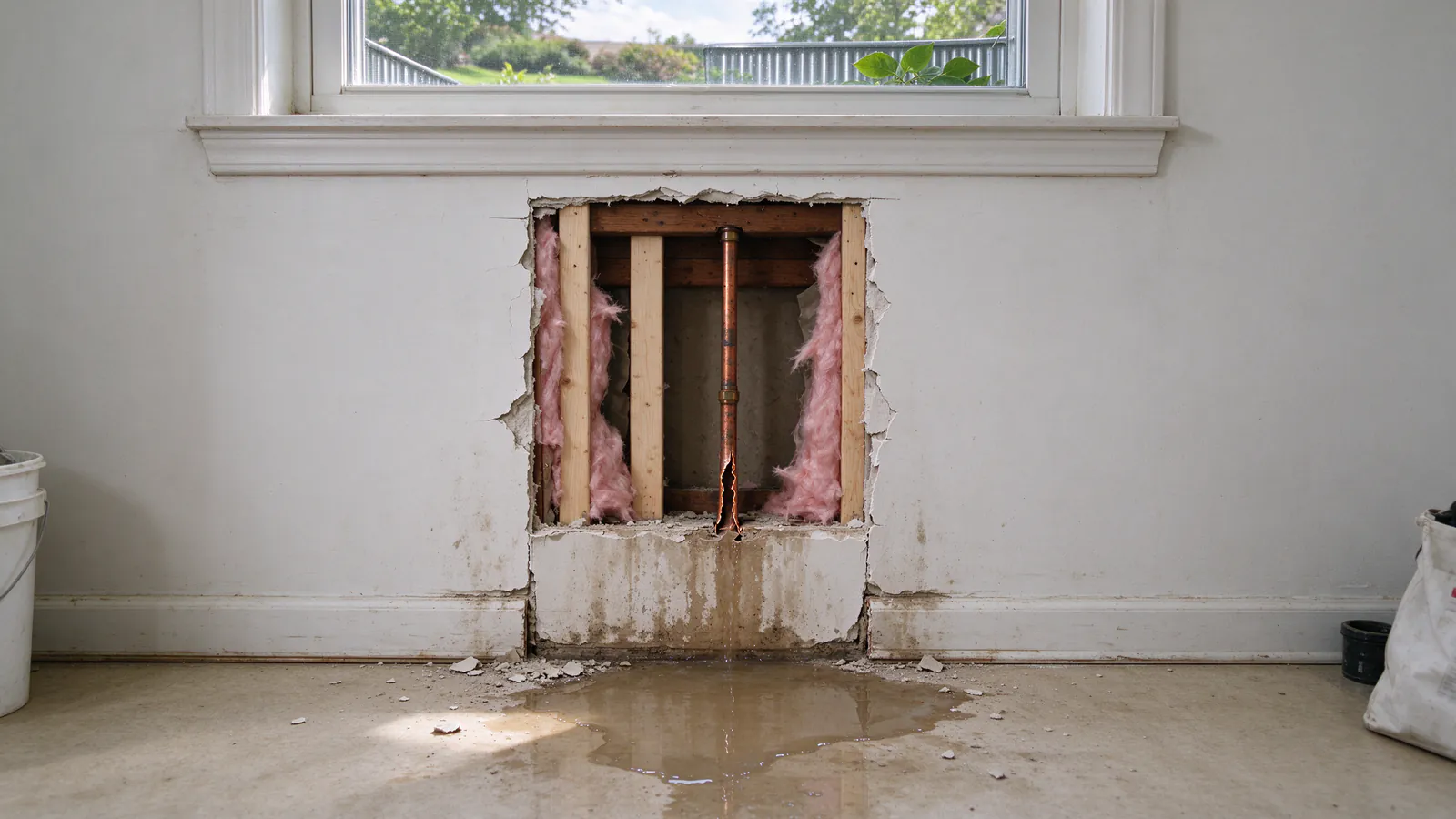
Usually not the repipe itself. Homeowners policies are commonly written around sudden, accidental damage rather than wear, so a policy may pay for water damage from a burst pipe while treating the worn-out pipe that caused it as maintenance. Whether a particular policy covers any part of it depends on its wording and on the insurer’s decision on the claim, not on general rules.
Circle City Repipe offers repiping and pipe repair across Indianapolis and nearby communities, carried out by licensed and insured contractors. A plumbing company cannot tell anyone what their policy covers, and this guide does not try to. What it can do is explain how insurance questions around pipe usually divide, so the right questions go to the insurer. For the repipe decision itself, see whole-house repiping.
The damage and the pipe are separate questions
A burst pipe produces two losses: the pipe and whatever the water reached. Policies commonly look at them differently. Water damage from a sudden, accidental discharge is the kind of loss a homeowners policy is built around. The pipe that failed because it was old, corroded or worn out is usually treated as wear and tear, which most policies leave to the owner.
That difference explains why a repipe is rarely covered. Replacing galvanized steel that has corroded for decades, or copper that has started pinholing, is replacing pipe that wore out. It is closer to a new roof than to a storm claim. The damage from the leak that prompted it may still be a covered loss, depending on the policy.
Gradual leaks are the hard case. A slow drip inside a wall that has rotted the subfloor over months is often excluded as continuous or repeated seepage, even though the same water from a sudden burst might have been covered. That is one more reason to deal with a stain or a musty closet as soon as it appears.
Burst pipes from freezing
Indianapolis averages about 105 nights a year at or below freezing, according to NOAA’s 1991 to 2020 normals, so freeze damage is a common claim question here. Many policies cover freeze damage only if the owner took reasonable care to keep the house heated, or shut off and drained the water. Vacancy clauses can also limit coverage after a house has sat empty for a period the policy defines.
Those conditions matter most for a house between owners, a rental between occupants or a winter spent away. The what to do when a pipe bursts guide covers the first steps, and the burst pipe repair page covers the repair.
Slab leaks
A leak in a supply line under a concrete slab raises the access question in its sharpest form: the pipe, the concrete over it and the water damage are three costs. Some policies pay to break and restore the slab to reach a covered leak and some do not, and the repair itself is often treated separately. Rerouting the line overhead instead of breaking the slab can change all three numbers. The slab leak repair page explains the options.
The service line from the meter to the house
In Citizens Energy Group territory, the property owner owns the full length of the water service line. Citizens repairs leaks in the public right-of-way, and a leak on the private side is repaired by a licensed and bonded plumber at the owner’s expense. Many standard homeowners policies do not cover wear on underground service lines, and some insurers sell a service line endorsement that does. Utility-branded service line plans are a separate product with their own terms.
Where the line is lead or galvanized, the Citizens lead service line program guide explains when Citizens pays for replacement, which is a program, not insurance. The water line replacement page covers the work.
Need the facts on paper?
A written scope records the pipe material, the condition found and what the work replaces, which is what an insurer may ask to see.
When an insurer asks about the pipe
Insurance questions also come up before anything breaks. Some insurers ask about galvanized steel or polybutylene supply pipe when writing or renewing a policy, and an inspection report at a sale can raise the same question. Answers vary by insurer, so one company’s decision says nothing about another’s.
A repipe documented by a closed permit and a passed final inspection gives an insurer something specific to read. Inside Indianapolis, that permit comes from the Department of Business and Neighborhood Services. The Indianapolis repiping permit guide covers it, and the guide to buying a house with galvanized pipes covers the sale side.
What to keep if a pipe fails
A claim is judged on the facts, and the facts disappear during cleanup. Keep:
- Photos and video of the break, the water and the damage, taken before anything is moved.
- The failed section of pipe, or clear photos of it, including its inside.
- The repair invoice, with the pipe repair, the access opening and any patching listed separately.
- A short written note of what was found and the likely cause.
- Receipts for drying equipment, cleanup and temporary repairs.
Ask the insurer what they need before the damaged materials go in a dumpster. An itemized invoice matters because an adjuster may treat the pipe, the access and the damage differently, and a single lump sum makes that impossible.
Programs that are not insurance
Some costs have help outside insurance. Citizens’ Lead Service Line Replacement Program replaces lead and galvanized service lines at no direct cost in prioritized areas once the owner signs a Right of Entry agreement, and shares the cost outside them. It does not pay for interior plumbing. There is no federal tax credit for water piping. The Indianapolis repipe cost guide lists the programs.
For questions about a policy itself, the insurer is the first stop, and the Indiana Department of Insurance handles consumer questions about insurers operating in the state. For a written description of the pipe and what a repair or repipe would replace, call Circle City Repipe.