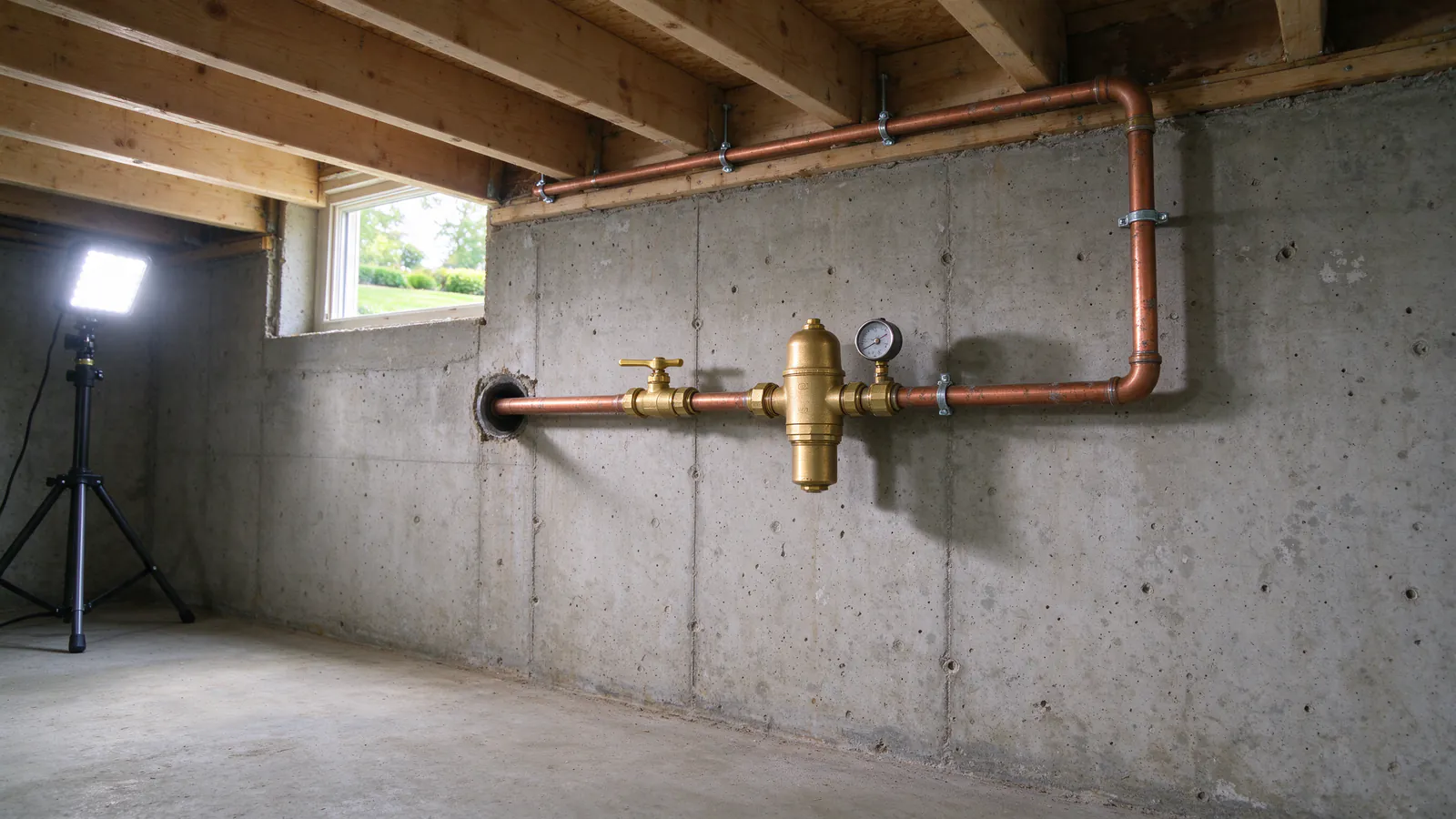
Circle City Repipe replaces pressure reducing valves in Indianapolis houses and small buildings, and in nearby communities across Marion and the surrounding counties. Pressure reducing valve replacement swaps the bell-shaped brass valve near the main shutoff, the one that lowers street pressure to a steady house pressure, for a new valve set on a gauge. Before anything is replaced, the incoming pressure is tested, because a valve that is only set wrong can be adjusted and some can be rebuilt. The work is carried out by licensed and insured contractors.
A PRV, or water pressure regulator, sits on the main just after the shutoff where water enters the house. Inside, a spring pushes against a diaphragm connected to a valve seat. When downstream pressure falls because a tap opens, the spring pushes the seat open and lets more water through; when pressure rises, the diaphragm pushes back and the seat closes down. The adjusting screw on top sets the spring, and with it the pressure the house sees. Most also have a strainer screen on the inlet to keep grit out of the seat.
What happens on the first visit
The first visit reads the pressure before it touches the valve. A gauge goes on a hose bibb or laundry connection with nothing running, for a static reading. Where the complaint is banging or a dripping relief valve, a gauge with a maximum-reading needle can stay on for a day to catch spikes overnight. Then flow is checked at fixtures upstairs and down, because a weak shower is just as likely to be scaled galvanized pipe or a clogged fixture as a PRV. The low water pressure page explains how those causes are sorted.
The valve itself is checked next: its age, whether the body or bell is corroded, whether the adjusting screw still turns, the size against the main, and the condition of the pipe either side of it. In older houses the valve may be threaded onto short galvanized nipples that are more corroded than the valve; the guide to identifying pipe material shows how to tell. The water heater is part of the visit too. If the house is a closed system and there is no expansion tank, or the tank has lost its charge, that is part of the problem the valve replacement has to solve.
How a PRV fails
Pressure reducing valves wear in a few recognizable ways. The diaphragm stiffens or tears, so the valve stops responding to changes in demand. The seat wears or collects scale, so it cannot close fully and street pressure leaks past it; that is the valve behind pressure that creeps up overnight. The strainer clogs with sediment and starves the house of flow. The spring weakens and the setting drifts. Indianapolis water is hard, averaging about 19 grains per gallon from Citizens, and the minerals that scale faucets also build on a valve seat, as the hard water guide explains.
Failure can go either way. A valve that sticks closed gives low pressure everywhere, which looks like a supply problem. A valve that sticks open gives the house full street pressure, which looks like nothing at all until supply connectors, toilet fill valves and the water heater start to fail. A burst washing machine hose or supply connector is the expensive version of that; if water is already loose, see emergency pipe repair. Pressure that swings between the two, with banging when a fast-closing valve shuts, is a third pattern. None of those signs proves the valve is the cause until a gauge confirms it, which is why the reading comes first.
Adjust, rebuild or replace
The cheapest fix that solves the problem comes first. If the valve holds a steady pressure but at the wrong level, turning the adjusting screw resets it, and the gauge shows the result immediately. If the setting will not hold, the internals are worn. Some valves take a rebuild kit with a new diaphragm, seat and strainer, which keeps the body and the piping in place. That makes sense when the body is sound and parts exist for the model.
Replacement is the answer when the body or bell is corroded, the model has no parts, the valve is undersized for the main or the threaded pipe around it is failing. The main is shut, the line is drained, and the old valve comes out with whatever corroded nipples or fittings surround it. The new valve, listed to ASSE 1003 and to NSF/ANSI 372 for drinking water, goes in with unions so it can be serviced or replaced later without cutting pipe. It is set on a gauge with water flowing and then checked static, and flow is checked again at the fixtures.
Banging pipes or a dripping relief valve?
A gauge reading at the hose bibb shows whether the PRV is the cause, and whether it needs a new setting, a rebuild or replacing.
Thermal expansion and the expansion tank
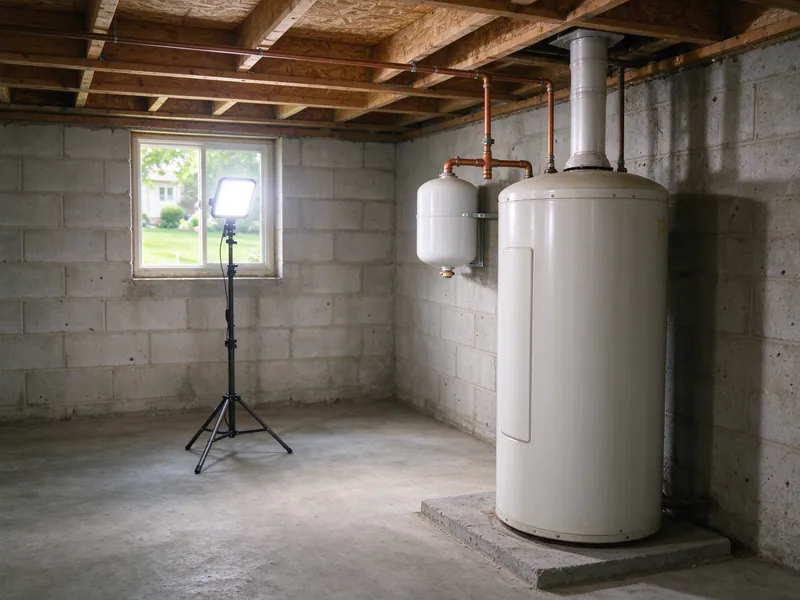
A PRV changes how the whole system behaves. Many pressure reducing valves, and any backflow device at the meter, stop water from flowing back toward the street. That makes the house a closed system. When the water heater warms a tank of cold water, the water expands, and with nowhere to go, the pressure in every pipe rises until a tap opens or the relief valve on the heater lets some out. A relief valve that drips after each heating cycle is the classic sign.
A thermal expansion tank solves it. It is a small steel tank with an air charge behind a bladder, installed on the cold supply to the heater. As heated water expands, it pushes into the tank instead of raising the pressure in the pipes. The tank’s air charge has to match the house pressure the PRV is set to, so the tank and the valve are set up together. An existing tank with a failed bladder or a lost charge does nothing and is checked as part of the job.
Main valve, piping and where the PRV sits
The PRV and the main shutoff sit next to each other, and they are usually worth looking at together. If the main is an old gate valve that will not close fully, it cannot isolate the PRV for the swap, and replacing it at the same time costs little extra while the water is already off. The main water shut-off valve replacement page covers that work, including the rules when a valve sits in a Citizens meter pit rather than inside the house.
The pipe around the valve matters as much as the valve. Where the main is galvanized, the threads at the PRV are often the most corroded point in the house, and a new valve on old nipples is a short-lived repair. Where the house is being repiped, the PRV, the main valve and the expansion tank belong in the repipe scope instead of a separate visit; the whole-house repiping page covers how valves fit into it, and galvanized pipe replacement covers the main itself.
Permit and code
Whether a straight PRV swap needs a City of Indianapolis plumbing permit is confirmed for each job before work starts. The City exempts some in-kind replacement from permits, and the repiping permit guide explains how that exemption works and how the excluded cities differ. Any valve or fitting installed has to meet the Indiana Plumbing Code, 675 IAC 16-1.4, which is based on the 2012 International Plumbing Code.
What moves the price of PRV replacement
PRV replacement is priced by the valve and what surrounds it. The drivers are the size of the main, 3/4-inch or 1-inch; whether the old valve can be adjusted or rebuilt rather than replaced; how the valve connects, by threads, sweat joints or press fittings; whether corroded galvanized nipples or a section of old main have to be replaced with it; whether the main shutoff is replaced at the same time; whether an expansion tank is needed; and access, from an open basement wall to a tight crawlspace. Repeat PRV failures on a main that is also leaking or restricting flow are a reason to compare a partial repipe, and the repipe vs repair guide explains where that line usually falls.