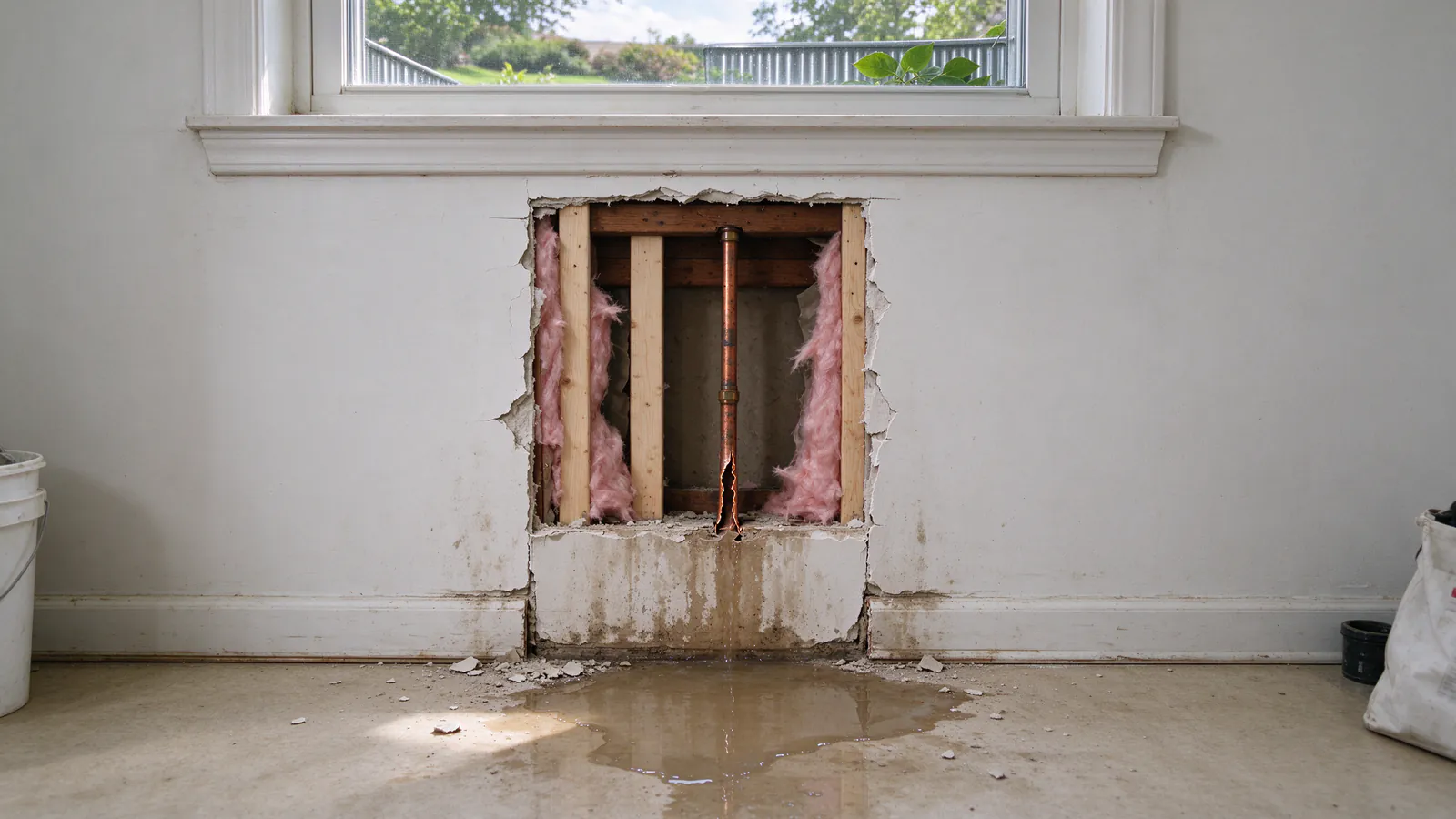
When a pipe bursts, shut off the water at the main valve first. Then cut the power to anything the water can reach, open a faucet at the lowest point to drain the lines, and turn the water heater down or off. After that, photograph the damage, move what you can and start drying. The repair can wait a few minutes for the water to stop; the water will not wait for the repair.
Circle City Repipe offers emergency response for burst pipes and active leaks across Indianapolis and nearby communities, including after hours, with the repair carried out by licensed and insured contractors. This guide covers what to do before anyone arrives. The burst pipe repair page covers the repair itself, and the emergency pipe repair page explains how an emergency call works.
Shut off the water at the main
The main shutoff sits where the service line enters the house. In most Indianapolis houses with a basement, that is low on the wall facing the street, close to the meter if the meter is inside. In a house on a crawlspace or slab it may be in a utility closet, beside the water heater or under the kitchen sink. Turn it clockwise until it stops.
What you find there tells you how quickly this will go. A lever handle is a ball valve: a quarter turn closes it, and it usually seals. A round wheel handle is a gate valve, the standard in older houses. It needs many turns, and an old one may stop partway, leak at the stem or never quite seal. If a gate valve will not move with firm hand pressure, forcing it with a wrench can snap the stem and leave you worse off.
When the main will not hold, the next place to stop the water is the meter. Many Indianapolis houses have an outside meter pit near the property line, and in Citizens Energy Group territory the property owner maintains that pit. Citizens can shut the water off at the street. Homeowners report that turning a curb valve themselves risks breaking it, and the cost of a broken one can land on the owner. A main shutoff that fails when you need it is worth replacing once the emergency is over; main water shut-off valve replacement swaps it for a quarter-turn valve.
Make the room safe
Ceilings fail before walls do. Water from an upstairs bath or a second-floor supply line collects on top of the drywall or plaster below, and a ceiling that has started to sag can come down without much warning. Clear the room under it and put a bucket under the drip.
Drain the lines and deal with the water heater
Closing the main stops new water, but the pipes above the break are still full. Open a cold tap at the lowest point in the house, such as a basement laundry tub or an outside hose bibb, and one upstairs to let air in. The lines empty through those taps instead of through the break.
Then turn the water heater down. On a gas heater, set the control to pilot or vacation. On an electric heater, switch its breaker off, because an element that heats with no cold water coming in can burn out. Leave the tank’s drain alone unless it is the tank that failed.
Record the damage before cleanup
Before mopping or throwing anything out, take photos and a short video: the break itself, where the water went, the wet materials and anything ruined. Note the time you found it. Ask whoever repairs the pipe to keep the damaged section and photograph it, because the piece of pipe that failed is the clearest record of why it failed. Keep every receipt from that day forward.
Call the insurer early, but do not assume what the policy will do. Homeowners policies are commonly built around sudden damage rather than wear, and they differ from one insurer to the next. The homeowners insurance and repiping guide explains how the damage and the pipe can be treated separately.
Start drying
Move furniture, rugs and boxes off wet floors and prop up what you cannot move. Mop or vacuum up standing water, then run fans and a dehumidifier. Wet carpet pad, soaked insulation and drywall that has been wet for a long time usually have to come out, and that is restoration work rather than plumbing.
That split matters for the bill too. A burst pipe repair typically runs about $400 to $1,500 for the pipe itself in the Indianapolis area, after-hours calls push toward the high end, and water damage cleanup is separate. The Indianapolis repipe cost guide lists what each repair range covers.
Water still coming through?
Emergency response is available for burst pipes and active leaks, after hours included. After-hours calls cost more.
If the pipe froze first
Indianapolis is freeze country. NOAA’s 1991 to 2020 normals for Indianapolis International Airport average about 105 days a year with a low at or below 32 F, and about three days a year at or below 0 F. The pipes that freeze are the ones near the cold: runs in exterior walls, crawlspaces, unheated garages, attics and the rim joist where the main comes in, plus outside hose bibbs.
A pipe that freezes usually splits while frozen, then leaks once it thaws, so the burst often appears on the first mild morning after a cold snap. If a line is frozen but not leaking, open the faucet it feeds and warm the pipe gently with a hair dryer or a space heater kept well clear of anything that burns. Never use an open flame or a torch inside a wall. If you suspect a split, close the main before it thaws.
PEX tolerates freezing better than copper or galvanized, but it can still fail at fittings, and new material alone does not remove the exposure. Moving a line out of an exterior wall does. The winter freezing pipes post covers prevention.
What the repair involves
The repair starts by finding the break, which is obvious with a split hose bibb and harder with a line inside a ceiling. The damaged section is cut out and replaced with new pipe and fittings, the line is refilled and tested under pressure, and the water is turned back on. A break behind a finished wall or ceiling means an opening and a patch. When the leak cannot be seen, water leak detection narrows it down before anything is cut, and water leak repair covers a concealed leak that is not a full burst.
A leak outside the house is a different job. In Citizens territory the owner owns the service line, a leak on the private side is repaired by a licensed and bonded plumber at the owner’s expense, and Citizens repairs leaks in the right-of-way. If the house has an inside meter and the repair runs longer than three feet, Citizens rules move the meter to an outside pit at the owner’s expense. The service line and meter pit guide and the water line replacement page explain that work.
After the emergency: one break or a pattern?
Once the water is off and the pipe is fixed, the useful question is why it broke. A freeze in one exposed run, a nail through a line or one failed connector is a single event, and the repair is the answer. Galvanized pipe that splits at a thread, or copper with a second pinhole a few feet from the first, points at a system that is wearing out. The cut-out section usually says which. The repipe vs repair guide works through that decision, and whole-house repiping describes the larger job when it comes to that.
If the water is still running and you cannot stop it, call Circle City Repipe for emergency response.