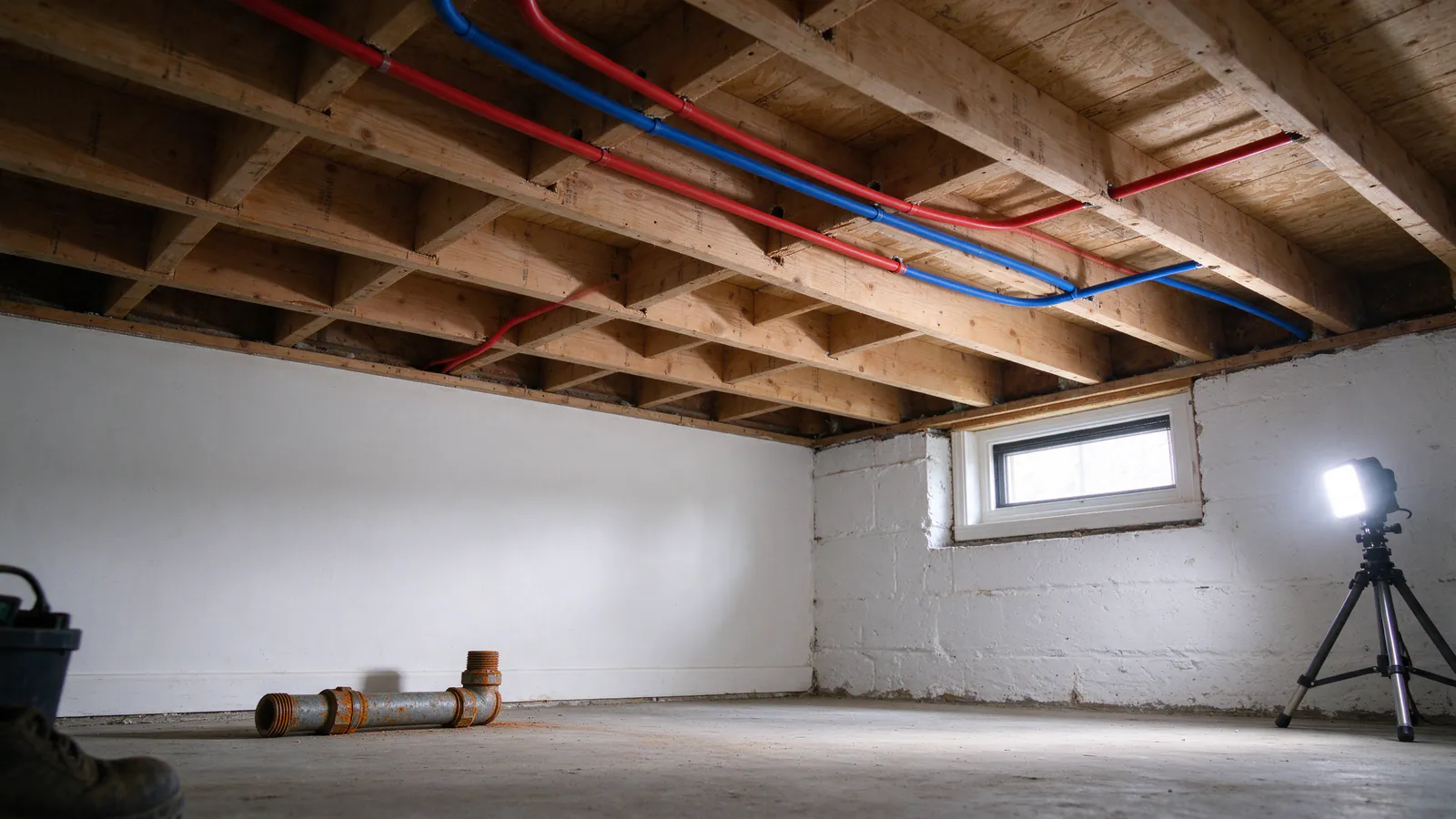
A whole-house repipe in the Indianapolis area typically costs $4,000 to $15,000 or more, and larger multi-story, tile-heavy or copper jobs can run higher. That is a typical local range, not a quote. Circle City Repipe gives a written scope and price for a specific house only after the pipe has been looked at, because fixture count, stories, access and patching decide where a house lands.
Typical ranges for repipe and pipe repair work
The ranges below are typical for Indianapolis-area work. Each one says what it usually covers, because a number without its scope is not comparable to anything.
| Work | Typical range | What it usually covers |
|---|---|---|
| Whole-house repipe, any material | $4,000 to $15,000+ | All hot and cold supply pipe from the main shutoff to the fixtures; larger multi-story, tile-heavy or copper jobs can run higher |
| Pipe repair, accessible | About $150 to $650 | A pinhole or short section of pipe that can be reached without opening a finished surface |
| Pipe repair, behind a wall or ceiling | About $300 to $1,200 | The same repair plus opening and patching the wall or ceiling |
| Water leak repair, one concealed leak | About $350 to $1,200 | Finding and fixing one leak behind a wall or ceiling, a small access opening and a basic patch; finish work and water damage are extra |
| Burst pipe repair | About $400 to $1,500 | The pipe repair itself; water damage cleanup is separate, and after-hours calls push toward the high end |
The whole-house range is wide because houses are. Converting galvanized pipe to PEX or copper is priced as a whole-house repipe; the pipe coming out matters less than the pipe going in and the route it takes. A partial repipe of one bath group or one floor costs less than a whole house, but it has no published local range, so it is priced from the same drivers once the boundary is drawn. Pipe repair, water leak repair and burst pipe repair each have their own page with what the repair includes.
PEX and copper costs
For the same house, PEX usually costs less than copper. PEX is flexible, so it can be pulled through a wall cavity from below without opening the wall at every turn, and a run that needs six copper fittings may need one PEX fitting or none. Fewer fittings mean fewer joints to make and fewer openings to patch. Copper is rigid, so each change of direction needs a fitting and room to make the joint.
The material gap has also widened. In the Bureau of Labor Statistics producer price index, copper mill products rose about 30% over a recent twelve months, while plastic pipe rose about 4 to 5%. That does not set a fixed premium for copper, because labor and access still drive most of the price, but it pushes a copper repipe toward the upper part of the whole-house range. The PEX vs copper guide covers the tradeoffs beyond price, and the PEX repiping and copper repiping pages describe how each is installed.
Stories, basements and access
A two-story house costs more to repipe than a one-story house of the same size, because every upstairs fixture needs a riser and every riser needs a route. In an older Indianapolis house with plaster interior walls, those routes are what the price really depends on. A closet stacked under the upstairs bath or an open chase beside the drain stack can carry the risers with few openings. Without one, the pipe goes up through finished walls, and each opening has to be cut, then closed.
Below the first floor, a full unfinished basement is the easiest case: the main and most branches run along exposed joists. A crawlspace works the same way but takes longer, and a tight or wet one takes longer still. A finished basement ceiling has to be opened along the main route. Slab sections, such as a later addition, usually get new lines overhead rather than under the floor.
What moves the price
| Factor | Pushes toward the low end | Pushes toward the high end |
|---|---|---|
| House size and fixture count | One bath, kitchen, laundry | Two or more baths, a second kitchen or wet bar |
| Stories | One story over a basement | Two or three stories with baths on each |
| Access below | Open basement | Finished basement ceiling, tight crawlspace or slab |
| Walls and finishes | Drywall, stacked baths, open chases | Plaster on lath, tile walls, built-in cabinets in the way |
| Material and layout | PEX, trunk-and-branch | Copper, or a home-run manifold with more tubing |
| Valves and extras | Fixture stops only | New main shutoff, pressure-reducing valve, expansion tank, recirculation return line |
| Service line interface | The existing main valve and meter setting stay | Meter moved to an outside pit or service line work at the same time |
| Patching scope | Owner closes the openings | Openings patched, textured and painted to match |
| Occupied-home protection | Empty house | Staged work around a household, extra dust protection |
Each item in that table is something a walk-through can see, which is why a written price only comes after one. The cost estimator shows how several of these factors move a planning range.
What’s inside an Indianapolis repipe price
A repipe price is labor, material, the permit and restoration. Some of those parts have public figures and some do not.
| Part of the price | What sets it | Local figure |
|---|---|---|
| Plumbing labor | Fixture count, stories, routes and access | Median plumber wage $37.01 an hour in the Indianapolis metro, against $30.67 nationally, about 21% higher (U.S. Bureau of Labor Statistics) |
| Pipe and fittings | PEX or copper, layout, number of fittings | Copper mill products up about 30% over a recent twelve months, plastic pipe about 4 to 5% (BLS producer price index) |
| Plumbing permit | The office that covers the address | $153 up to 1,000 sq ft plus $23 per additional 500 sq ft for an existing home in the City of Indianapolis; $175 per reinspection (Department of Business and Neighborhood Services) |
| Service line, where it is part of the job | Length, depth, crossings, meter setting | No public price; a full replacement must be SDR9 polyethylene with tracing wire, and a house with an inside meter gets an outside meter pit at the owner’s expense (Citizens Energy Group) |
| Valves, connectors and the water heater hookup | New main shutoff, fixture stops, expansion tank | No public figure; listed in the scope |
| Wall and ceiling patching | Number and size of openings, plaster or drywall, texture and paint | No public figure; a scope item to check |
| Old pipe | Removed where reachable, capped where not | No public figure; listed in the scope |
A wage is not a billing rate. The hourly price a plumbing company charges also carries licensing, City registration, insurance, vehicles, tools and office costs. The wage figures matter for another reason: plumbers in the Indianapolis metro earn a median $37.01 an hour, about 21% above the $30.67 national median, so a national average cost figure can understate what the same job costs here.
Plumbing permit fees by office
Who issues the permit depends on the address, and so does the fee.
| Where the house is | Who issues the permit | Fee |
|---|---|---|
| City of Indianapolis, existing home | Department of Business and Neighborhood Services | $153 up to 1,000 sq ft, plus $23 per additional 500 sq ft (about $199 for a 2,000 sq ft home) |
| City of Indianapolis, multifamily or commercial | Department of Business and Neighborhood Services | $182 for up to 10 fixtures, plus $23 per additional 5 fixtures |
| City of Indianapolis, failed inspection | Department of Business and Neighborhood Services | $175 per reinspection |
| Greenwood | Community Development Services | $75 for a residential plumbing permit; any combination of trade permits capped at $225 |
| Lawrence, Beech Grove, Speedway and the suburbs | The city or town building department | Set locally; confirmed per address |
Inside Indianapolis, in-kind pipe replacement is exempt from a permit only up to 20 percent of all the piping in the structure, so a whole-house repipe and most partial repipes need one. The Indianapolis repiping permit guide covers who can pull the permit and what the inspections check.
Want a number for your house?
A walk-through turns these ranges into a written scope: material, openings, permit and price.
Programs that pay for part of the work
The programs that exist pay for the service line outside the house, not the pipe inside it.
| Program | Who runs it | What it covers | What it does not cover |
|---|---|---|---|
| Lead Service Line Replacement Program, prioritized areas | Citizens Energy Group | Lead or galvanized service line components from the main to the home, at no direct cost, once the owner signs a Right of Entry agreement | Interior plumbing |
| Property-owner-initiated replacement | Citizens Energy Group | Citizens pays for the right-of-way portion; the owner pays for the private side and the meter move to an outside pit | Interior plumbing; lines that are copper or polyethylene on the private side |
| State revolving fund lead line funding | Indiana Finance Authority | Low-interest and forgivable loans to water utilities for full service line replacements | Payments to homeowners |
| Federal tax credits | Internal Revenue Service | Energy property, not water piping | Repiping of any kind |
The Citizens lead service line program guide explains eligibility and how the program’s timing can line up with an interior repipe. Homeowners insurance is a separate question, and the insurance and repiping guide covers what policies tend to separate.
Two example budgets (illustrative)
These examples are illustrative, built from the typical ranges and the City’s published permit fee. They are not quotes and not real jobs.
- A one-story, 1,500 sq ft house over an open basement, one bath, repiped in PEX. The main and most branches run on exposed joists, with openings mainly behind the kitchen sink and the tub. A house like this would usually sit in the lower part of the $4,000 to $15,000+ range. The City permit would be $176.
- A two-story, 2,000 sq ft prewar house with plaster walls and two baths, repiped in copper. Two floors of fixtures, risers through plaster and a copper choice put a job like this in the upper part of the range or above it. The City permit would be about $199, plus $175 for any reinspection.
What doesn’t belong in a repipe price
A supply repipe replaces the hot and cold drinking water pipe inside the house. The buried service line, the drains and vents, the sewer and the fixtures themselves are separate work with separate prices. Water line replacement and cast iron stack replacement are each priced on their own scope, even when they happen while the walls are open for a repipe. Water damage cleanup after a leak is a restoration job, not a plumbing one.
To turn these ranges into a number for your house, try the repiping cost estimator, read the repipe vs repair guide if you are weighing a smaller fix, or call Circle City Repipe to set up a walk-through.