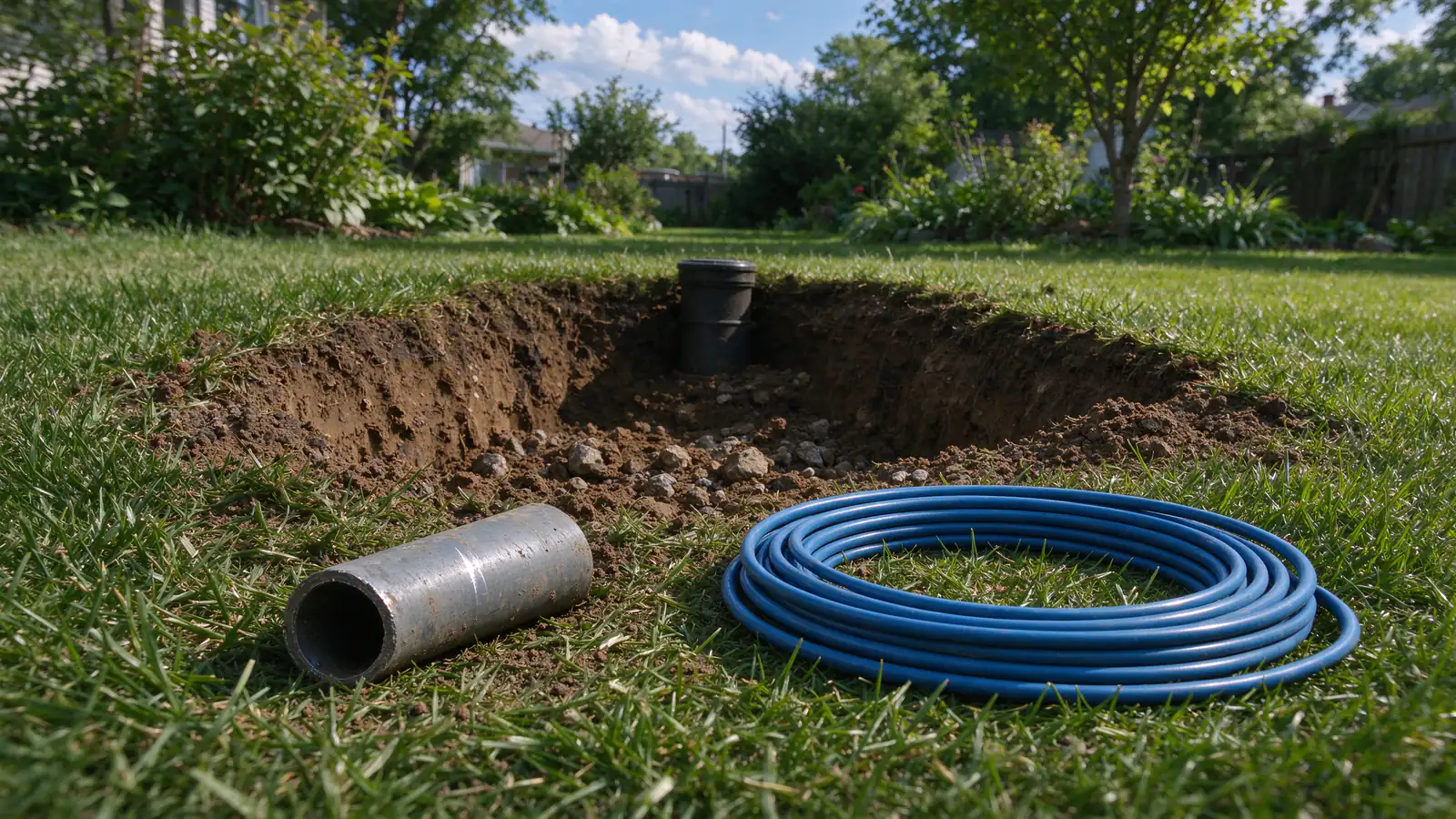
The lead service line replacement rule is the federal requirement that drinking water systems find and replace lead service lines within ten years. The U.S. Environmental Protection Agency finalized it as the Lead and Copper Rule Improvements on October 8, 2024, and water systems must comply starting November 1, 2027, when the ten-year replacement period begins.
Circle City Repipe replaces lead and galvanized water service lines and repipes the plumbing inside houses across Indianapolis and nearby communities, with the work carried out by licensed and insured contractors. This post explains what the rule asks of water systems and what it means for a house here.
What the rule requires
EPA’s Lead and Copper Rule Improvements page describes the rule as requiring drinking water systems across the country to identify and replace lead pipes within ten years. The details, from EPA’s published questions and answers for states and water systems:
- Full replacement, not partial. Systems must replace every lead service line and every “galvanized requiring replacement” line under their control, the whole length, regardless of their lead test results.
- A ten-year pace. The rule sets a minimum replacement rate of 10 percent a year, measured as a running average, which works out to a ten-year deadline. States can require a faster one where it is feasible.
- Public inventories. Systems must keep an inventory of the material of every service line, update it each year, make it public and identify every line of unknown material by the deadline. People served by a lead, galvanized requiring replacement or unknown line get an annual notice.
- A replacement plan. Systems with any lead, galvanized requiring replacement or unknown lines must submit a replacement plan by November 1, 2027, including a funding strategy and how they will tell customers before work starts.
- A lower action level. The lead level that triggers action drops from 15 to 10 parts per billion on the compliance date.
A narrow exception lets a system with a very high share of lead lines take longer than ten years: one that would need to replace more than 39 lines per 1,000 service connections each year. EPA’s page is the place to check the rule’s current status before relying on any date.
Why galvanized lines are included
A galvanized service line is steel pipe dipped in zinc. On its own it is not a lead pipe. But galvanized pipe that sat downstream of a lead line can hold lead particles in its corroded inner wall and release them long after the lead section is gone. That is why EPA requires those lines to be replaced too, and why a galvanized line counts unless the system can show it was never downstream of lead. The guide to whether galvanized pipes are safe covers the same mechanism inside the house.
What the rule does not cover
The rule stops at the service line and lead connectors. It does not require anyone to replace pipe inside the house, and it does not cover lead solder on older copper. Citizens Energy Group notes that homes built before 1950 may have lead plumbing inside as well as a lead service line, and that copper pipe in homes built before 1986 may have lead solder at the joints.
That interior pipe is a whole-house repiping or partial repiping question, done under a plumbing permit. When a service line is replaced, the new line ends at the meter or the house, and what happens to old galvanized or lead pipe past that point is the owner’s decision.
Service line letter in the mail?
Have the line traced from the meter so you know what is buried, what is inside and what each part involves.
How it plays out with Citizens Energy Group
In Citizens Energy Group’s territory the property owner owns the full length of the service line. Citizens runs an IURC-approved Lead Service Line Replacement Program that replaces customer-owned lead lines both in the right-of-way and on private property. In prioritized project areas the replacement is at no cost to the customer once the owner signs a Right of Entry Agreement. Outside those areas, an owner can start the replacement: Citizens pays for the right-of-way portion, and the owner pays for the portion from the property line to the house and for moving the meter to an outside pit.
A full replacement in Citizens territory must be SDR9 polyethylene with tracing wire, and the work is done under a Citizens permit by a plumber bonded with Citizens. Citizens publishes a service line map where owners can look up the recorded material for their own address. The Citizens lead service line program guide and the meter pit guide go further into both paths.
How it plays out in Speedway
Speedway has its own utility, Speedway Water Works, and its own approach. In a community update the Town of Speedway said it has about 4,300 water service connections, that service lines from the main to the home are owned by the property owners, and that its mains are not lead. The town has mailed status letters for lines of unknown material, lines where sampling indicates lead and lines with a confirmed lead portion. It noted that the EPA rule requires all lead service lines to be replaced within ten years starting 2027, and that it is waiting for state guidance and funding; no replacement program or owner cost had been announced in that update. The Town of Speedway’s update and the Speedway service area page have the local details.
What to do if you get a letter
A letter usually means the utility’s inventory lists your line as lead, galvanized requiring replacement or unknown. Unknown is not the same as lead, so the first step is finding out what is actually there, usually where the line enters the house at the meter. Then check whether your street is in a scheduled utility project before paying for a replacement yourself. The lead service line replacement page explains the work, and a request for an estimate starts with tracing the line.