Circle City Repipe offers copper pipe repair in Indianapolis and nearby communities across Marion and the surrounding counties: pinhole leaks, weeping solder joints, corroded fittings and the failures that come with copper as it ages. Copper has been the standard supply pipe in many houses for decades, and it usually fails in a few recognizable ways. Knowing which one you have says whether a repair is the end of it or the first of several. The work is carried out by licensed and insured contractors.
This page is about copper specifically. For galvanized, PEX or CPVC, pipe repair covers the other materials. If water is showing up but the source is not known yet, water leak repair covers finding it. And when copper has been leaking in several places, copper repiping or a switch to PEX may be the better spend.
What happens on the first visit
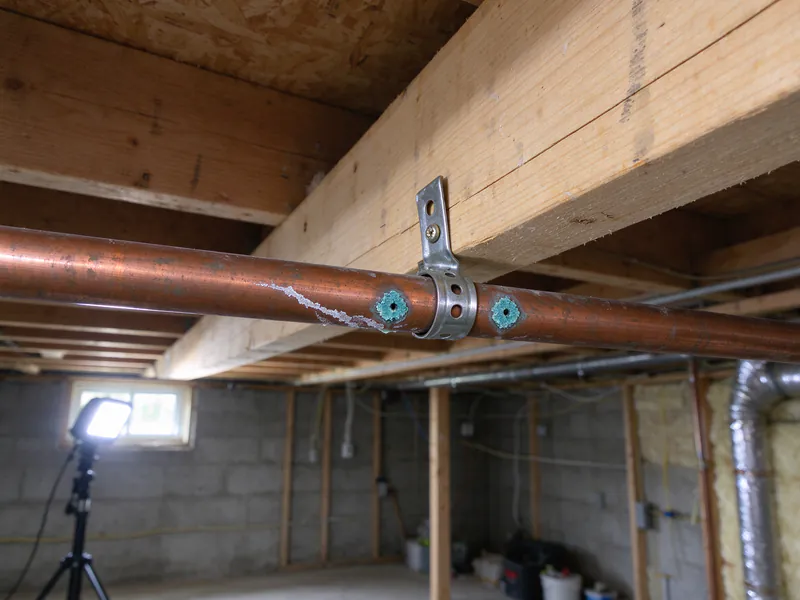
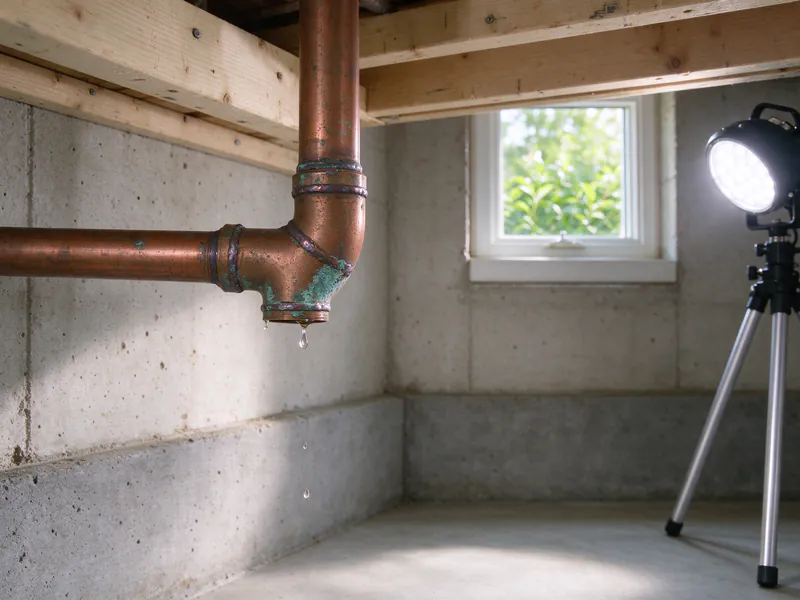
It starts at the leak, then looks beyond it. The exposed run is followed in both directions, looking for green or white crust, dark staining on the pipe, and mineral trails on the joists below. Joints get a close look, because a weeping solder joint and a pinhole in the pipe wall a few inches away mean different things. The pipe type is read where it is printed: Type M copper has the thinnest wall, Type L is heavier, and Type K heavier still. Older houses with thin-walled copper that has started pitting lose margin faster.
Next comes the house around the pipe. Is the leak on the hot side or the cold? Is there a recirculation pump keeping hot water moving? What is the static pressure at a hose bibb? Where does copper meet galvanized, and is there a dielectric fitting at that joint? Is the electrical system bonded to the water pipe, and where? Those answers point to a cause, and the cause decides whether a repair will hold.
Why copper develops pinholes
There is no single cause, and anyone who names one without looking is guessing. Copper pipe protects itself with a thin oxide film on its inner surface. Pinholes form where that film breaks down in a small spot and corrosion digs a pit through the wall instead of spreading evenly. Several things can start that.
Pitting from water chemistry. Some water is more aggressive to copper than others. Low pH, high chlorine or chloramine levels, dissolved oxygen and the balance of minerals all change how stable the film is. Cold-water pitting tends to show as scattered pits under small mounds of corrosion; hot-water pitting is often worse because heat speeds the reaction.
Erosion-corrosion. Water moving too fast, or swirling hard past a burr left at a cut, wears the film away. It shows just downstream of elbows and tees, on hot water lines, and especially on recirculation loops that run constantly. Undersized pipe makes it worse. Homeowners report clusters of hot-side pinholes in basement runs while the cold side holds.
Flux and workmanship. Too much flux left inside the pipe keeps working on the copper long after the joint was made. A cut that was not reamed leaves a lip that disturbs the flow just past the joint. Those failures tend to cluster near joints of the same age.
Galvanic and stray current. Copper joined straight to galvanized steel without a dielectric fitting corrodes the steel side quickly and can damage the copper too. Stray electrical current on the pipe, from a grounding fault or a bonding problem, can cause pitting that looks random. This is one reason a repair to metal pipe keeps the electrical bond continuous.
The copper pinhole leaks guide goes deeper into each cause and how to tell them apart.
Indianapolis water and copper
Indianapolis water is hard. Citizens Energy Group’s published Indianapolis water quality data shows hardness averaging about 19 grains per gallon, varying with the treatment plant serving the address, with an average pH of 7.7. Citizens treats the water with orthophosphate to limit lead and copper leaching from plumbing, and disinfects with chloramine. Its tap sampling has found copper levels well below the federal action level.
What that means for a copper repair is narrow. Hardness scales water heaters and fixtures, and a mild scale layer can even shield copper. It is not, on its own, an established cause of pinholes, so a house with repeated pinholes still needs a look at flow speed, hot-side temperatures, joint workmanship and bonding before anyone blames the water. The Indianapolis hard water guide covers what hard water does and does not do to supply pipe.
A pinhole in your copper?
Have the leak repaired and the pipe around it looked at, so you know whether it is a one-off.
How a copper repair is made
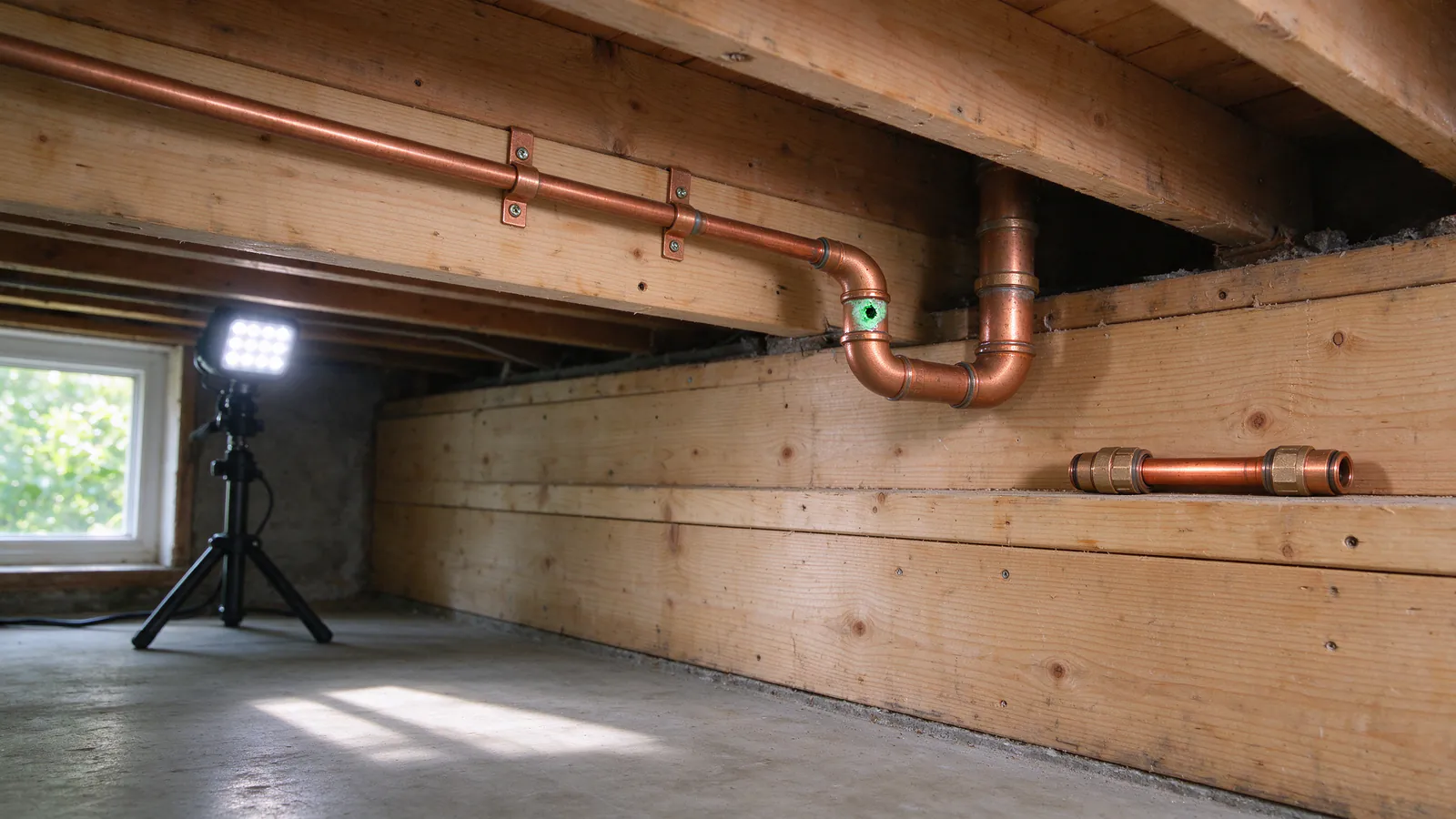
The line is isolated and drained, because solder will not flow on pipe with water in it. The pitted length is cut out back to pipe that is clean and full thickness, which is often a few inches more than the visible damage. A new section is joined with couplings, using lead-free solder and a water-soluble flux that is flushed out afterward, or with copper press fittings where a torch would be unsafe next to framing or finished surfaces. Where the run meets galvanized steel, a dielectric or listed transition fitting goes in. If the cut breaks a metal path that the electrical system is bonded to, the bonding jumper is restored across the gap.
Then the line is pressurized and every joint is checked dry before anything is closed. The pipe cut out is worth looking at: a pit that reaches through a wall that is otherwise full thickness is a local failure, while a wall that is thin and pocked along the whole length is a warning about the rest of the run.
When repeat pinholes mean replacement
One or two pinholes in otherwise sound copper are a repair. A third in a different place on the same run, or pinholes on the hot side spread across the basement, usually means the run is wearing the same way along its length. Replacing one run, often the hot side or one bath group, can be a reasonable step short of a full repipe; the repair or repipe guide sets out the signs. If the copper is replaced, the PEX vs copper guide compares the two, because a house with a chemistry or velocity problem may do better with PEX.
A repair section in a finished wall in Indianapolis normally needs no permit: the City’s Department of Business and Neighborhood Services exempts in-kind replacement up to 20 percent of the piping. Replacing a whole run in a new material can pass that limit.
What copper pipe repair costs
A typical Indianapolis-area range for an accessible pinhole or short copper section is about $150 to $650. When a wall or ceiling has to be opened and patched to reach the copper, the range is about $300 to $1,200. These are the same ranges as other pipe repair, because the work is priced on access and the opening rather than the copper. Repeated pinholes are a reason to price a partial repipe, not a higher repair price, and the Indianapolis repipe cost guide shows how those compare.