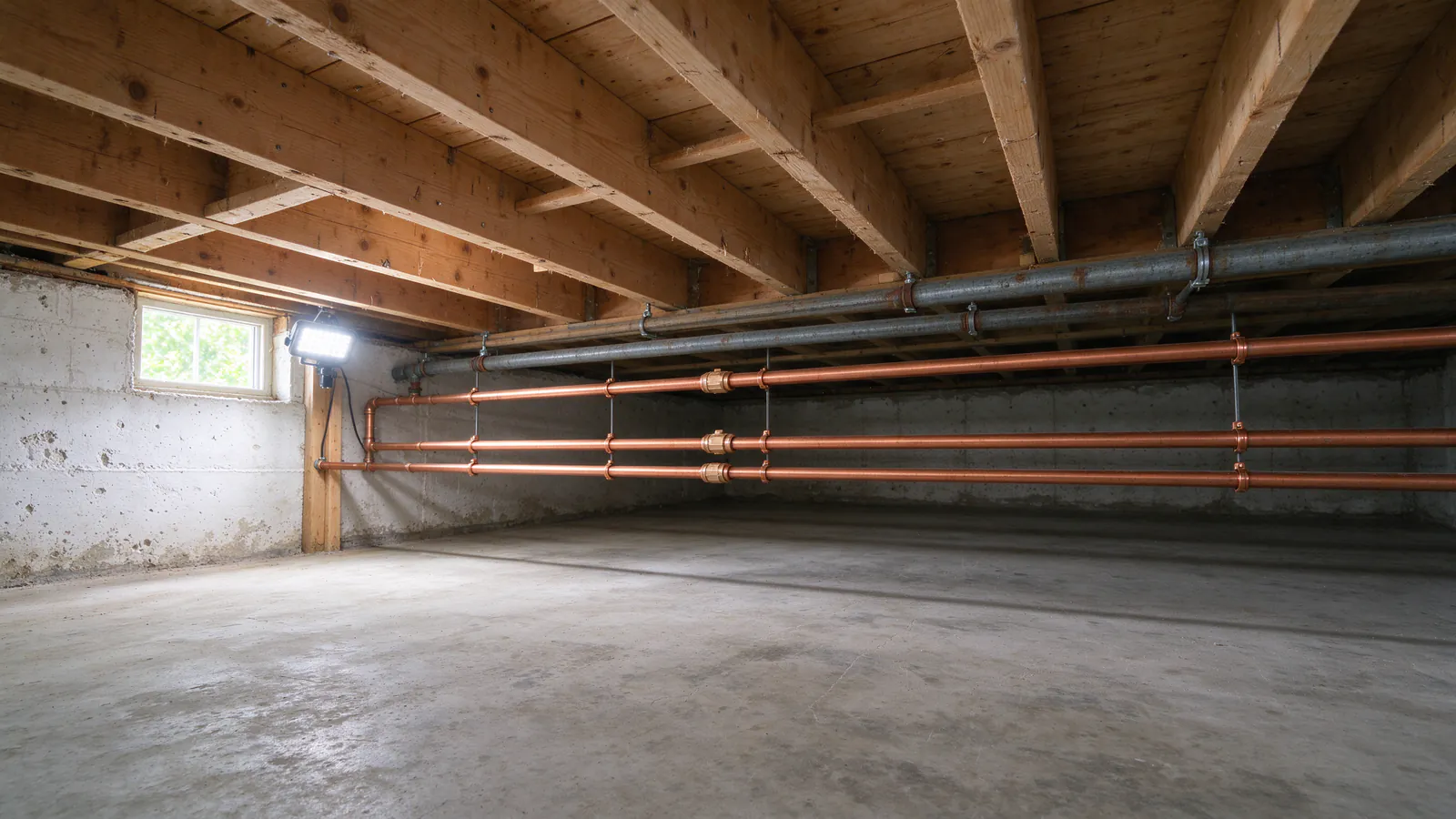
Type K copper has the thickest wall and is used mainly for buried water service lines. Type L has a medium wall and is the usual choice for water lines inside a house, including most copper repipes. Type M is thinner and cheaper, and allowed indoors by the code Indiana uses. All three have the same outside diameter.
Circle City Repipe offers and manages copper and PEX repiping, pipe repair and water line replacement across Indianapolis and nearby communities, carried out by licensed and insured contractors. This guide stays on the copper type question. For whether copper is the right material at all, the PEX vs copper guide comes first.
What the letters mean
Copper water tube in the United States is made to ASTM B88, which defines three standard wall thicknesses: Type K (heaviest), Type L (medium) and Type M (lightest). For any nominal size, all three have the same outside diameter. The extra wall goes inward, so a thicker type has a slightly smaller inside diameter.
That shared outside diameter is why one set of fittings serves all three. A half-inch elbow fits half-inch K, L or M, and a press or solder joint is made the same way on each. It also means you can’t tell the types apart by size; only the marking or the wall itself shows it.
Wall thickness, side by side
For the sizes most used in a house, ASTM B88 sets these nominal wall thicknesses:
| Nominal size | Type K wall | Type L wall | Type M wall |
|---|---|---|---|
| 1/2 inch | 0.049 in | 0.040 in | 0.028 in |
| 3/4 inch | 0.065 in | 0.045 in | 0.032 in |
| 1 inch | 0.065 in | 0.050 in | 0.035 in |
At three-quarter inch, the size of many house mains, Type K’s wall is more than 40% thicker than Type L’s, and Type L’s is about 40% thicker than Type M’s. The inside diameters differ only slightly, so for ordinary household flows the choice between types changes very little about pressure or flow. What it changes is how much metal there is to lose.
The color code
Rigid (hard-drawn) copper tube carries a continuous printed marking in a color that matches its type: green for Type K, blue for Type L and red for Type M. The printing also shows the manufacturer and the type letter. Soft, annealed coils are marked differently, with the type stamped at intervals rather than a colored stripe. On old pipe, paint, tarnish and time often remove the marking, which leaves the wall thickness as the only test.
Rigid lengths and soft coils
Copper tube comes in two tempers. Hard-drawn tube is rigid and sold in straight lengths; it is what runs through basements and walls in most copper systems. Annealed tube is soft and sold in coils; it can be bent by hand and pulled a long way without joints. Types K and L are made in both tempers. Type M is generally sold as rigid tube.
That difference is why Type K became the buried service line copper. A soft coil of K can be pulled from the curb to the house in one piece, with no joints underground, and its heavy wall stands up to soil and backfill.
Where each type belongs in a house
Inside the house: usually Type L
Type L is the common choice for interior water distribution and for copper repipes. Its wall gives a meaningful margin over Type M against pitting, erosion and physical damage, at a moderate cost increase, and it is widely stocked in both rigid lengths and coils. Where a house has had pinholes, a thicker wall buys time before the same corrosion breaks through, though it does not remove the cause; the copper pinhole leaks guide covers the causes.
Type M inside the house
Type M is lighter and cheaper, and the 2012 International Plumbing Code that Indiana’s code is built on lists it for water distribution. Plenty of houses were piped with it. The tradeoff is less wall: the same rate of corrosion reaches a leak sooner. Some owners and installers avoid it for that reason, especially in hot water lines and where water chemistry has caused pinholes before. Whether it suits a particular house is a scope decision, not a code violation.
Type K inside the house
Type K can be used inside, but it rarely is in a house. It costs more, is harder to work in tight framing, and its extra wall offers little in a protected interior run. It belongs where pipe is buried or exposed to damage.
The buried service line
This is where local rules matter most. In Citizens Energy Group territory, a complete service line replacement from the main to the meter pit or into the house must be SDR9 polyethylene pipe with tracing wire, and PEX and PVC are prohibited. Right-of-way repairs are made like for like, except that lead must be replaced with Type K copper. The lead service line replacement page covers that work. So in Indianapolis, Type K turns up in specific utility-side repairs, not as the default for a new service line. A proposed amendment to Indiana’s plumbing code would also remove Type M from the list of allowed water service pipe; as a proposal, it is not in force.
Other utilities around the city set their own standards, so a service line in Carmel, Lawrence or an Indiana American Water area is confirmed per address. The water line replacement page covers the outside line, and the service line and meter pit guide explains what happens when an inside meter moves outside.
Planning a copper repipe?
The scope names the copper type for each run, the joining method and every opening before anything is cut.
Cost and what it buys
Thicker wall means more copper per foot, so Type K costs more than L, and L more than M. Copper’s price has risen sharply in recent federal producer price data, which makes the difference between types, and between copper and PEX, larger than it used to be. Labor is still the bigger part of a repipe, and it barely changes between L and M. A whole-house repipe in the Indianapolis area typically runs $4,000 to $15,000 or more, with copper jobs toward the higher end; the Indianapolis repipe cost guide breaks it down.
Joining each type
All three types join the same ways: soldering with lead-free solder, brazing for some larger work, or press fittings sealed with a tool and no flame. Soft coils can also be joined with flare fittings, a common method on service lines. Joint quality matters more than wall type: a badly made joint leaks on Type K as readily as on Type M, and the copper pipe repair page covers fixing one. A poorly reamed cut or excess flux inside the pipe can start corrosion in any of them.
Which to ask for
For a copper repipe inside an Indianapolis house, Type L is the usual answer, and it is a reasonable thing to ask a quote to state. Ask what type is being used for each run, whether rigid or soft, and how it is joined. Ask how the new copper connects to any old galvanized that stays, because copper against steel needs a dielectric fitting. For the outside line, the utility’s rules decide. The copper repiping page covers the full scope, and the complete guide to repiping covers the rest of the job.
If you are comparing quotes that specify different copper types, call Circle City Repipe or request an estimate for a scope that names it.