For most Indianapolis repipes, PEX is the more practical choice because it bends through old framing with fewer openings and usually costs less, while copper is the better fit where pipe is exposed to sunlight or heat, or where an owner wants metal. Neither is universally better. The house, the water and how much can be opened decide.
Circle City Repipe offers and manages repipes in both materials across Indianapolis and nearby communities, carried out by licensed and insured contractors, so the choice here is about fit, not about what is on the truck. The complete guide to repiping covers the whole job; this page goes deep on the one decision.
What each material actually is
PEX is cross-linked polyethylene. Cross-linking bonds the polymer chains so the tubing holds its shape and pressure rating at hot-water temperatures, which ordinary polyethylene cannot. It comes in coils and straight lengths, is sized by copper tube size (so half-inch PEX and half-inch copper have the same outside diameter) and is made to ASTM F876, with its systems covered by standards such as ASTM F877. Tubing sold for drinking water carries a mark showing it meets NSF/ANSI 61 for health effects. There are three manufacturing methods, labeled PEX-A, PEX-B and PEX-C; the differences matter mostly for which fittings are used, and the PEX repiping page explains them.
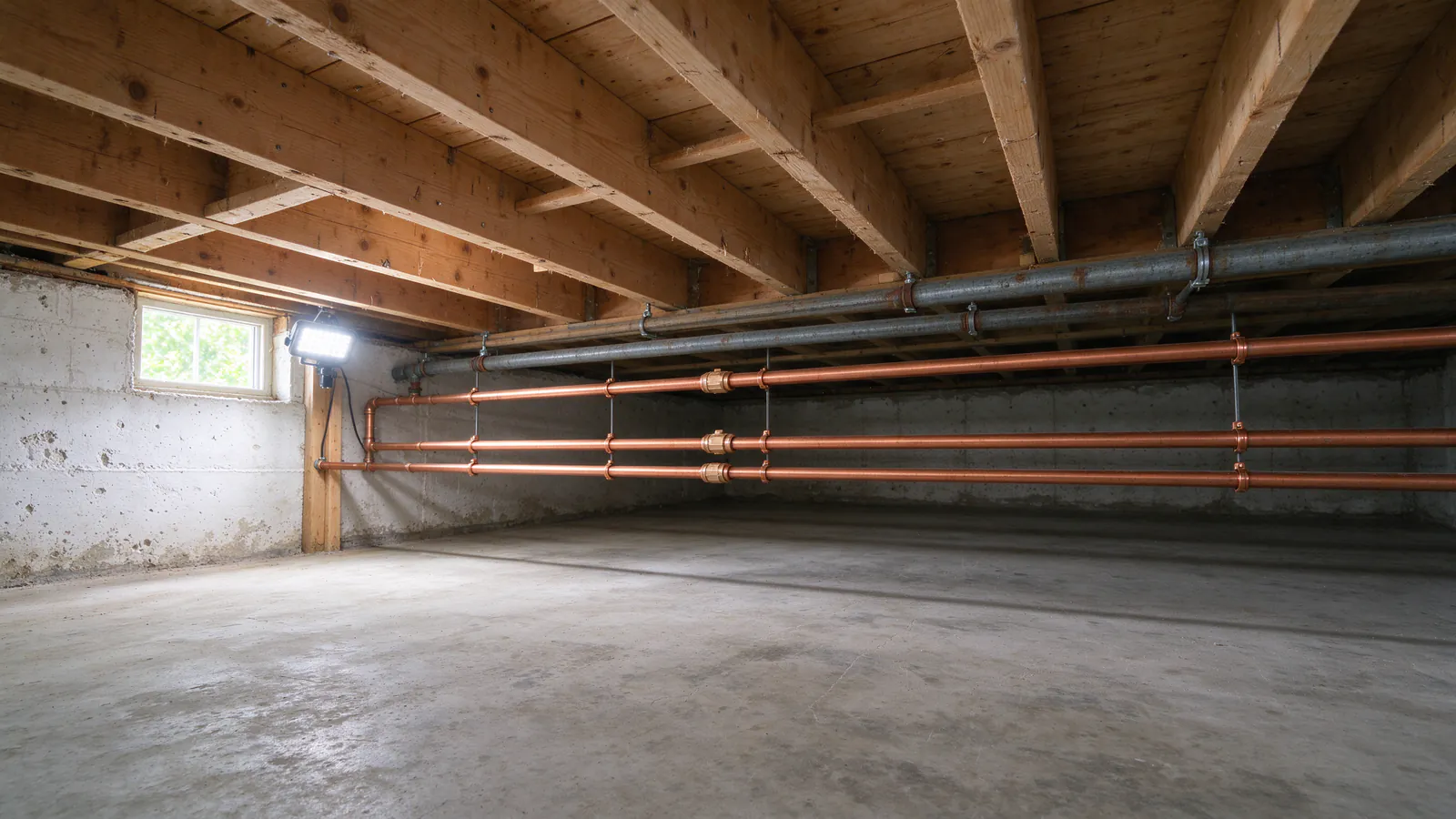
Copper water tube is made to ASTM B88 in three wall thicknesses, Types K, L and M, all with the same outside diameter for a given size. Type L is the usual choice for a repipe; the Type L vs Type K guide covers when the heavier and lighter walls are used. Copper is joined by soldering with lead-free solder or by press fittings, and it has been the default supply pipe in American houses since the postwar years.
The decision factors, one at a time
Water chemistry
Citizens Energy Group’s Indianapolis water is hard, averaging about 19 grains per gallon, with a pH around 7.7. Citizens doses orthophosphate to limit lead and copper leaching and disinfects with chloramines. That treatment is part of why copper at the tap tested well under the federal action level in Citizens’ own data. Hard water by itself is not proof that copper will pinhole in a given house; pitting has several possible causes, which the copper pinhole leaks guide goes through. Where a house has already had repeated pinholes in its copper, though, many owners prefer not to put the same material back, and that history is a fair reason to lean toward PEX.
PEX does not corrode, but it has its own chemistry limit: disinfectant resistance. The tubing’s printed material code rates its resistance to chlorinated water, and a hot-water recirculation loop, which keeps hot water moving through the pipe all day, calls for the highest rating. The guide to whether PEX is safe explains how to read that code.
Freezing
Indianapolis averages more than 100 nights a year at or below freezing, and about three at or below zero, in NOAA’s 1991-2020 climate normals. When water freezes in rigid copper, the pipe cannot give, and it splits, often well away from the ice plug. PEX can stretch somewhat and often survives a freeze that would burst copper. That is a real advantage in crawlspaces and outside walls, but it is not immunity: brass fittings, valves and repeated freezes still fail, and the burst pipe repair page covers what happens when they do. The better protection, with either pipe, is routing it inside the heated part of the house.
Routing through an older house
This is where the two differ most in practice. Copper runs in straight lengths and changes direction only at a fitting, so every turn means a soldered or pressed joint and usually an opening big enough to make it. PEX can be pulled through bored joists and up a wall cavity in one continuous piece, around bends, with the fittings only at the ends. In a plaster house in Irvington or the Old Northside, that can mean fewer and smaller openings, less patching and a shorter job. The guide to how invasive repiping is shows where openings usually fall.
Heat, sunlight and exposure
Copper does not care about daylight and tolerates heat close to a water heater. PEX degrades in ultraviolet light, so it must not be left in sunlight, and manufacturers set limits on how close it can run to a water heater’s flue and how it connects to the heater. Exposed runs in a sunny garage, along an outside wall or at the heater are where copper, or a short metal transition, usually earns its place.
Joining method
Copper is joined with an open flame and solder, or with press fittings that seal with a tool and no flame. Soldering inside an old house means fire precautions around dry framing, and press fittings avoid that at a higher fitting cost. PEX is joined with crimp rings, clamp rings, cold-expansion rings or press sleeves over listed fittings, with no flame at all. Each PEX method uses its own fittings and tools, and a good installer does not mix them.
Rodents, insects and physical damage
Rodents can chew PEX where they have access, which matters in a crawlspace or attic with an open entry point. Copper resists chewing but dents and can be nicked. Either way, sealing entry points and protecting pipe where it crosses framing edges matters more than the material.
Code, utility rules and insurance
Indiana’s plumbing code, 675 IAC 16-1.4, built on the 2012 International Plumbing Code, lists both PEX and copper for water distribution inside the house, so the choice is not a code question in Indianapolis. Inside the City, a whole-house repipe in either material needs a plumbing permit and a rough-in inspection before walls close. The Indianapolis repiping permit guide covers that.
The buried service line is different. Citizens Energy Group requires a complete service line replacement to be SDR9 polyethylene with tracing wire and prohibits PEX and PVC there. Copper comes in only where Citizens requires Type K for certain right-of-way repairs of lead lines. That is a water line replacement question, not an interior one.
Insurers are a softer factor. Homeowners report that some insurers ask about pipe material, and a few have been described as uneasy about PEX, while others ask about galvanized or polybutylene. No public source gives a rule, so the only reliable answer is the insurer’s own, in writing. The insurance and repiping guide covers what to ask.
Cost: why PEX usually comes in lower
Labor is the largest part of any repipe, and PEX usually needs less of it: fewer fittings, fewer openings and less patching. Material widens the gap. In Bureau of Labor Statistics producer price data, copper mill products rose about 30% over a recent twelve months, against about 4 to 5% for plastic pipe. A whole-house repipe in the Indianapolis area typically runs $4,000 to $15,000 or more in either material, and copper jobs tend to sit toward the higher end for the same house. The Indianapolis repipe cost guide breaks the price down, and the cost estimator gives a planning range.
Weighing PEX against copper for your house?
A written scope names the material for each run, the transitions and every opening, so you compare options on the same house.
How the two compare side by side
| Factor | PEX | Copper |
|---|---|---|
| Code status in Indiana | Allowed for water distribution | Allowed for water distribution |
| Routing in older framing | Pulls through in long runs, fewer joints | Straight lengths, a fitting at every turn |
| Freeze behavior | Often stretches and survives; fittings can still fail | Splits when water freezes inside |
| Sunlight and heat | Must be kept out of UV; limits near the water heater | Unaffected by daylight; tolerates heat |
| Joining | Crimp, clamp, expansion or press, no flame | Solder (open flame) or press |
| Noise | Quieter; absorbs some water hammer | Carries flow noise and hammer |
| Corrosion | Does not corrode; disinfectant rating matters | Can pit or erode in some conditions |
| Material price trend | Plastic pipe up about 4 to 5% over a recent year | Copper up about 30% over a recent year |
Other pairings people ask about
CPVC vs PEX. CPVC is rigid plastic joined with solvent cement. It turns up in some houses and in many past repairs. It does not corrode, but it becomes brittle with age and heat and can crack when disturbed, which is why few repipes use it today. Where a house has CPVC, the question is usually whether it is still sound, not whether to install more.
Galvanized vs copper. This is not really a choice anymore; galvanized steel is the pipe being replaced. Joining new copper to old galvanized needs a dielectric fitting to slow galvanic corrosion, and the guide to whether galvanized pipes are safe explains why mixed systems age badly. Galvanized pipe replacement covers taking it out.
A hybrid repipe. Many repipes use both: PEX for the concealed runs and copper at the water heater, in exposed basement runs or at fixtures where metal is wanted. That only works if the transition fittings are listed and the scope says exactly where each one sits.
Which way a house tends to lean
A house leans toward PEX when it has plaster walls or finished rooms that would need many openings for rigid pipe, a history of copper pinholes, runs through cold crawlspaces, or a budget that matters more than metal pipe. It leans toward copper when much of the pipe will be exposed in a sunny or hot space, when the owner simply wants metal and accepts the added cost and openings, or where a short run at the heater calls for it. The layout matters too, and the manifold vs trunk-and-branch guide covers how PEX is laid out.
If you want a second opinion on which fits your house, call Circle City Repipe or request an estimate. The first visit identifies the existing pipe and checks pressure and flow before anyone recommends a material.