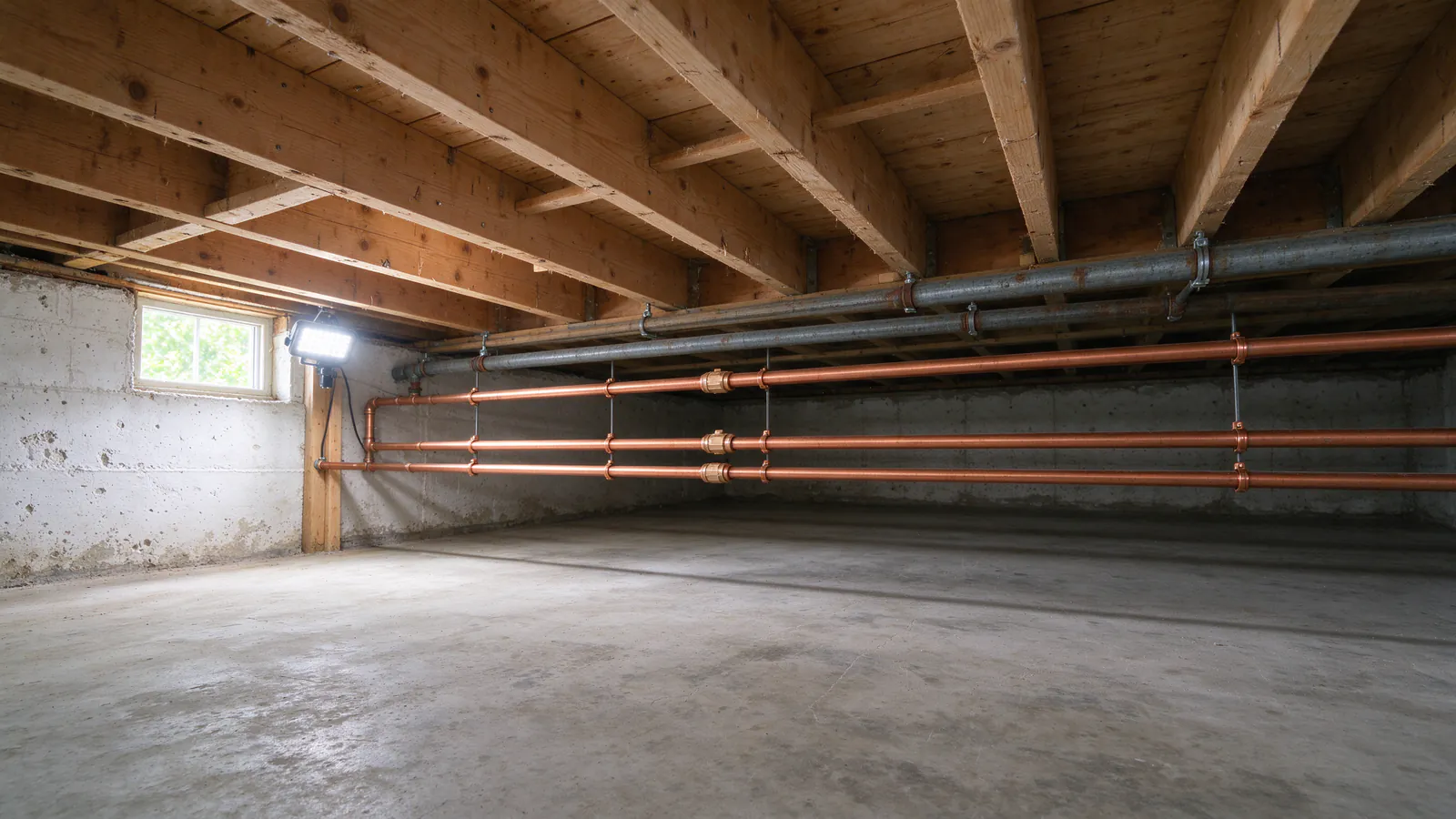
Pinhole leaks in copper pipes happen when a small spot of the tube wall corrodes through. The usual causes are pitting from water chemistry, erosion from fast or turbulent hot water, flux or debris left inside the pipe, poor joints and stray electrical current. No single cause explains them all, and one pinhole often means more thin spots nearby.
Circle City Repipe offers and manages copper pipe repair, copper repiping and PEX repiping across Indianapolis and nearby communities, carried out by licensed and insured contractors. This guide is about why pinholes form and what the pattern tells you, so the next step fits the cause.
How a pinhole forms
Copper protects itself. In normal water, a thin film of copper oxides and minerals forms on the inside of the tube and slows further corrosion. A pinhole starts where that film breaks down at one small spot and does not reform. Corrosion then concentrates there, digging a pit into the wall while the surrounding pipe stays nearly untouched. When the pit reaches the outside, water weeps through a hole often no bigger than a pin.
Because the attack is so concentrated, the outside of the pipe can look perfect right up to the leak. And because whatever caused one pit usually affected the whole run, the wall nearby is often thinner than it looks. That is the reason pinholes come in groups and why recurrence drives the repipe decision.
The mechanisms, one by one
Pitting from water chemistry
Pitting corrosion is the classic cause. Its exact chemistry depends on the water: pH, alkalinity, hardness, dissolved oxygen, chlorides, sulfates and the disinfectant all play a part, and corrosion engineers describe several distinct types of copper pitting tied to different water conditions, cold or hot, hard or soft. That is why pinhole problems can cluster in one water system or one part of a city and be rare in another.
Indianapolis is supplied mostly by Citizens Energy Group, whose water averages about 19 grains per gallon of hardness, with a pH around 7.7 and chloramines at about 2.0 parts per million in its own data. Citizens adds orthophosphate specifically to limit lead and copper leaching, and in its tap sampling, copper levels at the 90th percentile were well under the federal action level. None of that proves a particular house will or won’t pinhole. Hardness by itself is not a demonstrated cause of pinholes, and a hard-water city can have houses with sound copper for decades next to houses with repeated leaks. The Indianapolis hard water guide covers what hard water does do.
Erosion-corrosion from velocity and turbulence
Water moving fast, or tumbling at a sharp change of direction, can strip the protective film faster than it reforms. The wear concentrates just downstream of elbows, tees, burrs left inside cut tube, and partially closed valves, and it is worse with hot water. The inside of the pipe often shows smooth, horseshoe-shaped grooves pointing with the flow rather than round pits.
Hot water recirculation systems are a known setting for it, because a pump moves hot water through the pipe all day. An oversized pump, or a recirculation loop run in pipe too small for the flow, speeds it up. Homeowners report pinholes concentrated in hot lines in basements while the cold lines beside them stay sound, which fits this pattern. The hot water recirculation installation page covers how pumps are sized.
Flux, debris and workmanship
Soldering flux is corrosive by design. Too much of it, left inside the pipe after a joint is made, can keep attacking the copper downstream of the fitting for years. Pinholes clustered a short distance after joints, often on the bottom of horizontal runs where flux settled, point to it. Burrs from cutting tube without reaming the end, solder beads inside the pipe and joints overheated during soldering also create the turbulence and weak spots that start pits.
Stray electrical current and grounding
Electrical current traveling on the water pipe, from a grounding fault, a damaged neutral or bonding problems, has been linked to localized copper corrosion. It is less common than chemistry or velocity and hard to prove, but it is worth checking when pinholes appear in odd places with no flow or flux pattern. That is a question for a licensed electrician alongside the plumber.
Corrosion from the outside
Some pinholes start on the outside. Copper in contact with wet concrete, cinders, certain insulations or soil, or exposed to some household chemicals and fumes, can corrode from the outer surface inward. Where pipe has been buried in a slab or wrapped and kept damp, outside attack is a real possibility. The slab leak repair page covers pipe under concrete.
Thin-wall tube
Copper water tube comes in three wall thicknesses. Thinner Type M tube has less wall to lose before a pit breaks through, so the same corrosion produces a leak sooner. That is one reason many repipes use Type L. The Type L vs Type K copper guide explains the types.
Had more than one pinhole?
A first look maps where each leak was, checks the pipe type and the pressure, and looks at the cut-out section before recommending repair or replacement.
Reading the clues
The pattern of failures is often more useful than any one leak.
- Where they are. All on the hot side points toward velocity or temperature. Clustered after joints points toward flux. Spread through hot and cold, in several runs, points toward chemistry.
- What the inside looks like. A cut section split lengthwise shows round pits under green or white mounds for pitting, smooth grooves for erosion, or damage concentrated after a fitting for flux. A lab can analyze a sample if the cause really matters.
- How old the pipe is. Repeated pinholes in new copper, as some owners report, point away from age and toward water, velocity or workmanship.
- What the pressure is. Static pressure much above normal household levels stresses every joint and fixture. A failing pressure-reducing valve is worth ruling out.
A temporary fix while you wait
When a pinhole opens, shut off the nearest valve, or the main shutoff if there is none, and catch the water. A pipe repair clamp with a rubber pad, sized to the pipe and tightened over the hole, will usually hold for days. Repair tape rated for pressure and epoxy putty can slow a drip on a clean, dry pipe. None of these is a repair. The wall around a pinhole is usually thin, and a clamp hides the hole without changing the pipe. If water has reached ceilings or walls, the water leak repair page covers what comes next.
Repair or repipe after pinholes
A single pinhole in otherwise sound pipe is a repair. The usual repair cuts out a section of tube on either side of the hole and replaces it, which also gives a look at the inside of the pipe. In the Indianapolis area, an accessible copper pipe repair typically runs about $150 to $650, and about $300 to $1,200 when a wall or ceiling has to be opened and patched.
The answer changes when pinholes repeat. A second or third leak in the same run within a few years, or a cut section that shows the wall pitted thin along its length, means the run is failing as a whole. Replacing that run, a hot side or a floor is a partial repipe. Pinholes across several runs make a whole-house repipe the more sensible answer. Whether to put copper back or switch to PEX depends partly on what caused the pinholes; the PEX vs copper guide covers that choice, and the repipe vs repair guide works through the threshold.
If pinholes keep coming back in your house, call Circle City Repipe or request an estimate and keep the cut-out pieces from past repairs; they are evidence.