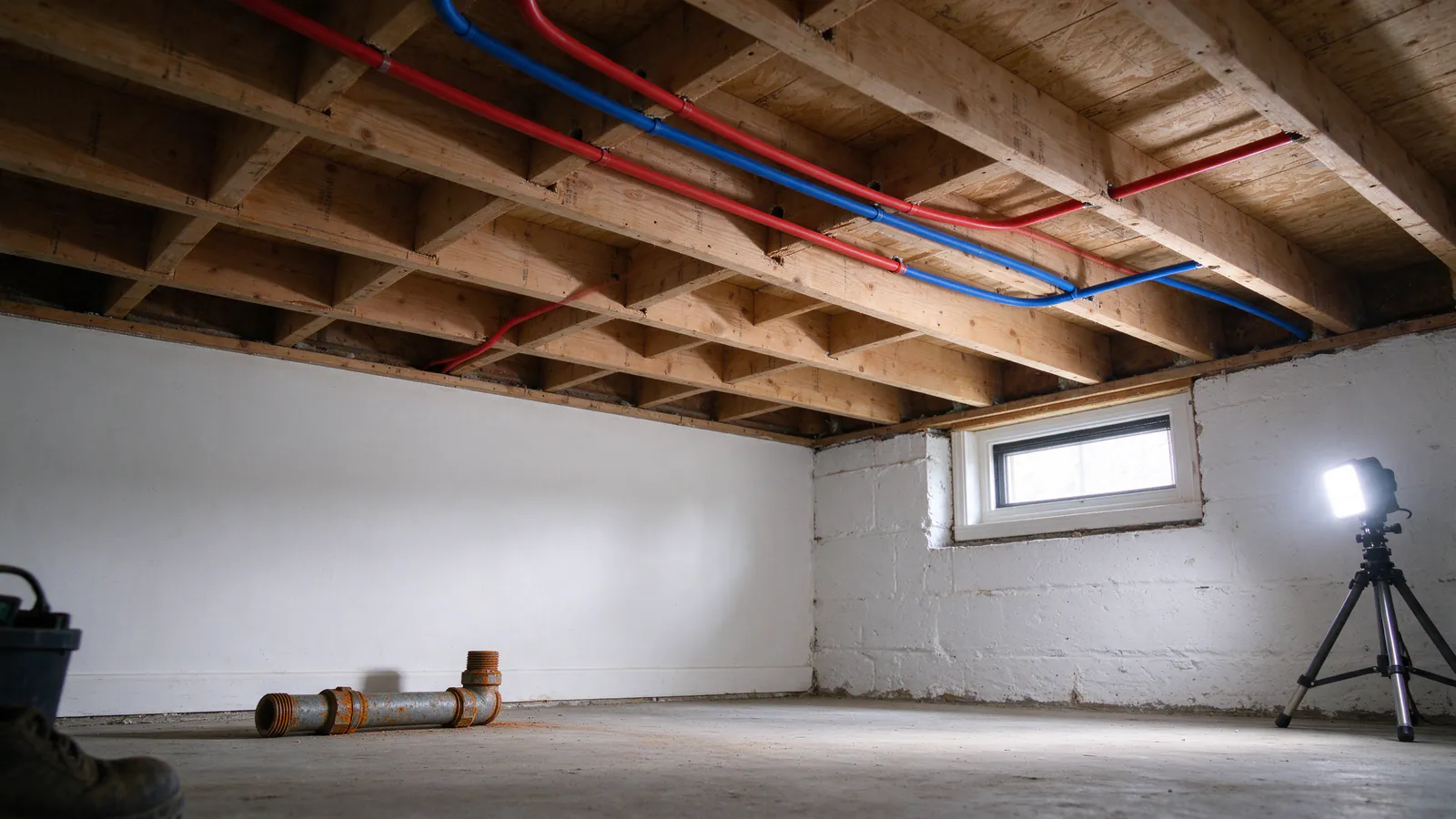
The pipe work in a typical house is usually counted in working days, not weeks, but the whole job runs longer than that. A repipe also needs a first visit and written scope, a plumbing permit, a rough-in inspection before the walls close, a pressure test and patching. How long each stage takes depends on the house: fixture count, stories, access and how the openings get closed.
Circle City Repipe offers whole-house and partial repipes across Indianapolis and nearby communities, carried out by licensed and insured contractors. A useful schedule comes with the written scope after the house has been seen, because a number given without seeing it would be a guess. This guide explains what goes into that schedule. The whole-house repiping page covers the job itself.
The stages of a repipe
First visit and scope. The visit starts at the meter and main shutoff, identifies the pipe material, and checks static pressure and flow at fixtures upstairs and down, hot and cold. It ends with a written scope: what gets replaced, where the walls open, the material and the price, all before anything is opened.
Permit. Inside the City of Indianapolis, a repipe needs a plumbing permit from the Department of Business and Neighborhood Services, applied for through Accela Citizens Access. The City does not publish a turnaround time. Lawrence, Beech Grove, Speedway and the suburbs run their own permit offices, each on its own schedule. Where the service line is part of the job, Citizens Energy Group says its service-line permit takes about 2 to 3 business days after a completed application. The Indianapolis repiping permit guide covers each office.
Pipe work. The openings are cut, the new lines are run and supported, and each area is tied in.
Inspection and test. The new piping is pressure tested, inspected at rough-in, then flushed through every fixture.
Patching. The openings are closed as agreed in the scope, with a list of every opening and who closes it.
Running new lines while the old ones still work
A repipe does not shut the water off for the whole job. The new mains and branches are run alongside the old pipe while the house still has water. Then each area is switched over in turn: the new line is connected, the old one is cut out or capped, and that area is back in service. So the outages come in blocks, usually part of a day at a time, and the house keeps water most of the day.
The longest outage is usually the tie-in at the main, when the whole house is isolated. If the old main valve is a seized or gate-type valve, it is replaced at that point, which means the water is shut off at the meter. In Citizens territory that is often an outside pit. The written scope should list the days the water is off and roughly for how long.
What makes a repipe take longer
| Factor | Why it adds time |
|---|---|
| Two or three stories | Every upstairs fixture needs a riser, and every riser needs a route through finished walls |
| Plaster on lath | Plaster has to be cut carefully to avoid cracking, and patching it takes more coats than drywall |
| Tile walls and built-ins | Routes have to go around them, from behind or below |
| Finished basement ceiling | The main route has to be opened along its length instead of running on exposed joists |
| Tight or wet crawlspace | Slower to work in than an open basement |
| Copper instead of PEX | Every change of direction needs a fitting and a joint |
| Valves and extras | A new main shutoff, pressure-reducing valve, expansion tank or recirculation line each add work |
| Service line or meter pit at the same time | Outside digging and the utility’s scheduling |
| A failed inspection | A correction, then a reinspection before walls can close |
Layout plays a part too. A home-run manifold uses more tubing than trunk-and-branch but fewer concealed fittings, so it shifts time rather than simply adding it. PEX repiping usually goes faster than copper repiping in the same house, because PEX bends around obstacles and can be pulled through a wall cavity from below.
Inspection, test and flush
Inside Indianapolis, the City’s Building Standards require a rough-in inspection after the pipe is installed but before it is covered and before fixtures are set. That rule sets the order of the job: open, pipe, test, inspect, then patch. It also means openings with new pipe in them stay open until the inspection passes. A failed inspection adds a correction, a reinspection and a $175 reinspection fee.
Before inspection, the lines are capped, filled and held under pressure while every joint is checked. After it, the system is flushed through each fixture, hot and cold, and flow is checked again against the first-visit readings. Faucet aerators often need clearing after the flush, because scale loosened from old galvanized can lodge in them.
Want a schedule for your house?
Start with a first visit and a written scope: the work days, the water outages and which rooms have open walls when.
Patching: often the longest stage
Patching drywall is a sequence: a backing, a patch, joint compound, then sanding, with drying time between coats. Plaster takes longer, because it is built up in layers to match the old wall’s thickness. Texture and paint, where they are part of the scope, add another round. A dozen small openings can take longer to finish than to cut.
That is why the scope has to say who closes each opening and to what standard: rough-patched and ready for a painter, or finished to match. The guide to how invasive repiping is covers where openings land and what patching includes.
Planning around the work
Most families stay home during a repipe. A few things make the days easier:
- Know which bathroom is usable on each day, and plan showers around the outage blocks.
- Clear the areas on the opening list, including closets that back onto bathrooms.
- Expect the laundry and kitchen to be out of service during their tie-ins.
- Keep pets away from open walls and work areas.
- If the job is timed around a move, an empty house is quicker to work in than an occupied one.
The Indianapolis repipe cost guide shows how the same factors that stretch the schedule also move the price. To get a written schedule for a specific house, call Circle City Repipe to set up a first visit, or start with the repiping cost estimator.