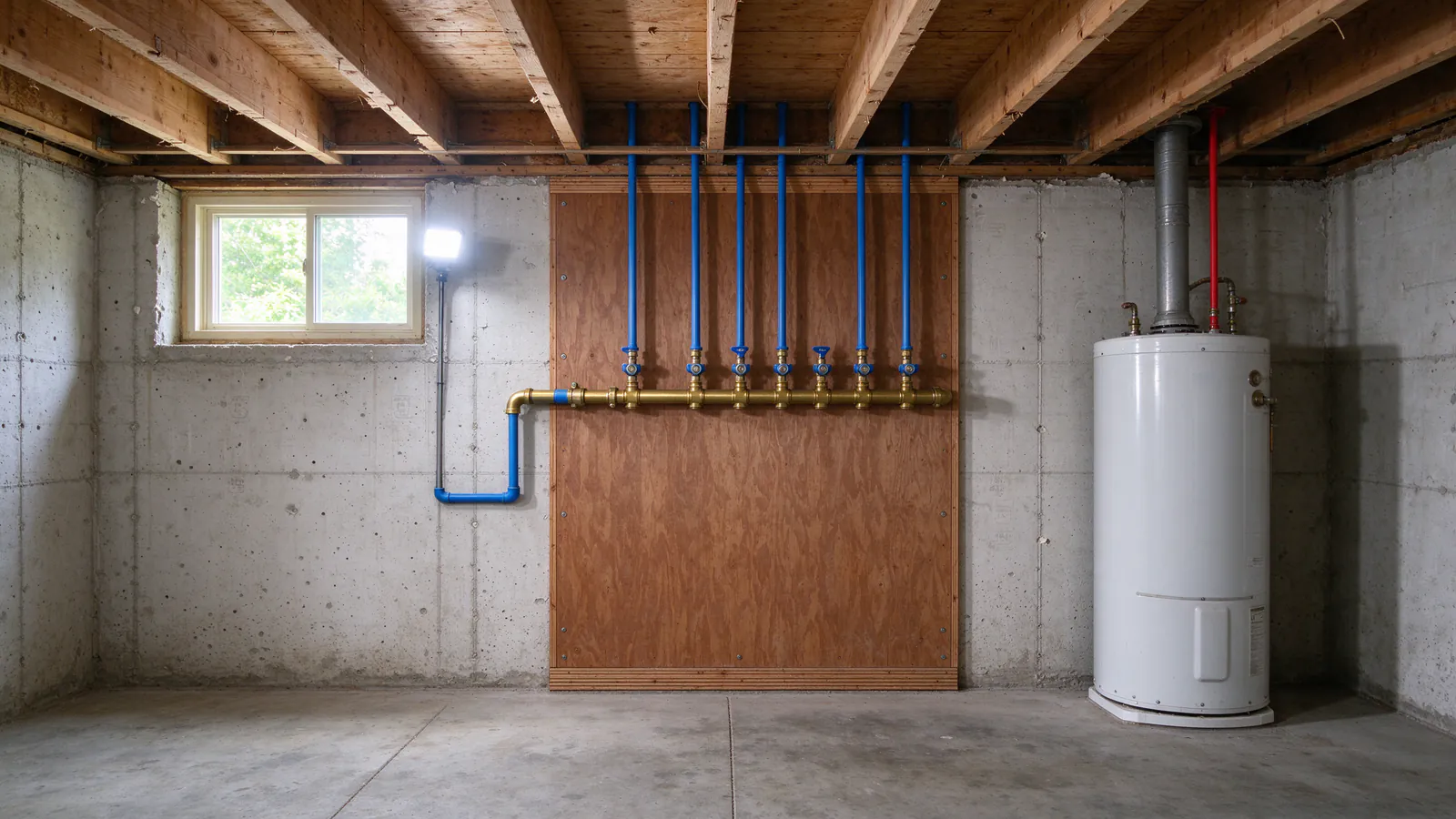
Yes. PEX made for drinking water is tested to NSF/ANSI 61, the national standard for health effects of plumbing components, and to ASTM F876 for performance, and Indiana’s plumbing code allows it for water distribution. New tubing can briefly affect taste or odor, and it needs protecting from sunlight, heat and rodents, but listed PEX is a safe supply pipe.
Circle City Repipe offers and manages PEX repiping and copper repiping across Indianapolis and nearby communities, carried out by licensed and insured contractors. This guide is about the safety question alone; the PEX vs copper guide compares the two as a buying decision.
What “safe” means for a water pipe
A pipe can be safe or unsafe in two different ways. The first is what it adds to the water: metals, chemicals, taste or odor. The second is whether it holds, under pressure and heat, for decades, without bursting or leaking into the house. PEX has to be judged on both, and the standards printed on the tubing address both.
The markings on the tubing and what they test
Every length of listed PEX carries a printed line that repeats along the tube. It usually shows the size, the manufacturer, the material designation code, the pressure and temperature ratings, and the standards it meets. Three matter most for safety.
NSF/ANSI 61 covers health effects. A product listed to it has been tested for what it releases into drinking water, with limits set for contaminants of health concern. This is the mark that answers “is it safe to drink from”. It sits alongside NSF/ANSI 14, which covers plastic piping more broadly, including physical performance.
ASTM F876 is the tubing standard. It sets dimensions, the pressure ratings PEX must hold at different temperatures (typically 160 psi at 73°F, 100 psi at 180°F and 80 psi at 200°F), and tests for chlorine and ultraviolet resistance. ASTM F877 covers PEX tubing with its fittings as a system.
Fitting standards such as ASTM F1807 (metal insert fittings with copper crimp rings), F1960 (cold-expansion fittings) and F2159 (plastic insert fittings) define how the joints are made. A safe system uses tubing and fittings listed for each other.
Lead and metals
PEX tubing is plastic and contains no lead. The lead question sits in the fittings. Many PEX fittings are brass, and since 2014 federal law has required pipe, fittings and fixtures for drinking water to be lead-free, meaning no more than 0.25% lead as a weighted average of wetted surfaces, with products listed to NSF/ANSI 372. Plastic fittings avoid brass altogether. In a house where lead is a concern, the bigger sources are usually a lead service line, old lead solder or old faucets, not new PEX. The guide to identifying pipe material helps sort that out.
Some brass alloys can also lose zinc over time in certain water, which leaves a fitting weak and porous. Listed fittings for PEX use alloys meant to resist that, and fittings made of engineered plastic sidestep it.
Taste and odor from new PEX
This is the safety concern people notice first. New PEX can release small amounts of organic compounds left from manufacturing into water standing in it. University studies of new tubing from several brands found that some gave water a detectable odor at first and that the levels fell as the pipe was flushed and used.
In practice, that means running every tap, hot and cold, after a repipe, and again after the house has sat unused. If an odor lasts more than a few weeks of normal use, it is worth raising with the installer. A carbon filter at the kitchen tap can help in the meantime.
Chloramines and the material code
Citizens Energy Group disinfects Indianapolis water with chloramines, averaging about 2.0 parts per million in its own data. Chlorine-based disinfectants slowly oxidize PEX, especially hot. That is why ASTM F876 rates chlorine resistance and why the tubing carries a four-digit material code, such as PEX 5306. The first digit is the chlorine resistance rating and the second is ultraviolet resistance; the last two describe the pressure rating.
A first digit of 5 is the highest chlorine rating, tested for continuous hot water at 140°F. That matters most on a hot water recirculation loop, where hot water moves through the pipe around the clock. For ordinary hot and cold lines, the rating on any listed tubing covers typical household use. The Indianapolis hard water guide covers what else is in the water.
Planning a PEX repipe?
The scope names the tubing, the fittings and the layout before anything is opened, so you know what is going into your walls.
Where PEX’s real limits are
PEX is safe, but it is not indestructible, and its failures follow known patterns.
Sunlight
Ultraviolet light breaks down PEX. Tubing must be stored out of sunlight on site and never left exposed outdoors or in a sunlit space. The second digit of the material code tells how long the tubing tolerates daylight during construction, and that window is measured in weeks or months, not years. Exposed runs in a sunny garage or porch are where copper or a protective cover belongs.
Heat near the water heater
PEX is rated for hot water, not for the heat of a gas water heater’s flue or the first stretch of pipe off the tank. Manufacturers set how close tubing may run and how it connects to the heater, often with a short metal transition. A repipe that ties PEX straight into a hot vent connector is a mistake.
Rodents and physical damage
Mice and rats can gnaw PEX where they reach it. Tubing can also be cut on sharp framing edges or damaged by a nail through drywall. Protective plates where pipe crosses studs near the surface, and sealed entry points in crawlspaces, deal with most of it.
Fittings and workmanship
Most PEX failures happen at connections. A crimp ring that was not fully closed, a ring placed too far from the end, an expansion fitting made in the cold without enough time, or a fitting meant for another system can all leak, sometimes months later. That is a workmanship question, and it is why the system is pressure tested before walls close. The whole-house repiping page covers the testing.
Freezing
PEX tolerates a freeze better than rigid copper because it can stretch somewhat, but a frozen line can still split or push a fitting apart. Pipe in crawlspaces and outside walls needs protecting whatever it is made of. The burst pipe repair page covers what happens when it fails.
Buried service lines
PEX is allowed inside the house, but Citizens Energy Group prohibits it for a replacement service line, which must be SDR9 polyethylene. The outside line is a water line replacement job with its own rules.
How long PEX lasts
PEX has been used for drinking water in North American houses for decades, and the standards are built around long service at rated temperatures and pressures. No one can honestly give a fixed lifespan for a particular house, because heat, disinfectant exposure, sunlight during construction and the quality of each fitting all count. What can be said is that a properly installed, listed system kept out of sunlight and away from flue heat has no inherent short life. It also does not last forever, any more than copper does.
The short version for a homeowner
Ask what tubing and fittings are being used and check that they are listed to NSF/ANSI 61 and the ASTM standards above. Ask how the system will connect at the water heater. Expect to flush the taps after the job. Make sure exposed pipe in crawlspaces is protected. If you are weighing PEX for your house, the repiping assessment gives a planning answer, or call Circle City Repipe and request an estimate.