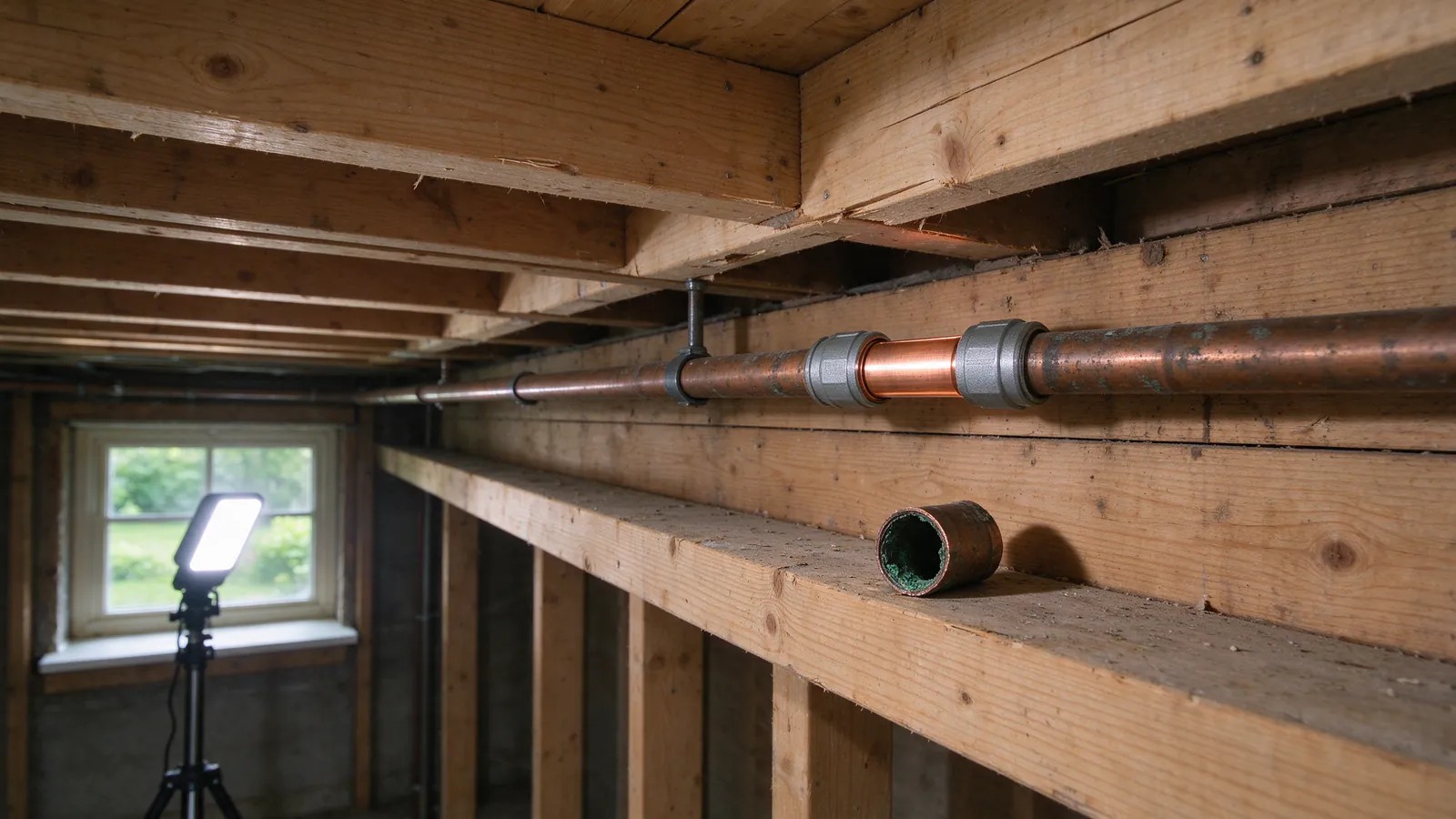
Pipe lining coats the inside of the existing pipe with epoxy; repiping replaces the pipe. Lining avoids most wall openings, but it keeps the old pipe, the old valves and the old layout, and it only works where the pipe wall is still sound. Repiping opens more of the house, then leaves new, tested and inspected pipe from the main shutoff to every fixture.
Circle City Repipe offers repiping and pipe repair across Indianapolis and nearby communities, carried out by licensed and insured contractors. It does not offer epoxy pipe lining. This guide compares the two honestly so the choice is made on how each works, not on a sales pitch. The whole-house repiping page covers replacement.
How supply pipe lining works
For drinking water lines, the process lining companies describe follows the same pattern. The system is drained and dried with heated air. An abrasive is blown through the pipe to strip rust and scale back to the base metal. Then an epoxy coating is blown or drawn through to coat the inside wall, and it cures before the water goes back on. Access is needed at the ends of each run, usually at fixtures and the main, rather than along the route.
The pitch is fewer openings and less disruption. In a building where reaching the pipe means breaking concrete, opening finished tile or working floor by floor in a tall structure, that can be a real advantage.
What lining leaves unchanged
Lining treats the inside of the pipe and nothing else. After lining, the house still has:
- The same pipe. Galvanized stays galvanized, copper stays copper, with the same age and the same joints.
- The same valves. An old gate-type main shutoff or a seized fixture stop is still there unless it is replaced separately.
- The same layout. Long runs, undersized branches and a far water heater stay as they were, and so does the hot-water wait.
- The same sizes, slightly smaller. Stripping scale opens up a narrowed pipe, but the coating takes a little of the bore back.
That matters most for galvanized. Its threads are the thinnest part of the pipe, and every joint is the same age. Blasting removes rust, and where rust was most of what remained of a wall, it can expose or open a hole. Lining cannot restore a wall that is already gone. The guide to whether galvanized pipes are safe explains how it ages.
Lining and repiping compared
| Question | Epoxy lining | Repiping |
|---|---|---|
| What happens to the pipe | Cleaned and coated inside; stays in place | Replaced with new PEX or copper |
| Openings | Mostly at the ends of runs | Planned openings behind fixtures, at risers and across ceilings |
| Depends on pipe condition | Yes; the wall must be sound enough to blast and coat | No; the old pipe comes out or is capped |
| Valves and layout | Unchanged unless replaced separately | New main shutoff where needed, new stops, layout can change |
| Verification | Coating coverage inside a concealed pipe is hard to see | New pipe is pressure tested and, inside Indianapolis, inspected at rough-in before it is covered |
| Permit | Treatment by the permit office confirmed per address | Inside Indianapolis, a DBNS plumbing permit |
| Future repairs | Cut out and replaced; joints made on old pipe | Repairs on new pipe |
| Drinking water standards | Coating should be listed to NSF/ANSI 61 | Pipe, fittings and valves listed to NSF/ANSI 61 and 372 |
Inside Indianapolis, the City’s Building Standards require plumbing to be inspected at rough-in, after installation and before it is covered. New pipe meets that rule in the normal course of the job. How a lining job is permitted and inspected is a question for the office that covers the address, and the Indianapolis repiping permit guide explains how permits work here.
Weighing lining against a repipe?
A first visit checks the pipe material, its condition and the routes, and gives a written scope for replacement.
Where each one fits
Lining is pitched hardest where access is worst: under slabs, behind extensive tile and in large buildings where opening walls means disturbing many households at once. For a supply line under a slab, rerouting it overhead is the usual alternative to both breaking the floor and lining; the slab leak repair page explains that option.
A house over a basement or crawlspace is the opposite case. There, the main and most branches are already reachable, and new pipe can rise into the fixtures from below with few openings. In that case lining’s main advantage shrinks, while its limits stay. The guide to how invasive repiping is covers what a repipe opens. For a single failing section, a straightforward pipe repair is usually simpler than either.
Keep supply lining and sewer lining apart
The word “lining” covers two unrelated things. Sewer and drain lining, often called cured-in-place pipe, puts a resin-soaked liner inside a gravity drain or sewer line. Supply lining coats small pressurized drinking water lines. A good result in one says nothing about the other. Cast iron drains inside the house are their own job, covered on the cast iron stack replacement page.
Questions to ask about any lining proposal
- What is the pipe, and how was its wall condition checked before the proposal?
- What happens if blasting opens a hole inside a wall?
- What is the coating product, and what is it listed to for drinking water?
- Which valves and fittings are replaced, and which stay?
- How will the coating be verified in runs that cannot be seen?
- How does the permit office for this address treat the work?
Ask the same of a repipe: what is replaced, where the walls open, what material goes in and who closes each opening. The repipe vs repair guide and the PEX vs copper guide cover the other choices. For a written replacement scope on a specific house, call Circle City Repipe.