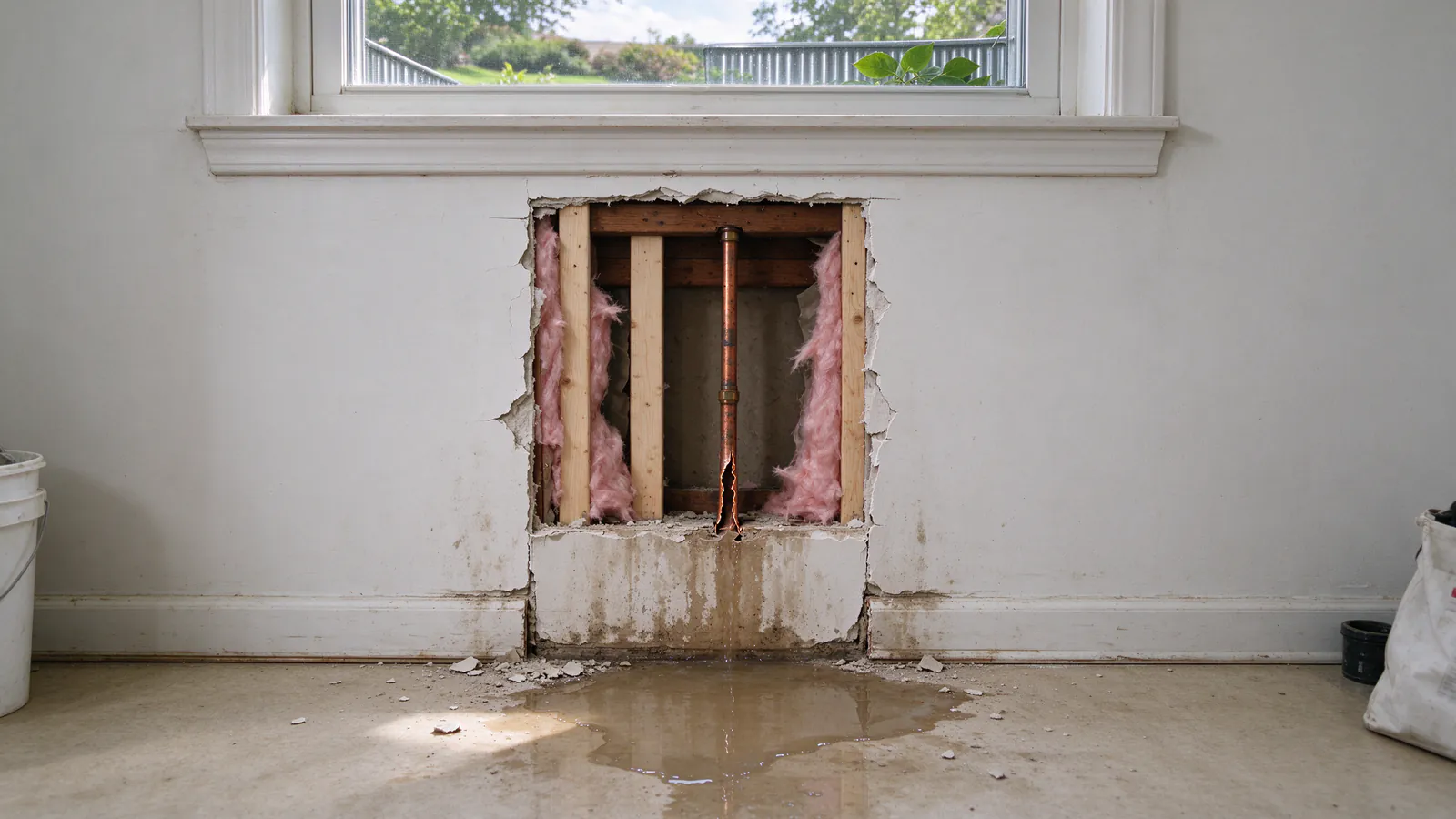
Freezing pipes in an Indianapolis winter are a seasonal risk rather than a daily one, but the season is long enough that most houses meet it every year. The pipes that freeze are rarely random: they sit in exterior walls, crawlspaces, attics, garages and hose bibbs, wherever cold air reaches water that is not moving.
Circle City Repipe repairs burst and frozen pipes and replaces supply piping across Indianapolis and nearby communities, with the work carried out by licensed and insured contractors. This post covers how cold it gets, where pipes freeze, why they split where they do and what a repipe can and cannot change about it.
How cold an Indianapolis winter gets
The NOAA U.S. Climate Normals for Indianapolis International Airport, the 1991 to 2020 averages, describe the season plainly. On average the low reaches 32°F or colder on about 105 days a year, and about 29 days a year never get above freezing at all. January averages 28.5°F, with an average low of 20.9°F. The temperature drops to 0°F or below on about three days in a typical year.
The median first fall freeze arrives around October 26 and the median last spring freeze around April 15. So the window for freeze trouble runs about half the year, and the worst of it comes in the stretches of several days below freezing, when walls and crawlspaces lose the heat they stored.
A single cold night seldom freezes a protected pipe. A run of days that never thaws, with wind against one side of the house, is what finds the weak spots.
Which pipes freeze first
Water in a pipe freezes when the pipe’s surroundings stay below 32°F long enough to pull the heat out of it. In practice that means pipe outside the heated part of the house, or pipe inside it that cold air can reach:
- Exterior walls. Supply lines to kitchen sinks and bathrooms on outside walls, especially in older houses with little or no insulation in the wall cavity.
- Crawlspaces. Vented or poorly sealed crawlspaces under additions and porches can sit near outdoor temperature on the coldest nights.
- Attics. Lines run overhead in an attic, sometimes added during a remodel or an earlier repipe, are in the coldest air in the house.
- Garages and unheated porches. Laundry lines and hose bibb runs often pass through them.
- Hose bibbs. An outdoor faucet that is not frost-free, or a frost-free one with a hose left connected, holds water at the exterior wall.
- The meter setting. Citizens Energy Group requires an inside meter to be protected from freezing, and a meter near a basement window or in a cold corner is exposed.
Pipe that carries water every day is less likely to freeze than a line to a guest bath or an outdoor faucet that sits still for weeks.
Why pipes split where they do
Water expands as it freezes, but in a supply pipe the ice is usually not what splits the wall of the pipe. An ice plug forms at the coldest point and seals the pipe like a valve. Between that plug and a closed faucet, water is trapped. As more ice forms, it squeezes that trapped water, and the pressure climbs until something gives.
The break is often some distance from the coldest spot, at a soldered joint, a threaded fitting or a thin, corroded stretch of old galvanized steel. That is why a split can appear in a heated room downstream of a frozen exterior wall. It is also why the leak often starts only when the line thaws: while the plug holds, little water escapes, and the flood begins once the ice melts and full pressure returns.
Pipe material changes how a freeze plays out, though it does not remove the risk. PEX tubing can stretch somewhat as water freezes inside it and often survives a freeze that would split copper, but its fittings can still fail. Copper and galvanized steel are rigid and split. The PEX vs copper guide covers the material choice in more depth.
A pipe that freezes every winter?
Have the run traced so the fix moves the pipe out of the cold, not just patches the split.
Before the cold arrives
Most freeze protection is about keeping heat on the pipe or keeping water out of it:
- Find the main shutoff and make sure it turns. A seized or gate-type main valve is worth replacing before winter; the main water shut-off valve replacement page explains why.
- Disconnect hoses from outdoor faucets. Where a hose bibb has an inside shutoff, close it and open the outside faucet to drain the line.
- Insulate exposed pipe in crawlspaces, garages and along rim joists. Insulation slows heat loss; it does not add heat, so it buys time rather than immunity.
- Seal air leaks near pipes, such as gaps around a basement window or a sill plate, where cold air blows directly onto a line.
- On the coldest nights, open the cabinet doors under sinks on exterior walls so room heat reaches the pipe, and keep the thermostat steady rather than setting it far back.
If a faucet produces only a trickle on a bitter morning, a line may be frozen. Leave that faucet open so meltwater and pressure have somewhere to go, and warm the area gently. Never use an open flame on a pipe or inside a wall.
When a pipe has already split
Close the main shutoff first. Then open a faucet on the lowest floor to drain the pressure off the system; water left in the pipes will keep running out of a break for a while even after the main is closed. Keep water away from electrical outlets and equipment, and photograph the damage before cleanup if an insurance claim is possible. The what to do when a pipe bursts guide walks through the first hour in order.
Circle City Repipe offers emergency response for burst pipes and active leaks, and after-hours calls cost more. The burst pipe repair page explains what the repair covers, and the cost guide lists the typical range for the pipe itself. Water damage cleanup is a separate job from the pipe repair. How a policy treats freeze damage depends on its wording, which the homeowners insurance and repiping guide covers.
What a repipe changes about freeze risk
A repipe is the one time most of a house’s supply pipe can be moved. Lines that ran in an exterior wall or a vented crawlspace can be rerouted through interior walls, heated basements or chases, which removes the exposure instead of insulating around it. That routing choice matters more than the pipe material.
New pipe on its own does not make a house freeze-proof. A new line run in the same cold attic will freeze in the same cold snap. When a whole-house repipe or a partial repipe is on the table for a house that has frozen before, ask where each line will run and which, if any, remain in unheated space. The whole-house repipe walkthrough shows where that decision fits in a typical job.